India targets 2% of GDP for R&D; ₹1 lakh crore RDIF open to private sector

Synopsis
India's private sector R&D spend sits at a thin 0.65% of GDP — and the government wants to nearly triple the national total to 2%. The ₹1 lakh crore RDIF, offering collateral-free, decade-long funding covering half of project costs, is the most direct lever yet to make Indian firms creators — not just consumers — of frontier technology.
Key Takeaways
The Centre targets raising India's total R&D spending from 0.65% of GDP to approximately 2% of GDP .
The ₹1 lakh crore RDIF can fund up to 50% of eligible R&D project costs, with no collateral required and tenures of 10–15 years .
Priority sectors include quantum computing , AI , biotechnology , green hydrogen , space , and clean energy .
TDB Secretary Rajesh Kumar Pathak said the fund is designed for cutting-edge, not routine, R&D — and can also fund technology acquisition from abroad.
FICCI Vice President Puneet Dalmia called the RDIF a signal that 'India is ready to become a creator of technology.'
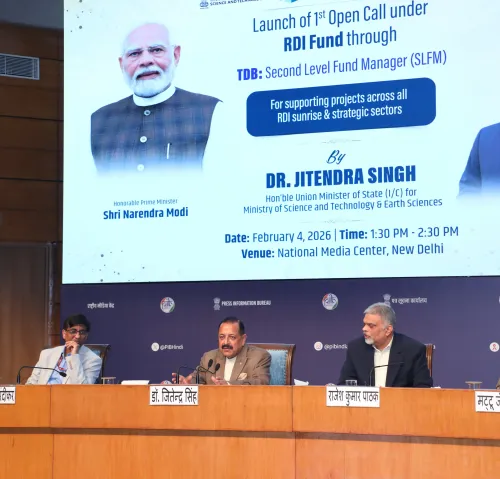
Technology Development Board (TDB) Secretary Rajesh Kumar Pathak on Tuesday, 7 July said the central government is targeting a near-tripling of research and development spending — from the current 0.65 per cent of GDP to approximately 2 per cent of GDP — and urged private firms to actively tap the ₹1 lakh crore Research, Development and Innovation Fund (RDIF), which can underwrite up to 50 per cent of eligible project costs. Pathak made the remarks while addressing an industry outreach programme organised by the Federation of Indian Chambers of Commerce and Industry (FICCI) in New Delhi.
What the RDIF Offers Private Industry
Under the RDIF framework, private companies can receive funding covering half their total R&D expenditure, with no collateral requirement. Loans are structured over a tenure of 10 to 15 years, specifically designed to absorb the front-loaded risk that typically deters corporate investment in early-stage innovation. Crucially, the facility can also be used to acquire technology from abroad, broadening its utility for firms looking to license or co-develop cutting-edge capabilities.
Pathak noted that the ₹1 lakh crore corpus is intended as a revolving base. 'The government has allocated ₹1 lakh crore fund, but it can become much more by reinvesting the fund in research and development,' he said, signalling that returns from funded projects would be recycled back into the pool.
Priority Sectors and Deep Technology Focus
The RDIF is not designed for incremental or routine R&D. Officials have drawn a clear line, restricting support to critical and frontier research across a defined set of sunrise sectors. These include energy security, clean energy transition, and climate action. On the deep technology side, the fund covers quantum computing, robotics, and space technologies. Artificial intelligence applications in agriculture, health, and education are also eligible, as are biotechnology, biomanufacturing, synthetic biology, pharmaceuticals, and medical devices. The digital economy — including digital agriculture — rounds out the priority list.
Industry's Reading of the Signal
Puneet Dalmia, Vice President of FICCI, Chair of its R&D and Innovation Committee, and Managing Director and Chief Executive Officer of Dalmia Bharat Group, welcomed the initiative as a strategic inflection point. 'RDIF is a clear signal that India is no longer just a consumer of technology, but it is ready to become a creator of technology,' Dalmia said. He added that sectors such as AI, semiconductors, quantum technologies, biotechnology, green hydrogen, defence, and deep tech 'are not just sectors of the future — they are the foundation of India's future competitiveness.'
Why the Gap Between Public and Private R&D Matters
India's overall R&D spending as a share of GDP has long lagged peer economies. China allocates roughly 2.4 per cent of GDP to R&D, while South Korea exceeds 4 per cent, according to global benchmarks. India's private sector contribution remains particularly thin — the bulk of domestic R&D has historically been driven by public institutions and defence labs. The RDIF is the government's most direct attempt yet to shift that balance, making private firms the primary engine of innovation investment. This comes amid a broader push to position India as a technology-producing nation ahead of the next decade of global supply-chain restructuring.
What Comes Next
The TDB, which administers the RDIF, is expected to roll out sector-specific application windows and evaluation criteria in the coming months. Industry bodies including FICCI have been engaged as outreach partners to ensure smaller firms and startups — not just large conglomerates — can navigate the fund's access mechanisms. Whether uptake matches ambition will depend on how quickly bureaucratic processes are streamlined for genuinely high-risk, long-horizon projects.
Point of View
Long-tenure design is better calibrated for genuine innovation risk than past schemes, but the critical variable is execution: who evaluates projects, how fast capital is deployed, and whether mid-sized firms can access it without navigating a bureaucratic maze built for large conglomerates. The 2% GDP target is also a long-run aspiration, not a committed timeline — and without a binding roadmap, it risks becoming another aspirational number that trails China and South Korea for another decade.
NationPress
6 Oct 2026
Frequently Asked Questions
What is India's Research, Development and Innovation Fund (RDIF)?
The RDIF is a ₹1 lakh crore government-backed fund designed to co-finance private sector R&D, covering up to 50% of project costs without requiring collateral. Loans run for 10 to 15 years and target frontier sectors such as AI, quantum computing, biotechnology, and clean energy.
What is India's current R&D spending as a percentage of GDP?
India's private sector R&D spending stands at around 0.65% of GDP, which is significantly below peer economies. The government's stated goal is to raise overall national R&D expenditure to approximately 2% of GDP.
Which sectors are eligible for RDIF funding?
The RDIF focuses on sunrise and deep technology sectors including quantum computing, robotics, space, AI applications in agriculture and health, biotechnology, biomanufacturing, synthetic biology, pharmaceuticals, medical devices, green energy transition, and digital agriculture. Routine or incremental R&D is not eligible.
Can private firms use the RDIF to acquire technology from abroad?
Yes. According to TDB Secretary Rajesh Kumar Pathak, the RDIF can be used to acquire technology from foreign sources, making it useful for firms seeking to license or co-develop capabilities internationally.
Who administers the RDIF and how can companies apply?
The Technology Development Board (TDB), under the Ministry of Science and Technology, administers the RDIF. Sector-specific application windows and evaluation criteria are expected to be announced in the coming months, with FICCI involved as an industry outreach partner.