Indian researchers develop metal-free catalyst to rival platinum in clean-energy cells
Synopsis
Indian researchers have built a metal-free material called TTT-DHTD that matches 96% of platinum's catalytic performance in zinc-air batteries and holds up for over 120 hours without degradation. If it scales, this could be one of the most consequential cost-reduction breakthroughs in clean-energy storage in years — built entirely from carbon, sulfur, nitrogen, and hydrogen.
Key Takeaways
Indian researchers developed TTT-DHTD , a metal-free porous catalyst made from carbon, sulfur, nitrogen , and hydrogen .
Laboratory tests showed TTT-DHTD achieved about 96% of commercial platinum catalyst performance in oxygen reduction reactions.
The material remained stable through 120 hours of continuous operation without degradation.
Zinc-air batteries using this catalyst could make clean transportation and renewable energy storage significantly more affordable.
The breakthrough was confirmed by the Ministry of Science & Technology on 7 October 2026 .
A team of Indian researchers has developed a metal-free porous material capable of performing nearly as well as platinum as a catalyst in zinc-air batteries, a breakthrough that could dramatically lower costs for next-generation clean-energy technologies, according to the Ministry of Science & Technology on 7 October 2026.
What the New Material Is
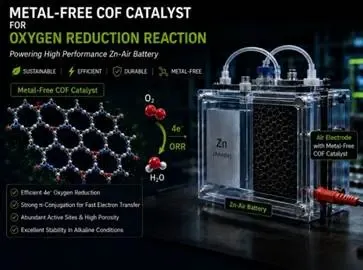
The material, designated TTT-DHTD, is constructed from earth-abundant elements — carbon, sulfur, nitrogen, and hydrogen — arranged into an ultra-porous, honeycomb-like molecular network. This architecture creates highly active sites where oxygen molecules can readily attach and react, enabling efficient conversion of oxygen into electricity, a process central to the oxygen reduction reaction (ORR).
Crucially, the material contains no precious or rare metals, setting it apart from conventional ORR catalysts that depend heavily on platinum — one of the world's rarest and most expensive elements.
How It Performs Against Platinum
According to the ministry's official statement, laboratory tests showed that TTT-DHTD achieved approximately 96 per cent of the electrochemical performance of commercial platinum catalysts. Even more notably, the material demonstrated exceptional durability: after 120 hours of continuous operation, it maintained its performance without the degradation or contamination that typically afflicts conventional metal-based catalysts.
'While platinum provides excellent catalytic performance, its high cost, scarcity and limited availability remain major barriers to large-scale deployment,' the ministry stated, underscoring the urgency of developing platinum-free alternatives.
Why Zinc-Air Batteries Matter
Zinc-air batteries offer a simpler and more compact energy storage solution compared with hydrogen fuel cells, which require high-pressure hydrogen storage and extensive distribution infrastructure. Yet both technologies depend critically on efficient oxygen electrochemistry at their core. The ability to substitute platinum in this reaction has long been considered a pivotal challenge in scaling affordable clean energy.
This comes amid a global push to reduce dependence on critical minerals — including platinum-group metals — whose supply chains are geographically concentrated and vulnerable to geopolitical disruption.
Significance for Clean-Energy Costs
Replacing platinum with low-cost organic materials could make clean transportation, portable power systems, and renewable energy storage far more affordable and accessible, particularly for cost-sensitive markets such as India. The ministry noted that researchers combined 'innovative molecular design with advanced computational studies' to demonstrate that earth-abundant materials can rival precious metals in one of clean energy's most demanding reactions.
Notably, this is among a growing wave of material-science breakthroughs from Indian academic laboratories, signalling a broader push to position the country at the frontier of energy technology research.
What Comes Next
The development remains at the laboratory stage, and independent peer-reviewed validation and scale-up studies will be necessary before commercial deployment. Industry bodies and energy researchers will likely watch closely for results from longer-duration stability tests and prototype integration into actual battery systems. If the performance holds at scale, TTT-DHTD could become a foundational technology for affordable clean-energy solutions across India and beyond.
Point of View
Expensive road. India has a pattern of announcing materials-science breakthroughs that stall at the prototype stage due to scale-up challenges and limited domestic manufacturing ecosystems. The real test will be whether the Ministry of Science & Technology channels follow-through funding into pilot production and independent peer review, or whether TTT-DHTD becomes another citation in a research paper rather than a component in an affordable clean-energy product. The global race to escape platinum dependency is real and urgent; India has the scientific talent to compete, but institutional continuity is what converts talent into technology.
NationPress
7 Oct 2026
Frequently Asked Questions
What is TTT-DHTD and why is it significant?
TTT-DHTD is a metal-free, ultra-porous material developed by Indian researchers that can replace platinum as a catalyst in zinc-air batteries. Its significance lies in achieving about 96% of platinum's catalytic performance using only earth-abundant elements — carbon, sulfur, nitrogen, and hydrogen — which could dramatically lower the cost of clean-energy technologies.
How does the new catalyst compare with platinum in performance?
Laboratory tests showed TTT-DHTD achieved approximately 96% of commercial platinum catalyst performance. It also demonstrated strong durability, maintaining stable performance after 120 hours of continuous operation without the degradation typical of metal-based catalysts.
What are zinc-air batteries and how are they used?
Zinc-air batteries are electrochemical cells that generate electricity by reacting zinc with oxygen from the air. Compared with hydrogen fuel cells, they offer a simpler, more compact energy storage option that does not require high-pressure hydrogen storage or extensive infrastructure, making them attractive for clean transportation and portable power systems.
Why is replacing platinum important for clean energy?
Platinum is one of the world's rarest and most expensive metals, making it a major cost barrier to large-scale deployment of fuel cells and metal-air batteries. A viable metal-free alternative could make clean transportation, renewable energy storage, and portable power significantly more affordable and accessible.
Is this catalyst ready for commercial use?
Not yet. The breakthrough is currently at the laboratory stage. Independent peer-reviewed validation, longer-duration stability testing, and scale-up studies are needed before TTT-DHTD can be integrated into commercial clean-energy products.