Chinese scientists develop alloy surviving 2,400°C extreme heat
Synopsis
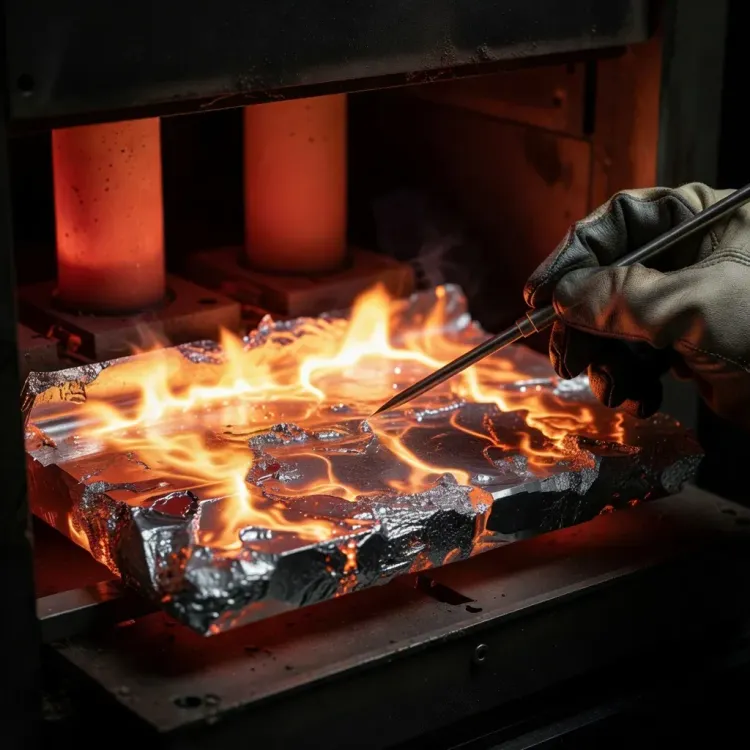
Chinese researchers at Xian Jiaotong University have published a Nature paper describing a tantalum-based alloy that holds structural strength at 2,400°C — 400 degrees beyond what jet-engine superalloys can survive — potentially reshaping hypersonic and nuclear materials engineering.
Key Takeaways
Professor Sun Jun and his team at Xian Jiaotong University developed the B-ODS tantalum alloy , published in Nature in June 2026 .
The alloy maintains load-bearing performance at up to 2,400 degrees Celsius , exceeding the 2,000-degree ceiling of nickel-based single-crystal superalloys used in aircraft engines.
The breakthrough uses oxide dispersion strengthening (ODS) with hafnium oxide and hafnium boride to reinforce a tantalum base, which melts at nearly 3,000 degrees Celsius .
Target applications include hypersonic vehicles , aerospace propulsion systems , and nuclear reactors .
The alloy outperforms existing niobium-tungsten alloys and prior T-alloy formulations in high-temperature load tests, according to the research paper.
Industrial-scale production timelines and oxidation-resistance data have not yet been disclosed by the research team.
A research team at Xian Jiaotong University in China has developed a tantalum-based alloy capable of maintaining exceptional load-bearing strength at temperatures up to 2,400 degrees Celsius, pushing past a longstanding barrier in high-temperature materials science. The breakthrough, led by Professor Sun Jun, was published last month in Nature and has drawn attention from the aerospace, hypersonic and nuclear energy sectors.
Why It Matters
Most metals begin to lose structural integrity once temperatures exceed roughly 60 per cent of their melting point — a threshold at which internal crystalline structures rapidly degrade. Nickel-based single-crystal superalloys, the current gold standard in commercial aeroplane engines, cannot reliably operate beyond 2,000 degrees Celsius (3,632 degrees Fahrenheit). Applications in hypersonic vehicles, aerospace propulsion, and nuclear reactors demand materials that can simultaneously endure extreme heat and heavy mechanical loads — a combination that has historically eluded materials engineers.
The Breakthrough: B-ODS Tantalum Alloy
The team's innovation centres on a B-ODS tantalum alloy — a formulation that uses oxide dispersion strengthening (ODS) techniques combined with hafnium oxide and hafnium boride reinforcements. Tantalum itself melts at nearly 3,000 degrees Celsius, making it one of the few refractory metals with a sufficiently high melting point to serve as a base for ultra-high-temperature alloys. According to the research paper, the resulting alloy outperforms existing niobium-tungsten alloys and previously reported T-alloy variants in sustained load-bearing tests above 2,000 degrees Celsius.
Competitive Backdrop
The race for ultra-high-temperature structural materials has intensified globally, with agencies including NASA investing heavily in refractory alloy research for next-generation propulsion systems. China's entry into this space with a peer-reviewed Nature publication signals a maturing domestic capability in advanced materials — a field closely tied to hypersonic missile development and space launch technology. The Xinhua News Agency highlighted the research as part of broader state-backed science initiatives.
What's Next
The research team has not yet disclosed a timeline for industrial-scale production or real-world component testing. Key questions remain around the alloy's performance under cyclic thermal stress, oxidation resistance in atmospheric re-entry conditions, and cost-effectiveness at scale — factors that will determine whether the B-ODS tantalum alloy transitions from laboratory achievement to deployable engineering material. Aerospace manufacturers and defence contractors in both China and rival nations will be watching the next phase of testing closely.
Point of View
Where thermal management is the primary engineering constraint. Mainstream coverage tends to frame this as a pure scientific achievement, but the involvement of state media amplification via Xinhua and the explicit mention of hypersonic applications suggests deliberate positioning within China's broader advanced-manufacturing and defence modernisation narrative. What mainstream analysis misses is the supply-chain dimension: tantalum is a conflict-sensitive critical mineral, and a shift toward tantalum-dominant high-temperature alloys could reshape procurement strategies for aerospace primes globally. The real test will be whether the alloy's oxidation resistance — unaddressed in current reporting — holds up in atmospheric conditions, which remains the graveyard of many promising refractory material candidates.
NationPress
24 Oct 2026
Frequently Asked Questions
What is the new Chinese high-temperature alloy made of?
The alloy is a B-ODS tantalum alloy — a tantalum-based material reinforced using oxide dispersion strengthening (ODS) techniques with hafnium oxide and hafnium boride . Tantalum was chosen as the base metal because it melts at nearly 3,000 degrees Celsius , giving the alloy an exceptionally high operating ceiling.
How hot can the new Chinese alloy withstand?
According to the Nature paper, the alloy maintains exceptional load-bearing performance at temperatures up to 2,400 degrees Celsius (4,352 degrees Fahrenheit) . This is significantly above the 2,000-degree threshold that defeats nickel-based superalloys currently used in commercial jet engines.
Who developed the ultra-high-temperature tantalum alloy?
The alloy was developed by a research team led by Professor Sun Jun at Xian Jiaotong University in China . Their findings were published last month in the peer-reviewed journal Nature .
What are the applications of this high-temperature alloy?
The primary target applications are hypersonic vehicles , aerospace propulsion systems , and nuclear reactors — environments where materials must simultaneously endure extreme heat and heavy structural loads. Current materials like nickel superalloys fail above 2,000 degrees Celsius , creating a critical engineering gap the new alloy aims to fill.
How does this compare to existing high-temperature alloys like NASA's materials?
The B-ODS tantalum alloy reportedly outperforms existing niobium-tungsten alloys and prior T-alloy formulations in sustained high-temperature load tests. NASA and other agencies have been actively researching refractory alloys for next-generation propulsion, making China's peer-reviewed breakthrough a notable development in what is an intensely competitive global field.