China's carbon-14 nuclear battery hits microwatt milestone, no foreign parts
Synopsis
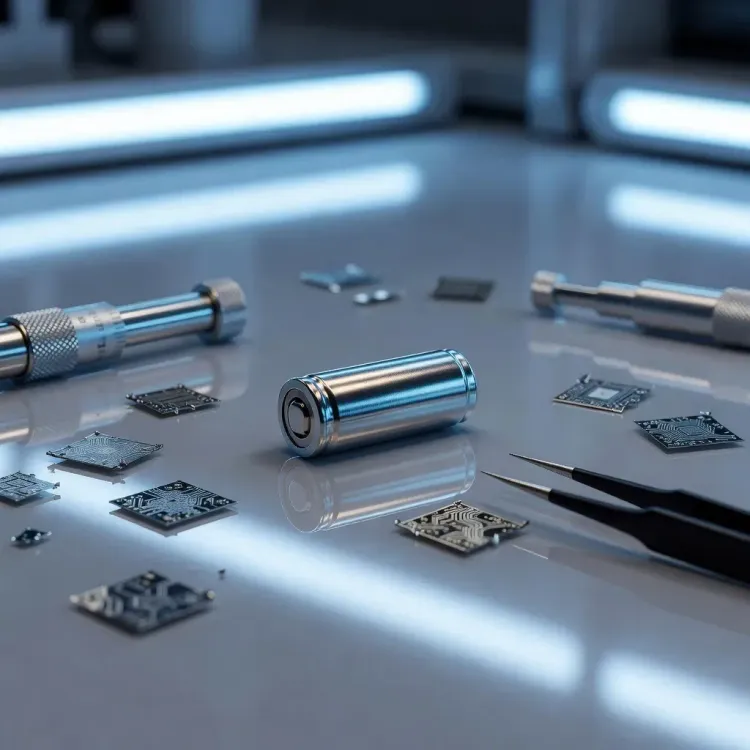
China's Northwest Normal University and Gansu Zhulong Technology have built a carbon-14 nuclear battery with a 15.5-fold jump in volumetric power density and zero foreign parts — a device theoretically capable of lasting thousands of years and operating from −100 °C to 200 °C.
Key Takeaways
The Qianjiyuan Tianshu carbon-14 nuclear battery was unveiled on 7 July 2026 by Northwest Normal University and Gansu Zhulong Technology .
Radioactive material use was cut to 22% of the previous design; maximum power rose 2.6 times and short-circuit current 2.5 times .
Effective device volume shrank to 17% of the predecessor, delivering a 15.5-fold increase in volumetric power density .
Carbon-14 's half-life of 5,730 years gives the battery a theoretical lifespan of thousands of years, according to project lead Su Maogen .
The battery operates between −100 °C and 200 °C , targeting medical implants, deep-sea, polar, aerospace, and defence use cases.
The entire device — including its silicon carbide (SiC) transducer — was developed without any foreign technology or components.
Northwest Normal University and Gansu Zhulong Technology have unveiled the Qianjiyuan Tianshu, a next-generation carbon-14 nuclear battery built entirely with domestic components, marking a significant advance in long-duration power technology. The announcement, made on Monday, 7 July 2026, positions China as a self-sufficient player in betavoltaic energy — a sector with deep implications for space, defence, and medical applications.
A dramatic leap from the predecessor
The Qianjiyuan Tianshu is a substantial upgrade over the team's earlier Candle Dragon-I (Zhulong-1) prototype, which debuted in November 2024. According to the research team, the new battery reduces radioactive material consumption to just 22 per cent of the original design while simultaneously boosting short-circuit current by 2.5 times and maximum power output by 2.6 times — all without sacrificing voltage or operational stability.
Perhaps most striking is the device's physical footprint: its effective volume has been compressed to 17 per cent of the predecessor's, translating into a 15.5-fold increase in volumetric power density — a metric critical for applications where space and weight are tightly constrained.
Why it matters: thousands of years of theoretical life
Su Maogen, who leads the project team at Northwest Normal University, noted that carbon-14 carries a half-life of 5,730 years, giving the battery a theoretical operational lifespan measured in millennia. The device reportedly functions reliably across a temperature range of minus 100 degrees to 200 degrees Celsius (−148 to 392 Fahrenheit), according to a university statement.
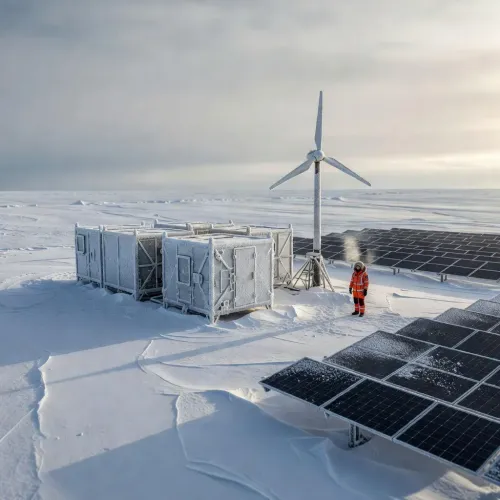
That thermal tolerance opens deployment windows in environments hostile to conventional batteries: deep-sea installations, polar research stations, medical implants, and aerospace payloads. China's official Science and Technology Daily quoted the team on Tuesday, framing nuclear batteries as 'vital for space exploration, polar missions, specialised equipment and unmanned operations, and a key part of China's new-energy strategy.'
Full domestic supply chain — a strategic signal
The team explicitly stated the battery and its silicon carbide (SiC) transducer were developed without any foreign technology or components. That claim carries weight at a time when export controls on advanced semiconductors and materials have intensified globally. Silicon carbide is a wide-bandgap semiconductor already at the centre of separate geopolitical supply-chain tensions in power electronics.
Earlier iterations of betavoltaic devices, the team acknowledged, were hampered by 'low power, poor integration and high costs.' The Qianjiyuan Tianshu directly addresses all three constraints, according to the university's statement.
What's next: from lab to deployment
No commercial timeline or production volume has been disclosed. The battery's target sectors — medical implants, aerospace, deep-sea, and defence — each carry distinct regulatory and certification hurdles that could extend the path from prototype to fielded product. Analysts will be watching whether Gansu Zhulong Technology moves toward volume manufacturing of the SiC transducer, which is the proprietary conversion layer at the heart of the device's efficiency gains. How quickly China can certify and integrate this technology into programmes such as lunar and deep-space missions will be a key indicator of its real-world strategic value.
Point of View
China is signalling self-sufficiency in a niche but strategically sensitive energy technology at a moment when SiC supply chains are already contested. Mainstream coverage tends to treat betavoltaic batteries as a curiosity, but their relevance to uncrewed deep-space probes, autonomous undersea vehicles, and long-duration implants makes them a quiet priority for any nation pursuing technological sovereignty. The 15.5-fold volumetric power density gain is the headline, but the harder question is whether Gansu Zhulong Technology can manufacture the SiC transducer at scale and cost — the gap where most lab breakthroughs stall. If China certifies this for a lunar or Mars mission within the decade, the geopolitical subtext of 'no foreign parts' will look considerably more significant in retrospect.
NationPress
6 Oct 2026
Frequently Asked Questions
What is the Qianjiyuan Tianshu nuclear battery?
The Qianjiyuan Tianshu is a carbon-14 betavoltaic nuclear battery developed by Northwest Normal University and Gansu Zhulong Technology, unveiled on 7 July 2026. It converts the beta radiation emitted by carbon-14 into electricity using a silicon carbide transducer, and was built entirely without foreign components.
How long can a carbon-14 nuclear battery last?
Carbon-14 has a half-life of 5,730 years, giving the Qianjiyuan Tianshu a theoretical operational lifespan of thousands of years, according to project lead Su Maogen. In practice, longevity will depend on encapsulation integrity and application conditions.
How does the new battery compare to its predecessor?
Compared with the Candle Dragon-I (Zhulong-1) prototype from November 2024, the new battery uses only 22% of the radioactive material, delivers 2.6 times the maximum power, and occupies just 17% of the volume — resulting in a 15.5-fold improvement in volumetric power density.
What are the main uses of nuclear batteries like this?
According to the research team, target applications include medical implants, deep-sea and polar installations, aerospace payloads, and defence systems — any environment where battery replacement is impractical and extreme temperatures are common. The device operates between −100 °C and 200 °C.
Why is China developing its own nuclear battery without foreign parts?
The team stated the goal was to make the device 'compact, powerful, affordable and fully domestically produced,' addressing earlier limitations of low power and high cost. The move also insulates the programme from export controls on advanced materials such as silicon carbide, which is subject to growing international supply-chain restrictions.