China's Xidian University beams 1,180W to moving targets in space solar test
Synopsis
China's Xidian University has beamed 1,180 watts of microwave power to moving targets simultaneously from a 75-metre tower — a ground-level milestone for space-based solar power that edges the technology closer to orbital deployment, even as its 20.8% efficiency trails NASA's 1975 benchmark.
Key Takeaways
Xidian University in Xi'an, China successfully transmitted 1,180 watts of microwave power to multiple moving targets simultaneously from a 75-metre tower .
The system was developed by senior engineer Duan Baoyan and achieved an overall wireless power transmission efficiency of 20.8 per cent .
A drone flying at 30 km/h received 143 watts from approximately 30 metres away during a mobility test, according to Xinhua .
NASA's Jet Propulsion Laboratory recorded 54 per cent efficiency in its 1975 microwave transmission experiment, but under static, controlled conditions — not while tracking moving targets.
The ground verification platform was first completed in 2022 ; the multi-target moving-receiver capability represents the latest phase of the programme.
The demonstration is a precursor to potential orbital deployment as part of China's broader space-based solar power ambitions.
Chinese researchers at Xidian University in Xi'an have successfully demonstrated a wireless power transmission system capable of beaming kilowatt-level energy to multiple moving targets simultaneously, marking a significant ground-based milestone in the global race to develop space-based solar power stations. The breakthrough was reported on 19 May 2026 and represents the latest advance in a programme that completed its full-chain ground verification platform in 2022.
What was demonstrated
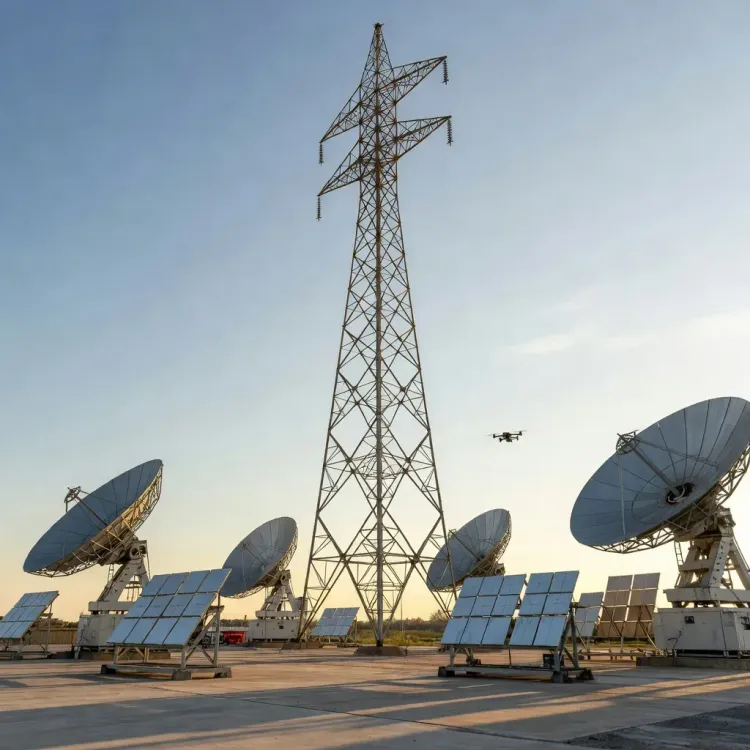
The system, developed under senior engineer Duan Baoyan, reportedly transmitted 1,180 watts across distances of approximately 100 metres while maintaining precise microwave beam control — a capability considered critical for eventually powering satellites, drones, or lunar infrastructure wirelessly. The test facility is built around a 75-metre (245-foot) tower at Xidian University, purpose-designed to validate the entire energy transmission chain on Earth before any orbital deployment.
In a separate mobility test, a drone flying at 30 km/h (18 mph) received 143 watts of microwave power from approximately 30 metres away, according to state news agency Xinhua. The ability to track and power a moving aerial vehicle is widely seen as a prerequisite for practical space-to-ground energy delivery.
Efficiency figures and context
The system achieved an overall wireless power transmission efficiency of 20.8 per cent, meaning roughly one-fifth of the original electrical energy was successfully delivered and converted back into usable power, Xinhua said. For comparison, a microwave power transmission experiment conducted by NASA's Jet Propulsion Laboratory in 1975 reported an overall efficiency of 54 per cent — though that test was performed under tightly controlled, static conditions rather than while tracking and powering moving targets.
The distinction is important: the Xidian University result is a lower absolute efficiency figure but addresses a more complex, operationally relevant challenge that the 1975 NASA experiment did not attempt.
Why it matters
Space-based solar power has long been considered a theoretically abundant but technically daunting clean energy source — orbital platforms could collect sunlight continuously, unaffected by weather or night cycles, then beam energy to Earth via microwave. Demonstrating multi-target, mobile-receiver capability on the ground is a necessary precursor to any orbital pilot mission. China has been among the most active nations pursuing this technology, alongside programmes in Japan, Europe, and the United States.
The competitive backdrop
The global push for space solar power has intensified as nations seek energy independence and long-duration power solutions for remote or extraterrestrial infrastructure. NASA, the European Space Agency, and private players have all outlined roadmaps, but ground-to-orbit demonstration remains years away for most programmes. China's structured, university-led verification approach — building and testing a dedicated tower facility before committing to orbital hardware — reflects a methodical engineering strategy.
What's next
The Xidian University team's next challenge will be improving transmission efficiency while scaling power levels toward the megawatt range required for commercially or strategically meaningful energy delivery. Progress on beam-steering accuracy, rectenna design, and thermal management will determine how quickly this ground demonstration can inform an orbital prototype. The trajectory of China's space solar programme will be closely watched by energy planners and space agencies worldwide.
Point of View
Harder problem by tracking and powering mobile receivers, which is the operationally critical capability for any real-world deployment. What mainstream coverage underweights is that this is infrastructure-building disguised as a physics experiment; a dedicated 75-metre tower purpose-built for end-to-end chain verification signals institutional commitment, not a one-off demonstration. Space solar sits at the intersection of the clean-energy transition and the new space race, and ground-based milestones like this one compress the timeline to orbital trials faster than most Western energy forecasters currently model. The programme's methodical pace also suggests China is optimising for engineering reliability over headline speed — a posture that has historically preceded rapid capability jumps.
NationPress
6 Oct 2026
Frequently Asked Questions
What did China's space solar power test achieve in May 2026?
Researchers at Xidian University in Xi'an transmitted 1,180 watts of microwave power to multiple moving targets simultaneously from a 75-metre tower , achieving an overall efficiency of 20.8 per cent . The test also powered a drone flying at 30 km/h , which received 143 watts from about 30 metres away.
How does China's wireless power efficiency compare to NASA's?
NASA's Jet Propulsion Laboratory achieved 54 per cent overall efficiency in its 1975 microwave transmission experiment, compared with 20.8 per cent in the Xidian University test. However, the NASA experiment was conducted under static, tightly controlled conditions, whereas the Chinese test tracked and powered multiple moving targets — a significantly more complex challenge.
What is space-based solar power and why does it matter?
Space-based solar power involves placing solar collectors in orbit to harvest sunlight continuously, then beaming the energy to Earth via microwave or laser. Because orbital platforms are unaffected by weather or the day-night cycle, they could theoretically provide a steady, large-scale clean energy supply — making the technology strategically significant for energy security.
Who led China's wireless power transmission research?
The system was developed by senior engineer Duan Baoyan and his team at Xidian University . The ground verification platform underpinning the latest tests was first completed in 2022 , with the multi-target mobile-receiver capability representing the programme's most recent milestone.
When could China deploy a space-based solar power satellite?
No official orbital deployment date has been announced. The current programme is focused on ground-based verification of the full transmission chain before committing to orbital hardware. Improving efficiency, scaling power to the megawatt range, and advancing beam-steering technology are the key remaining hurdles before a space pilot mission becomes feasible.