China scientists propose lunar laser grid to power moon south pole rovers
Synopsis
Chinese scientists have formally proposed beaming solar energy via laser from sunlit crater rims to rovers in the moon's permanently shadowed south pole craters — the first credible engineering framework for wireless lunar power, published in a peer-reviewed journal by researchers tied to China's national aerospace labs.
Key Takeaways
Harbin Institute of Technology researchers published a lunar laser power transmission proposal in the Journal of Deep Space Exploration .
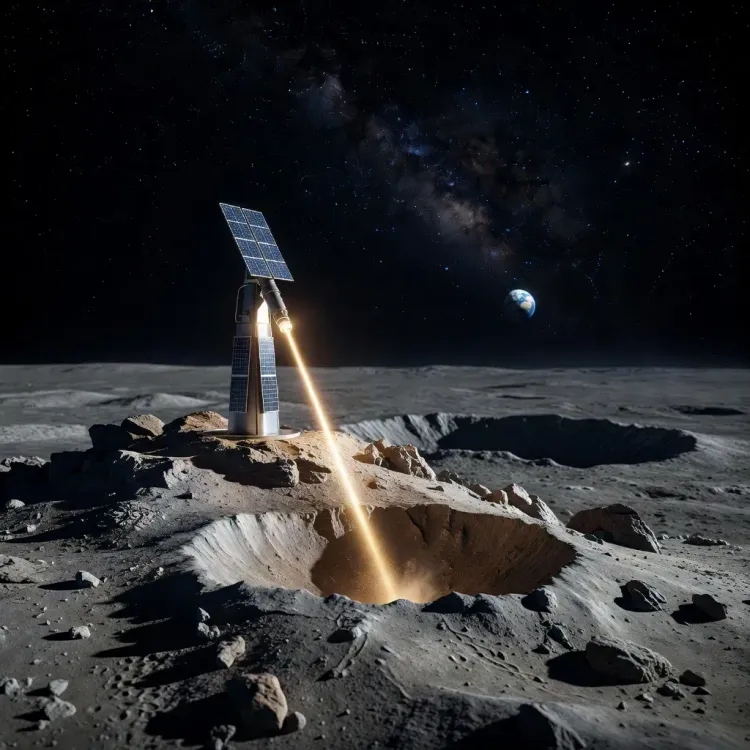
The system would place solar-powered laser stations on sunlit crater rims at the moon's south pole to beam power to rovers in permanently shadowed craters below.
Target zones are believed to contain water ice , making them a priority for both China's Chang'e missions and NASA's Artemis programme .
The research team is affiliated with the National Key Laboratory of Laser Spatial Information and the National Key Laboratory of Aerospace Mechanism , both central to China's aerospace strategy.
The proposal echoes Nikola Tesla 's wireless electricity transmission concept, which never achieved practical deployment on Earth.
NASA has set a crewed lunar south pole landing target of 2028 , intensifying the strategic significance of power-delivery solutions.
Harbin Institute of Technology researchers have proposed a solar-powered laser transmission network at the moon's south pole that could wirelessly beam electricity to rovers exploring permanently shadowed craters — reviving a concept first imagined by Nikola Tesla over a century ago, but now targeting an extraterrestrial environment where cables and batteries are impractical.
The core proposal
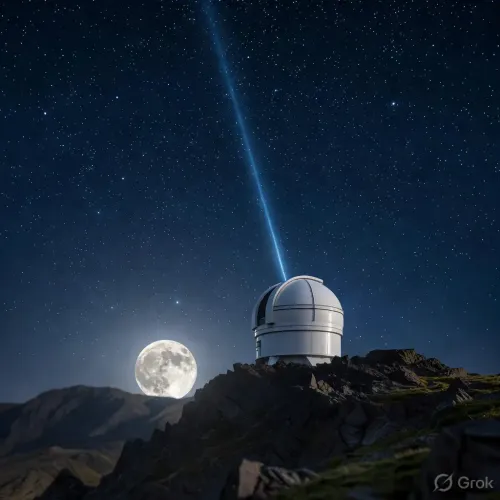
The team outlined an optimised deployment strategy for a lunar laser power transmission network in a peer-reviewed paper published in the Journal of Deep Space Exploration. The concept positions solar-powered stations on sunlit crater rims near the south pole, which receive near-continuous sunlight, and uses laser beams to deliver electricity to rovers operating in the permanently shadowed regions below. Those shadowed craters are scientifically significant: they are believed to contain water ice — frozen water trapped on or beneath the lunar surface — making them a priority target for future crewed and robotic missions.Why it matters
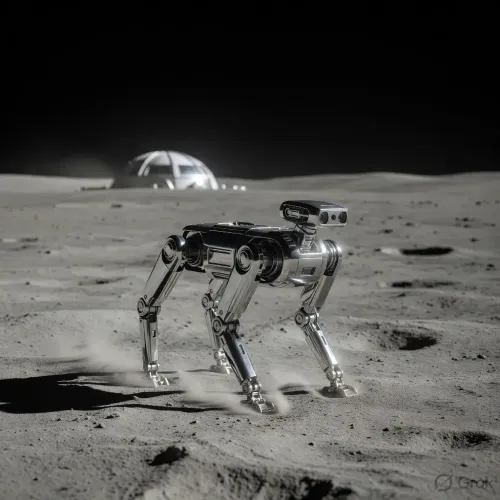
The lunar south pole is at the centre of an intensifying space race. NASA's Artemis programme has targeted the region, with a crewed landing deadline of 2028, while China's Chang'e missions are advancing on a parallel track. Power delivery to permanently shadowed regions is one of the most persistent engineering obstacles for both programmes — long cable runs across rugged terrain are impractical, and battery-only systems limit operational range and duration. A laser-based grid would sidestep both constraints, enabling rovers to operate deeper inside craters for longer periods without returning to a charging station.The Tesla connection
Tesla's late-19th and early-20th century experiments with wireless electricity transmission — most associated with his Wardenclyffe Tower project — never achieved practical terrestrial deployment. The Harbin Institute researchers argue the moon's vacuum environment and the specific geometry of south pole crater rims make it a more viable setting for the principle than anything attempted on Earth.Institutional backing
The scientists behind the study are affiliated with two strategically significant Chinese research bodies: the National Key Laboratory of Laser Spatial Information and the National Key Laboratory of Aerospace Mechanism. Both are described as critical to China's broader aerospace advancement agenda, signalling that this is not a purely academic exercise.What's next
The paper represents a planning and optimisation study rather than a hardware commitment, but its publication in a peer-reviewed journal marks a formal step toward engineering validation. Attention will now focus on whether the proposal feeds into upcoming Chang'e mission planning cycles and how NASA's own power-delivery strategies for Shackleton crater and surrounding terrain compare. The outcome of this competition could define which programme reaches the south pole's water ice deposits first.Point of View
Not just a science paper — its authors' dual affiliation with national-key aerospace laboratories places it squarely inside China's strategic lunar infrastructure planning. Mainstream coverage tends to frame the south pole race around rockets and landing dates, but the real chokepoint is energy: whichever programme solves persistent power delivery to shadowed craters first gains a decisive operational advantage over water ice extraction. The Tesla framing, while evocative, slightly obscures the point — this is less about a century-old dream and more about a very concrete 2020s engineering competition where China has now staked out a formal position. With NASA's Artemis timeline under pressure and China's Chang'e cadence accelerating, the Journal of Deep Space Exploration paper may be a quiet but consequential marker in the race for the south pole's most valuable resource.
NationPress
10 Oct 2026
Frequently Asked Questions
What is China's lunar laser power transmission proposal?
Researchers at Harbin Institute of Technology have proposed placing solar-powered laser stations on sunlit crater rims at the moon's south pole to wirelessly beam electricity to rovers exploring permanently shadowed craters below. The strategy was outlined in a peer-reviewed paper in the Journal of Deep Space Exploration and is designed to overcome the impracticality of cables and battery-only systems in rugged lunar terrain.
Why is the moon's south pole important for space exploration?
The lunar south pole's permanently shadowed craters are believed to contain water ice , which could be extracted for drinking water, oxygen, and rocket fuel — making it the most strategically valuable real estate on the moon. Both NASA's Artemis programme and China's Chang'e missions are targeting the region, with NASA aiming for a crewed landing by 2028 .
What does Nikola Tesla have to do with China's moon power plan?
Nikola Tesla famously attempted to develop wireless electricity transmission on Earth in the late 19th and early 20th centuries, a project that never achieved practical deployment. The Harbin Institute researchers argue that the moon's vacuum environment and the geometry of its south pole crater rims make laser-based wireless power transmission more feasible there than anything Tesla attempted on Earth.
Who are the researchers behind the lunar laser power study?
The study was conducted by scientists at the Harbin Institute of Technology who are also affiliated with the National Key Laboratory of Laser Spatial Information and the National Key Laboratory of Aerospace Mechanism — two research institutes described as strategically critical to China's aerospace advancement.
How does this affect the US-China moon race?
Solving power delivery to permanently shadowed craters is one of the central engineering challenges for any south pole mission, and a working laser grid would give its operator a significant advantage in accessing water ice deposits. With NASA 's Artemis crewed landing targeted for 2028 and China's lunar programme accelerating, the publication of a formal optimised deployment strategy marks a concrete step by China toward resolving this bottleneck ahead of its rivals.