NASA plans lunar drones and robotic rovers for Moon's South Pole by 2028
Synopsis
NASA isn't just planning a return to the Moon — it's designing a distributed lunar city spanning hundreds of square miles. With the MoonFall drone mission launching in 2028 to map permanently shadowed craters at centimetre-level precision, and a satellite communications network already under contract, the agency is laying the operational groundwork for a Mars-bound civilisation anchored at the South Pole.
Key Takeaways
NASA unveiled plans on 27 May to deploy autonomous drones, robotic rovers, and a communications network at the Moon's South Pole .
The MoonFall drone mission, developed by NASA's Jet Propulsion Laboratory and carried by Firefly Aerospace , is targeted for launch in 2028 .
Drones will map landing sites at centimetre-level precision and test 'survive-the-night' technologies in extreme lunar temperatures.
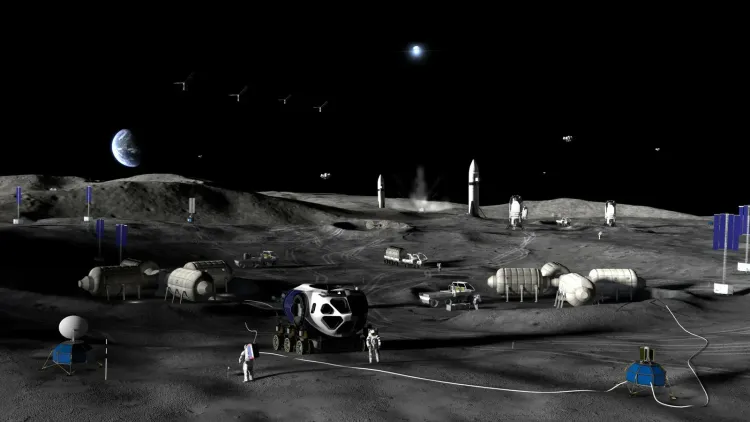
The Moon Base could span hundreds of square miles , structured more like a distributed city than a single outpost, according to officials.
Chief architect Nujoud Merancy said habitats would sit on sunlit ridges while nuclear systems remain kilometres away for radiation safety.
A satellite communications and navigation network is already under contract, with plans to expand to timing and observation capabilities.
NASA has unveiled an ambitious plan to deploy autonomous lunar drones, roaming robotic vehicles, and a wide-area communications network across the Moon's South Pole, marking a decisive shift from symbolic landings toward a sustained operational human presence on the lunar surface. The agency detailed the strategy at a Moon Base briefing at NASA Headquarters in Washington on 27 May, outlining infrastructure that officials say will eventually support astronauts, cargo systems, scientific missions, and future exploration of Mars.
MoonFall: The Drone Mission at the Centre of the Plan
The centrepiece of the new strategy is MoonFall, a drone mission designed to scout difficult lunar terrain, search for water ice, and prepare landing sites for future Artemis astronauts. NASA's Jet Propulsion Laboratory (JPL) is developing the MoonFall drones, while Firefly Aerospace has been selected to build the carrier spacecraft that will transport them from Earth orbit to the Moon. Launch is targeted for 2028.
The drones are engineered to make short 'hops' across the lunar surface, exploring permanently shadowed craters and other difficult terrain near the South Pole. According to agency officials, the vehicles will gather high-resolution imagery, map landing sites at centimetre-level precision, and test 'survive-the-night' technologies capable of enduring the Moon's extreme temperature swings.
Moon Base programme executive Carlos Garcia Golan described the operational value: 'These drones will allow us to go, cover a broader range of areas that we prospect and get that ground truth.' He added that the mission would deliver 'a range of like one meter dedicated information on the different areas we wanna go to,' underscoring the harsh and unpredictable environment around the South Pole.
A Distributed City, Not a Compact Outpost
NASA also revealed that future Moon Base infrastructure could resemble a distributed city rather than a compact outpost — potentially spanning hundreds of square miles. Agency officials explained that different components — habitats, power systems, mining sites, and scientific stations — would likely be spread across wide areas because no single location on the Moon offers all the conditions needed for habitation, energy generation, and exploration.
Chief architect Nujoud Merancy said habitats would probably sit on elevated ridges with sunlight access, while nuclear systems may need to remain kilometres away for radiation safety. 'It ends up sprawling a little bit more like a city as you start building it out,' she said.
Communications and Navigation Network
NASA confirmed plans to build a robust communications and navigation network around the Moon to support the expanding infrastructure. Garcia Golan said one contract is already in place for initial communications, with plans to expand that to include 'navigation, pointing, clock timing and observation capabilities.' Future lunar missions would involve constellations of satellites providing communications, navigation, and observation support for both robotic and human operations.
The Broader Vision: From Moon to Mars
This comes amid a broader transformation in NASA's strategic direction. NASA Administrator Jared Isaacman framed the effort as uniquely within the agency's capabilities: 'We are moving with the competence and the purpose to accomplish the missions that only NASA is capable of achieving.' The Moon Base architecture is explicitly designed as a stepping stone toward Mars, with the South Pole's water-ice deposits seen as a critical resource for fuel and life support on long-duration missions.
Point of View
Not a destination. The distributed-city model — habitats on ridges, reactors kilometres away, drones scouting shadowed craters — reflects hard-won lessons from the ISS era about the gap between a headline mission and a liveable system. The 2028 MoonFall launch date, however, sits against a backdrop of repeated Artemis schedule slippages; the credibility of this architecture will rest on whether the agency can hold that timeline. And with China accelerating its own lunar south-pole programme, the geopolitical stakes of who maps and controls access to water-ice deposits are no longer hypothetical.
NationPress
22 Oct 2026
Frequently Asked Questions
What is NASA's MoonFall drone mission?
MoonFall is a NASA drone mission designed to scout difficult terrain near the Moon's South Pole, search for water ice, and prepare landing sites for future Artemis astronauts. Developed by NASA's Jet Propulsion Laboratory and carried by a Firefly Aerospace spacecraft, it is targeted for launch in 2028.
Why is NASA focusing on the Moon's South Pole?
The Moon's South Pole contains permanently shadowed craters believed to hold water ice, which is critical for fuel production and life support on long-duration missions. NASA officials said no single location on the Moon offers all conditions for habitation, energy, and exploration, making the South Pole's resources strategically essential for both lunar and future Mars missions.
What will NASA's Moon Base look like?
According to NASA officials, the Moon Base could span hundreds of square miles and resemble a distributed city rather than a compact outpost. Habitats would sit on elevated ridges with sunlight access, while nuclear power systems would be located kilometres away for radiation safety.
Who is building the MoonFall carrier spacecraft?
Firefly Aerospace has been selected to build the carrier spacecraft that will transport the MoonFall drones from Earth orbit to the Moon. NASA's Jet Propulsion Laboratory is responsible for developing the drones themselves.
What communications infrastructure is NASA planning for the Moon?
NASA has confirmed at least one existing contract for initial lunar communications and plans to expand it to include navigation, pointing, clock timing, and observation capabilities. Future missions will involve satellite constellations supporting both robotic and human operations on the lunar surface.