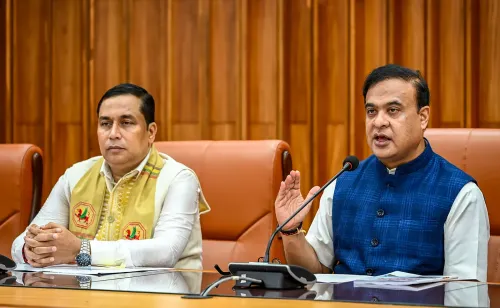
ISRO radar facility in Assam: CM Sarma lays foundation stone at Chandrapur

Synopsis
India's space tracking network just got a northeastern anchor. ISRO's IARRF at Chandrapur, Assam — laid down by CM Himanta Biswa Sarma on Monday — is the first major ISRO infrastructure project in the Northeast, with sophisticated radar and optical telescopes set to strengthen India's space situational awareness under the NETRA programme.
Key Takeaways
Assam CM Himanta Biswa Sarma performed the Bhumi Pujan for ISRO's IARRF at Chandrapur, Assam on 21 September 2026 .
The facility falls under ISRO's NETRA programme, focused on tracking and monitoring space objects to protect India's space assets.
It will feature advanced radar systems and optical telescopes for space situational awareness.
The Assam government has allocated nearly 200 bighas of land for the project at Chandrapur.
The IARRF is among the first major ISRO infrastructure projects in India's Northeast region.
Assam Chief Minister Himanta Biswa Sarma on Monday, 21 September 2026, performed the Bhumi Pujan and laid the foundation stone for the Indian Space Research Organisation's (ISRO) ISTRAC Advanced Radar Research Facility (IARRF) at Chandrapur, marking Assam's formal entry into India's space research infrastructure. The facility will be established under ISRO's Network for Space Object Tracking and Analysis (NETRA) programme, aimed at bolstering the country's space situational awareness.
What the Facility Will Do
The IARRF will house sophisticated radar systems and optical telescopes specifically designed to track objects in space and protect India's growing fleet of space assets. As part of the NETRA programme, it will contribute directly to India's ability to monitor orbital debris, foreign satellites, and other space objects that could pose collision risks.
This represents a significant upgrade in India's space domain awareness capabilities, placing the country alongside a small group of nations with dedicated space object tracking infrastructure.
Land Allocation and State Support
The Assam government has allocated nearly 200 bighas of land for the project at Chandrapur. The scale of the land grant signals a strong institutional commitment from the state government to embed itself in India's expanding space ecosystem, which has seen accelerating investment since the liberalisation of the sector in 2020.
What Chief Minister Sarma Said
Speaking to the media after the ceremony, Chief Minister Sarma expressed gratitude to Prime Minister Narendra Modi and the ISRO leadership for selecting Assam as the host state for the advanced facility. He described the project as 'an important milestone in Assam's transition towards new opportunities in science, technology and institutional development.'
Sarma also reflected on the state's broader transformation, noting that Assam had moved beyond a period historically associated with civil unrest and was now creating institutions and opportunities for its people. He said the Chandrapur facility symbolised Assam's entry into a new phase of space science and research.
Strategic Significance for India and the Northeast
The location of a strategic space tracking facility in Assam is geographically significant. The northeastern region offers distinct advantages for radar coverage given its position relative to key orbital paths. This comes amid India's broader push to develop space infrastructure outside its traditional southern hubs — a diversification that analysts say reduces risk and extends tracking range.
Notably, this is among the first major ISRO infrastructure projects to be anchored in the Northeast, potentially opening the door to further scientific investment in the region. The facility is expected to contribute to India's long-term goal of becoming a leading space power, with the government having set ambitious targets for the domestic space economy over the next decade.
What Comes Next
Construction timelines for the IARRF were not disclosed at the foundation stone-laying event. Once operational, the facility is expected to integrate with ISRO's existing tracking and ground station network, enhancing real-time space object monitoring across a wider geographic arc. The project also opens possibilities for academic and research collaboration between ISRO and institutions in Assam and the broader Northeast.
Point of View
The Northeast extends India's radar coverage arc in ways that southern stations cannot replicate — a practical advantage that also happens to carry political weight for a government keen to showcase development dividends in a historically restive region. What is missing from today's announcement is a timeline and an operational roadmap: ISRO's NETRA programme has been in the works for years, and the gap between foundation stones and functional infrastructure in Indian space projects has often been measured in decades rather than years. The real test of Assam's 'entry into the space research era' will be when the first tracking data comes out of Chandrapur.
NationPress
21 Sept 2026
Frequently Asked Questions
What is the ISRO IARRF facility being built in Assam?
The ISRO ISTRAC Advanced Radar Research Facility (IARRF) is a space object tracking centre being established at Chandrapur, Assam, under ISRO's NETRA (Network for Space Object Tracking and Analysis) programme. It will be equipped with radar systems and optical telescopes to monitor objects in orbit and protect India's space assets.
Why was Assam chosen for this ISRO facility?
The Assam government allocated nearly 200 bighas of land at Chandrapur for the project, and the northeastern location offers geographic advantages for radar coverage of certain orbital paths. Chief Minister Himanta Biswa Sarma credited Prime Minister Narendra Modi and ISRO leadership for selecting the state.
What is ISRO's NETRA programme?
NETRA stands for Network for Space Object Tracking and Analysis, an ISRO initiative to strengthen India's space situational awareness by detecting, tracking, and cataloguing objects in Earth's orbit, including debris, foreign satellites, and other potential threats to Indian space assets.
What is the significance of the IARRF for the Northeast?
The IARRF is among the first major ISRO infrastructure projects anchored in India's northeastern region. It signals a geographic diversification of India's space infrastructure beyond traditional southern hubs, and could open pathways for further scientific investment and academic collaboration in the Northeast.
When will the Chandrapur ISRO facility become operational?
No construction timeline or operational date was announced at the foundation stone-laying ceremony on 21 September 2026. Once complete, it is expected to integrate with ISRO's existing ground station and tracking network.