Nanjing University perovskite farm outperforms silicon in 1MW field test
Synopsis
A Nanjing University-led team has published the first industrial-scale proof that perovskite solar beats silicon in real-world output — outperforming by up to 5.81% in May — using a defect-sealing coating that solves the technology's longest-standing commercial barrier, according to a Nature paper.
Key Takeaways
Nanjing University , leading a China–Canada team, published perovskite solar results in Nature on 13 August 2026 .
A large-format perovskite panel achieved 22 per cent efficiency and 158.4 watts output — a record at this scale — while meeting commercial durability standards.
A 1-megawatt perovskite array was tested against a 3.5MW silicon system at the same solar farm over three months .
Perovskite outperformed silicon by 3.42% in March, 3.79% in April, and 5.81% in May, with the gap widening as temperatures rose.
The team developed a super-stable surface coating that patches microscopic defects in perovskite films, the key barrier to commercial deployment.
No commercial production timeline has been announced, but the field installation signals active scale-up engineering is underway.
A Nanjing University-led research team from China and Canada has demonstrated, at industrial scale, that perovskite solar technology can consistently outperform conventional silicon systems under real-world conditions — a milestone that clears the most significant commercial barrier the emerging sector has faced. The findings were published on Wednesday, 13 August 2026, in the journal Nature.
The breakthrough: defect-sealing at scale
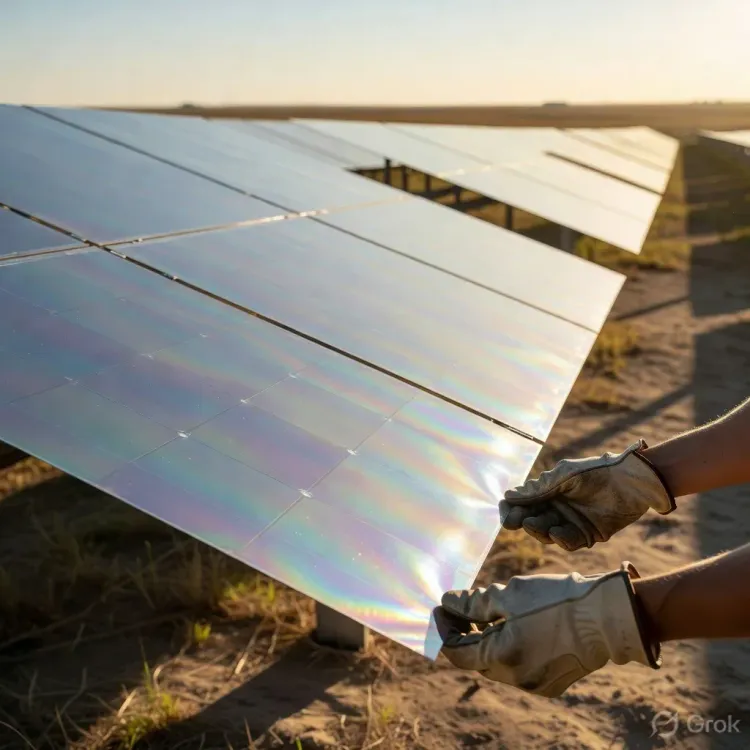
The team developed a super-stable surface coating capable of patching the microscopic defects in perovskite films that have historically caused energy losses. The coating was applied to a panel roughly the size of a dining table, enabling it to achieve 22 per cent efficiency with a peak power output of 158.4 watts. Critically, the panel also withstood the heat, humidity, and temperature extremes required for commercial certification — a record for perovskite technology at this scale, according to the paper.
Field test: 1MW perovskite vs 3.5MW silicon
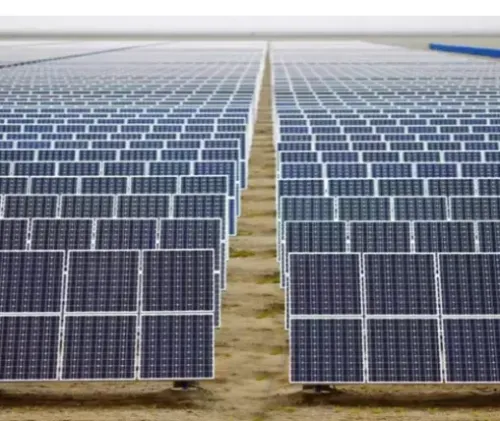
Moving beyond the laboratory, the researchers installed a 1-megawatt perovskite array directly alongside a 3.5-megawatt silicon facility at the same solar farm. Performance was monitored over three months. For the same installed capacity, the perovskite system generated more electricity in every month of the trial, according to the published findings.
The perovskite array outperformed silicon by 3.42 per cent in March, 3.79 per cent in April, and 5.81 per cent in May. The widening gap in May indicates that perovskite's advantage compounds as ambient temperatures rise and solar irradiance intensifies — conditions that typically degrade silicon performance more sharply.
Why it matters
Perovskite is an ultra-thin, lightweight material that can be printed onto large surfaces at a fraction of the cost of silicon wafer manufacturing. The central obstacle to commercialisation has been its instability at scale — specifically, the accumulation of surface defects that erode efficiency over time. The new coating reportedly resolves this at the module level, not just in controlled lab conditions.
The combination of printable fabrication, lower raw-material costs, and now a demonstrated field efficiency edge over silicon positions perovskite as a credible next-generation solar platform, industry analysts have noted.
The competitive backdrop
China already dominates global silicon solar panel manufacturing, controlling an estimated 80 per cent of the supply chain. A Chinese-led perovskite breakthrough compounds that structural advantage: domestic research institutions are now positioned to lead the transition to the next technology generation before incumbent Western and Asian silicon manufacturers can adapt. The Nature publication lends the findings significant international scientific credibility.
What's next
The research team has not announced a commercial partner or a timeline for mass production, but the 1MW field installation signals that scale-up engineering is already underway. The next benchmarks to watch are long-term degradation data beyond three months, and whether the coating process can be integrated into existing high-throughput manufacturing lines. How quickly silicon-dominant panel makers respond — and whether they license or replicate the coating technology — will shape the solar industry's competitive order through the end of the decade.
Point of View
Megawatt-scale field validation that perovskite's laboratory advantage survives real operating conditions — the precise gap that has kept investors cautious for a decade. What mainstream coverage underweights is the geopolitical dimension: China's research institutions are now positioned to lead the perovskite transition just as they led the silicon cost-down curve, potentially locking in a second consecutive generation of solar supply-chain dominance. The widening performance gap in warmer months also matters for tropical and equatorial markets — precisely where energy demand growth is fastest and where silicon's heat-induced degradation is most acute. Silicon panel manufacturers, particularly those in South Korea, the US, and Europe that have bet on silicon efficiency improvements as their moat, face a more compressed runway than their current capex cycles assume.
NationPress
1 Oct 2026
Frequently Asked Questions
What did the Nanjing University perovskite solar study find?
A Nanjing University -led team found that a 1-megawatt perovskite solar array consistently generated more electricity than a co-located 3.5MW silicon facility over three months, outperforming by up to 5.81 per cent in May. The findings were published in Nature on 13 August 2026 .
Why is perovskite solar better than silicon?
Perovskite is a lightweight, printable material that can be manufactured at lower cost than silicon wafers. In this study, the perovskite system's efficiency advantage over silicon grew as temperatures and sunlight intensity increased — conditions under which silicon performance typically declines more sharply.
What was the key technical breakthrough in this research?
The team developed a super-stable surface coating that seals the microscopic defects in perovskite films responsible for energy loss. This enabled a large-format panel to achieve 22 per cent efficiency at 158.4 watts while meeting commercial heat, humidity, and temperature durability standards — a record for perovskite at this scale.
When will perovskite solar panels be commercially available?
No commercial production timeline has been announced by the research team. However, the deployment of a 1MW field installation alongside an operating silicon farm indicates that scale-up engineering is already in progress, and the Nature publication is likely to accelerate industry and investor interest.
How does China's perovskite breakthrough affect the global solar industry?
China already controls an estimated 80 per cent of the silicon solar supply chain. A Chinese-led perovskite breakthrough could extend that dominance into the next technology generation, putting pressure on silicon-focused manufacturers in South Korea , the United States , and Europe to adapt or license the new technology.