Huawei and Nanjing University build world's first 2D parallel computing chip
Synopsis
Huawei and Nanjing University have built the world's first 2D molybdenum disulfide parallel processor — the Mengqi-1000 — achieving record integration density and potentially offering a path beyond silicon's physical limits, in a finding published in Nature Electronics.
Key Takeaways
Huawei Technologies and Nanjing University's School of Integrated Circuits jointly developed the Mengqi-1000 , the world's first molybdenum disulfide-based multi-bit parallel microprocessor.
The chip achieves record-breaking integration density , surpassing all prior 2D semiconductor processor prototypes.
The research was published in Nature Electronics on Tuesday, 27 May 2026 .
Molybdenum disulfide is atom-thin, allowing stable electron movement at scales where conventional silicon breaks down.
The processor is built on the RISC-V open-source instruction set architecture, ensuring compatibility with existing computing ecosystems.
Professor Shi Yi of Nanjing University stated the work charts a path toward commercial-scale production of 2D semiconductor chips in China .
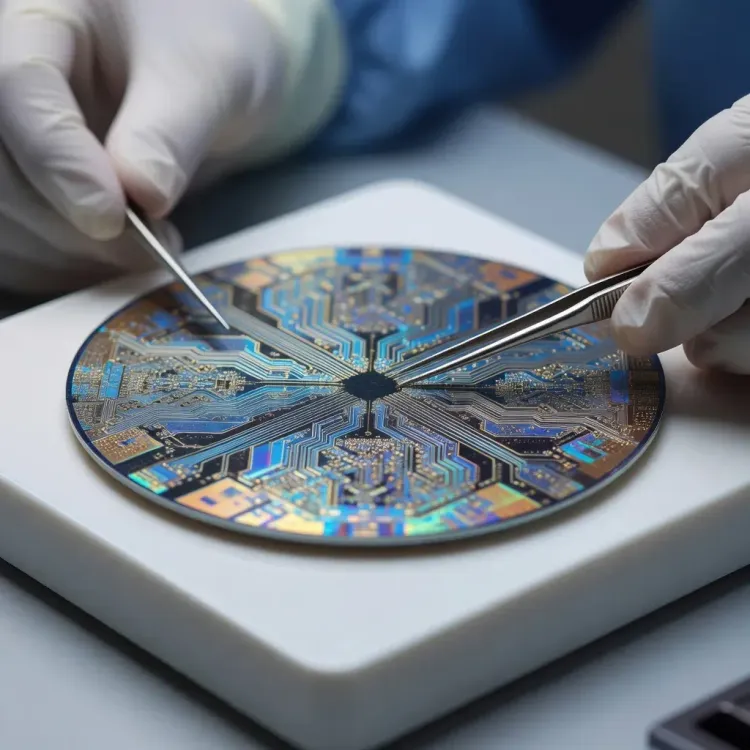
Huawei Technologies and researchers at Nanjing University's School of Integrated Circuits have developed the world's first parallel processor built on a two-dimensional (2D) semiconductor, a breakthrough published in Nature Electronics on Tuesday, 27 May 2026. The chip, named Mengqi-1000 (or Magic-1000 in English), achieves record-breaking integration density using molybdenum disulfide — an atom-thin material — as its base.
Why it matters
Moore's Law — the principle that computing power doubles roughly every two years while costs halve — is approaching a hard physical ceiling as conventional silicon transistors near their atomic size limits. Two-dimensional materials like molybdenum disulfide are naturally atom-thin, enabling electrons to move stably and efficiently at scales where silicon fails. This makes them among the most promising candidates to sustain the pace of semiconductor advancement beyond the silicon era.
The breakthrough: Mengqi-1000
The Mengqi-1000 is the first molybdenum disulfide-based multi-bit parallel microprocessor ever fabricated, according to the research team. Its record integration density — the number of transistors packed onto a single chip — marks a significant leap from prior 2D semiconductor prototypes, which had largely been limited to single-function or serial-processing demonstrations. The device's architecture draws on RISC-V, the open-source instruction set, signalling compatibility with mainstream computing frameworks.
China's industrial ambitions in 2D semiconductors
According to Nanjing University professor Shi Yi, the development demonstrates that China is not only a leader in fundamental 2D semiconductor research but is actively forging a route toward mass production through industry collaboration. The involvement of Huawei — which faces sustained restrictions on access to advanced chips from Western suppliers — underscores the strategic urgency behind the project. Researchers from Fudan University and Peking University are also cited among contributors to the broader field, reflecting a coordinated national push.
The competitive backdrop
The race to extend semiconductor scaling has drawn global interest, with research groups in the United States, Europe, and South Korea all pursuing 2D material transistors. However, the combination of a parallel, multi-bit processor architecture with molybdenum disulfide at this integration density is, according to the published research, a first. The work also references the Tau Scaling Law, an emerging framework proposed as a successor metric to Moore's Law for evaluating 2D material devices. Researcher Zhao Chunsong is among those associated with the project.
What's next
The immediate challenge is transitioning from laboratory demonstration to manufacturable processes at scale — a gap that has historically taken years to bridge in semiconductor development. Huawei's direct involvement suggests the company is positioning itself to accelerate that timeline, potentially reducing its dependence on foreign chip supply chains. Whether Mengqi-1000 can be reproduced at wafer scale with acceptable yield rates will be the defining test of its commercial viability.
Point of View
Investing in a post-silicon substrate is a rational hedge — not just an academic exercise. What mainstream coverage underplays is that molybdenum disulfide chips don't merely extend Moore's Law; they operate under a different scaling paradigm (the Tau Scaling Law), which could eventually render current benchmarking frameworks obsolete. The RISC-V architecture choice is deliberate: it insulates the platform from instruction-set licensing risk, compounding the self-sufficiency logic. The real question is yield — and whether China's semiconductor fabrication ecosystem can close that gap before Western rivals commercialise their own 2D material devices.
NationPress
14 Oct 2026
Frequently Asked Questions
What is the Mengqi-1000 chip and who built it?
The Mengqi-1000 (also called Magic-1000 ) is the world's first multi-bit parallel microprocessor built on a molybdenum disulfide two-dimensional semiconductor. It was developed jointly by Huawei Technologies and researchers at Nanjing University's School of Integrated Circuits , with findings published in Nature Electronics on 27 May 2026 .
Why does a 2D semiconductor chip matter for Moore's Law?
Conventional silicon transistors are approaching their physical size limits, causing Moore's Law — the doubling of computing power roughly every two years — to slow. Two-dimensional materials like molybdenum disulfide are atom-thin, enabling efficient electron movement at scales impossible for silicon, offering a credible path to sustaining semiconductor progress.
What is molybdenum disulfide and why is it used in chips?
Molybdenum disulfide is a naturally atom-thin 2D material that allows electrons to move stably and efficiently at extremely small scales. Its thinness makes it a strong candidate to replace silicon in next-generation transistors, as it does not suffer the same quantum-tunnelling leakage problems that afflict scaled-down silicon devices.
How does this chip relate to China's semiconductor self-sufficiency goals?
Huawei 's direct involvement in the Mengqi-1000 project reflects China's broader push to develop indigenous semiconductor technologies amid restrictions on access to advanced foreign chips. According to professor Shi Yi , the collaboration signals a deliberate effort to move 2D semiconductor research from the lab toward mass production within China .
What is RISC-V and why did the team use it for this chip?
RISC-V is an open-source processor instruction set architecture that is free from proprietary licensing restrictions. The Mengqi-1000 's use of RISC-V means it can integrate with mainstream computing software ecosystems without dependence on architectures controlled by US companies such as Arm or Intel .