White House Pushes Voter ID, Targets Democrat Opposition
Synopsis
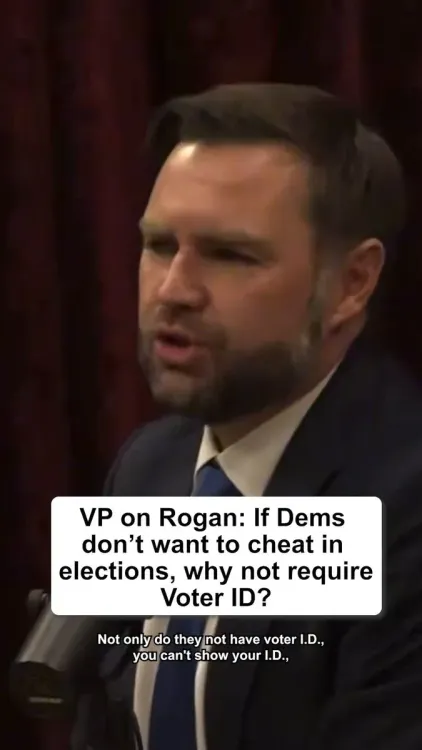
The White House on 15 July 2026 used its official X account to amplify a video of Vice President JD Vance and Joe Rogan arguing for mandatory voter ID, directly accusing Democrats of hypocrisy for opposing such requirements — escalating long-running partisan tensions over US election rules.
Key Takeaways
The White House official X account posted on 15 July 2026 demanding mandatory voter identification laws.
The post featured a video with Vice President JD Vance and podcast host Joe Rogan criticising Democratic opposition to voter ID.
The Help America Vote Act of 2002 set baseline federal election standards; stricter state ID laws proliferated after the 2013 Shelby County v.
Republicans argue voter ID prevents fraud; Democrats contend strict mandates suppress turnout among minority, elderly, and low-income voters.
Congressional debate over a national voter ID standard and state-level legal challenges to existing laws are ongoing ahead of future federal elections.
The White House, the official communications account of the Executive Office of the President of the United States, posted on X on Wednesday, 15 July 2026, amplifying a video featuring Vice President JD Vance and podcast host Joe Rogan to press the case for mandatory voter identification laws while directly accusing the Democratic Party of hypocrisy.
Context
The post, carrying the caption 'VOTER ID IS LOGICAL. If Democrats aren't cheating in elections, why do they refuse to require it?', frames the absence of a federal photo ID mandate as evidence of partisan bad faith. It tags @VP Vance and @JoeRogan, pointing followers to an attached video described as an 'expose' of Democratic hypocrisy on election rules. The language is unusually direct for an official White House account, blending institutional authority with campaign-style rhetoric.
Policy Backdrop
The voter ID debate has a long legislative history in the United States. The Help America Vote Act of 2002 established minimum federal standards for election administration and voter identification in the aftermath of the disputed 2000 presidential recount. After the 2013 Supreme Court ruling in Shelby County v. Holder curtailed federal oversight of state election laws, a wave of Republican-led states enacted or strengthened their own voter ID statutes.
Republican officials have consistently argued that photo identification requirements are a common-sense safeguard against fraud, citing widespread public support in polling. Democratic leaders and civil liberties groups have countered that strict ID mandates disproportionately burden low-income voters, racial minorities, the elderly, and young voters who are less likely to hold qualifying documents, thereby suppressing turnout rather than preventing fraud.
Stakeholders and Impact
Vice President JD Vance, who previously served as a U.S. Senator from Ohio, has been a vocal proponent of election-integrity measures since his entry into national politics. Joe Rogan, whose podcast commands one of the largest audiences in American media, has hosted a range of political figures and has previously interviewed Republican leaders on voting and election security issues. The White House's decision to amplify a Rogan appearance signals a continued effort to reach audiences outside traditional media channels.
For ordinary voters and election administrators, the stakes are practical: any federal voter ID legislation would reshape registration and polling-place procedures across all 50 states, affecting tens of millions of voters. Advocacy groups on both sides are closely monitoring Congressional activity and state-level court challenges to existing ID laws.
What's Next
Congressional debate over a potential national voter ID standard remains active, with Republican legislators having introduced multiple proposals in recent sessions. State legislatures continue to pass or contest identification requirements ahead of future federal election cycles. The White House's use of its official platform to promote partisan election-integrity messaging is likely to intensify scrutiny of any forthcoming legislative push, and Democratic leadership is expected to respond with renewed arguments about voting access and civil rights protections.
Point of View
The administration is deliberately targeting non-traditional media audiences in a bid to build public pressure for federal voter ID legislation. This fits a broader Republican pattern of using election-integrity arguments as both policy and mobilisation tools, a strategy that has proved durable since the 2020 cycle. Democrats will likely use the post itself as evidence that voter ID advocacy is a political project rather than a neutral administrative reform.
NationPress
16 Jul 2026
Frequently Asked Questions
What did the White House post about voter ID?
The White House posted on X on 15 July 2026 stating 'VOTER ID IS LOGICAL' and shared a video of Vice President JD Vance and Joe Rogan accusing Democrats of hypocrisy for opposing mandatory voter identification requirements.
Why do Democrats oppose voter ID laws?
Democratic leaders and civil liberties organisations argue that strict photo ID requirements disproportionately affect low-income voters, racial minorities, elderly citizens, and young people who are less likely to possess qualifying identification, effectively reducing voter turnout.
What is the current US federal law on voter ID?
The Help America Vote Act of 2002 sets minimum federal standards for voter identification, but there is no single national photo ID mandate; requirements vary significantly by state, with many Republican-led states having enacted stricter rules after the 2013 Shelby County v. Holder Supreme Court ruling.
Who is JD Vance and why is he involved in the voter ID debate?
JD Vance is the Vice President of the United States and a former U.S. Senator from Ohio. He has been a consistent advocate for election-integrity measures, including voter identification requirements, since entering national politics.
What could a federal voter ID law mean for US voters?
A national voter ID standard would require all voters across the 50 states to present approved identification at polling places, potentially affecting tens of millions of citizens and prompting significant changes to registration processes and polling-place administration.