Punjab Police Hits Day 298 of 'Gangsteran Te Vaar' with 580 Raids

Synopsis
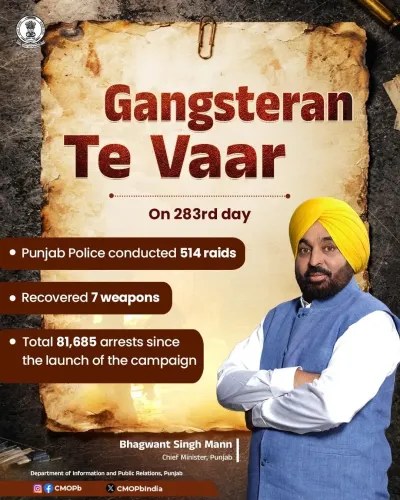
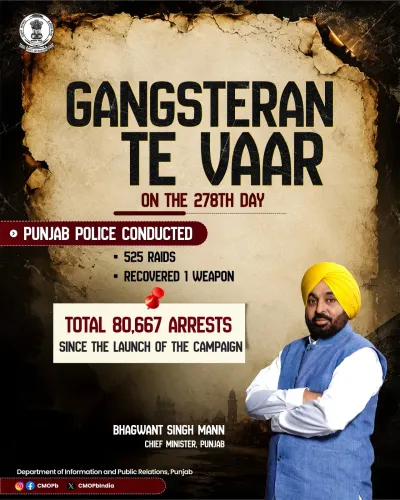
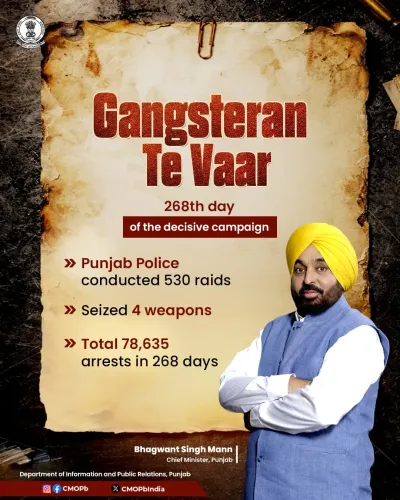
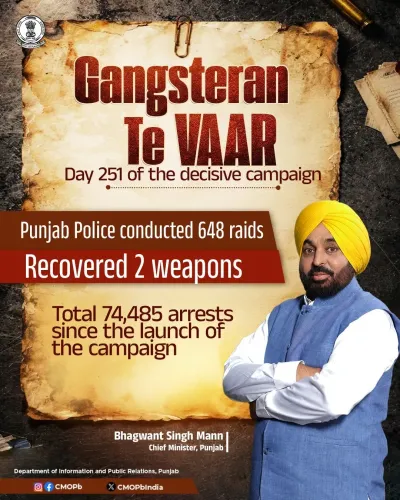
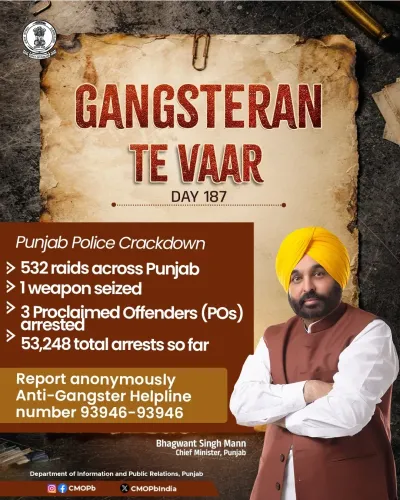
On Day 298 of Punjab's 'Gangsteran Te Vaar' campaign, police conducted 580 raids, arrested individuals and recovered four weapons, bringing total arrests since the drive's launch to 84,287 — a milestone the CMO's Office announced on 15 November 2026.
Key Takeaways
Day 298 of the Gangsteran Te Vaar campaign was recorded on 15 November 2026 .
580 raids were conducted at locations linked to gangster associates across Punjab.
Four weapons were recovered during Day 298 operations.
Cumulative arrests since the campaign's launch have reached 84,287 .
The campaign was initiated by the Bhagwant Mann -led AAP government after taking office in March 2022 .
Punjab Police targets associates and support networks — not just fugitives — using a network-disruption model.
Five hundred and eighty raids in a single day — and a cumulative arrest tally that has now crossed 84,287. On Sunday, 15 November 2026, the Chief Minister's Office of Punjab announced the latest operational figures from Gangsteran Te Vaar (the decisive 'Strike Against Gangsters' campaign), marking Day 298 of an anti-crime drive that has become one of the most sustained crackdowns on organised crime in the state's recent history.
580 raids, four weapons, one more day on the board
Police teams fanned out across Punjab on Day 298, targeting identified and mapped locations linked to associates of active gangsters. By the end of the operational window, officers had arrested multiple individuals and seized four weapons, adding to a stockpile of recovered arms accumulated over nearly ten months of daily action. The CMO's post described the campaign as 'decisive' — a word that has appeared consistently in official communications, underscoring the government's intent to frame this not as a periodic sweep but as a permanent operational posture.
From 2022 pledge to nearly 85,000 arrests
When Chief Minister Bhagwant Mann of the Aam Aadmi Party took office in March 2022, tackling Punjab's entrenched organised-crime networks was front and centre of the administration's law-and-order promise. The state had spent well over a decade grappling with gang rivalries, narcotics trafficking, and cross-border criminal linkages — a web successive governments had periodically targeted but never systematically dismantled. Gangsteran Te Vaar was the Mann government's answer: a named, branded, daily-counted campaign designed to signal both operational seriousness and political accountability.
The 84,287 total arrests since the campaign's launch represent a staggering operational tempo for Punjab Police. The force has structured the drive around mapping associates and support networks of known gangsters — a network-disruption model rather than a simple fugitive-hunt — which explains why the daily raid counts remain high even as the campaign matures past its ninth month.
Why the daily count matters politically and operationally
Releasing a day-numbered tally every 24 hours is a deliberate communications choice. It converts a law-enforcement campaign into a live, trackable commitment — one that is easy for citizens to follow and equally easy for the opposition to audit. Each update locks the government into continuity; a gap in the numbers or a dramatic drop in raid intensity would become an instant news event. That pressure, by design, keeps the operational machinery running.
Punjab's gang-and-narcotics problem has historically been difficult to separate from political patronage and cross-border supply chains, making sustained police action — rather than episodic crackdowns — the only model that analysts argue can produce durable results. Whether the arrest numbers translate into successful prosecutions and long-term dismantlement of networks is the question that will define this campaign's legacy.
With Day 298 logged and the 300-day milestone two nights away, the next marker worth watching is not just the number of raids but the quality of cases built — because the courtroom, ultimately, is where Gangsteran Te Vaar will be judged.
Point of View
Publicly auditable commitment that is difficult to quietly wind down. With 84,287 arrests over 298 days, the sheer volume suggests the campaign has penetrated deep into the support ecosystem of organised crime, not just its visible leadership. The harder test, however, lies ahead: whether Punjab's courts and prosecution machinery can convert mass arrests into convictions that actually shrink the criminal networks. If the case-to-conviction ratio is weak, the campaign's optics could outlast its operational impact.
NationPress
15 Nov 2026
Frequently Asked Questions
What is the 'Gangsteran Te Vaar' campaign in Punjab?
'Gangsteran Te Vaar' — meaning 'Strike Against Gangsters' — is a statewide anti-crime campaign launched by the Bhagwant Mann government in Punjab, involving daily raids, arrests and weapon recoveries targeting gangsters, their associates and criminal networks across the state.
How many arrests have been made in the Gangsteran Te Vaar campaign?
As of Day 298 on 15 November 2026, the total arrests since the campaign's launch have reached 84,287, according to the Chief Minister's Office of Punjab.
How many raids did Punjab Police conduct on Day 298?
Punjab Police conducted 580 raids at identified and mapped locations linked to gangster associates across Punjab on Day 298 of the Gangsteran Te Vaar campaign.
When did Bhagwant Mann launch the anti-gangster campaign in Punjab?
Chief Minister Bhagwant Mann, who took office in March 2022 from the Aam Aadmi Party, initiated intensified action against organised crime and gang networks as a core law-and-order commitment of his administration. The named Gangsteran Te Vaar campaign operationalised that pledge.
What weapons were recovered on Day 298 of Gangsteran Te Vaar?
Four weapons were recovered during Punjab Police operations on Day 298 of the Gangsteran Te Vaar campaign on 15 November 2026, as announced by the CMO Punjab's official account.