Chinese scientist Lu Yaxiang cracks sodium battery performance barrier
Synopsis
A Chinese scientist who spent a decade on what many called an impossible materials problem has won China's top youth science honour for pushing sodium-ion batteries — abundant, cheap, and strategically vital — closer to rivalling lithium-ion performance.
Key Takeaways
Lu Yaxiang , professor at the Chinese Academy of Sciences' Institute of Physics , received the China Youth May Fourth Medal in April 2026 for energy storage research.
The medal is China 's highest national honour for achievers under 35 .
Sodium-ion batteries use sodium — an abundant and cheap mineral — as an alternative to scarce lithium-ion raw materials.
Lu 's decade-long focus on materials innovation targeted the core weakness of sodium-ion cells: lower energy density.
His findings have been published in top-tier journals including Nature Energy and Science .
Parallel sodium-ion research programmes are active at the University of Birmingham and the University of Surrey .
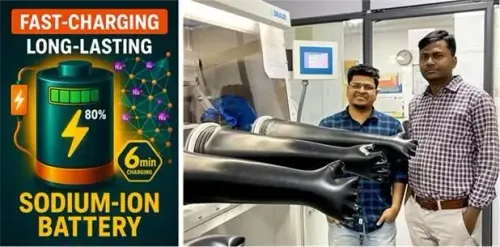
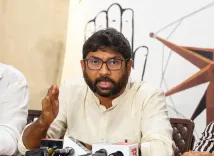
Lu Yaxiang, a professor at the Chinese Academy of Sciences' Institute of Physics, has spent a decade pushing sodium-ion batteries toward commercial viability — and his persistence is now drawing national recognition. In April 2026, Lu was awarded the China Youth May Fourth Medal, the country's highest honour for outstanding achievers under 35, for his work on energy storage materials.
Why sodium batteries matter
Lithium-ion batteries have long dominated the global energy storage market, but their dependence on scarce and environmentally costly raw materials has made the search for alternatives urgent. Sodium-ion batteries have emerged as a leading candidate — sodium is abundant, inexpensive, and far simpler to source — yet the technology has historically been held back by lower energy density compared with lithium-ion equivalents.The breakthrough approach
Lu's research centred on materials innovation as the primary lever for closing the performance gap. Rather than treating sodium's limitations as fixed constraints, he pursued fundamental advances in electrode and electrolyte materials to boost the energy density of sodium-ion cells. His work, which has been published in journals including Nature Energy and Science, challenged what many in the field had considered an insurmountable ceiling.Energy security as the driving thesis
Lu has framed sodium's abundance explicitly in terms of China's energy security, according to reports. Unlike lithium, cobalt, and nickel — minerals concentrated in a handful of countries and subject to supply-chain disruption — sodium is domestically accessible at scale. That strategic framing has aligned his laboratory work with broader national priorities around reducing import dependence in critical technology supply chains.Competitive backdrop
The race to commercialise sodium-ion technology is intensifying globally. Researchers at institutions including the University of Birmingham and the University of Surrey are pursuing parallel programmes, while Chinese battery manufacturers have begun moving prototype sodium-ion cells toward production. Lu's recognition by the state signals that Beijing views sodium-ion development as strategically significant, not merely an academic exercise.What's next
The central question now is whether laboratory-level materials breakthroughs can translate into manufacturable, cost-competitive cells at scale. As sodium-ion battery pilots expand and automakers seek alternatives to lithium dependency, researchers like Lu Yaxiang — and the institutions backing them — will face mounting pressure to move from peer-reviewed validation to industrial deployment.Point of View
A calculus sharpened considerably by Western export controls on semiconductor and battery supply chains. Sodium-ion technology is one of the few credible routes to a battery supply chain that does not run through lithium triangle nations or cobalt-rich regions subject to geopolitical pressure. What mainstream coverage tends to underplay is that the bottleneck was never sodium's availability but its electrochemical behaviour at the materials level — and that is precisely where a decade of unglamorous lab work now appears to be paying off. The real test will be whether China's manufacturing ecosystem can absorb these materials advances faster than Western competitors, who are pursuing the same prize with significant university and government backing.
NationPress
13 Oct 2026
Frequently Asked Questions
Who is Lu Yaxiang and what did he achieve?
Lu Yaxiang is a professor at the Chinese Academy of Sciences' Institute of Physics who has spent a decade developing sodium-ion battery materials. In April 2026 , he was awarded the China Youth May Fourth Medal — the country's top honour for outstanding achievers under 35 — for his contributions to energy storage research.
Why are sodium-ion batteries important?
Sodium-ion batteries offer a potentially cheaper and more strategically secure alternative to lithium-ion batteries, whose raw materials are scarce and geographically concentrated. Sodium is abundant and easy to source domestically, making it attractive for countries seeking to reduce critical mineral import dependence.
What was the main technical challenge Lu Yaxiang solved?
The primary obstacle for sodium-ion batteries has been their lower energy density compared with lithium-ion equivalents. Lu 's research focused on materials innovation — advancing electrode and electrolyte compositions — to close that performance gap, with results published in journals including Nature Energy and Science .
How does this fit into China's energy security strategy?
According to reports, Lu has explicitly framed sodium's abundance as vital for China 's energy security, aligning his laboratory work with national priorities around reducing reliance on imported critical minerals. State recognition of his research signals that Beijing views sodium-ion development as strategically significant.
Who else is working on sodium-ion battery technology?
Research programmes at the University of Birmingham and the University of Surrey are among the international efforts pursuing sodium-ion technology in parallel with Chinese institutions. Chinese battery manufacturers have also begun moving prototype sodium-ion cells toward commercial production.