How is India’s mining sector advancing with major reforms in 2025?

Synopsis
Discover how the Ministry of Mines is transforming India's mining sector with groundbreaking reforms in 2025, enhancing mineral security and production efficiency. Key initiatives include the introduction of the MMDR Amendment Act and the establishment of the National Critical Mineral Mission for sustainable resource management.
Key Takeaways
Comprehensive reforms in India's mining sector aim to enhance sustainability.
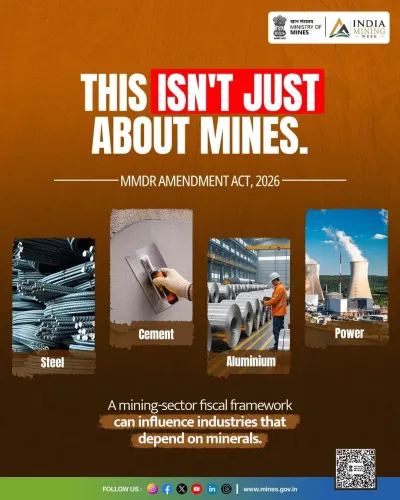
The MMDR Amendment Act has been a cornerstone of these reforms.
141 mineral blocks were successfully auctioned in 2025.
The National Critical Mineral Mission is set to secure essential mineral supplies.
Public sector companies like NALCO and Hindustan Copper show impressive financial growth.
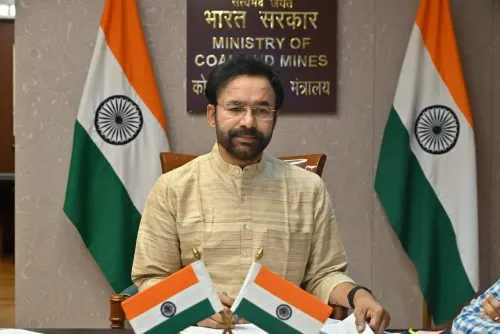
New Delhi, Dec 31 (NationPress) The Ministry of Mines has initiated extensive policy reforms to modernize India’s mining landscape and enhance mineral security in 2025, according to an official announcement released on Wednesday.
Significant changes include the introduction of the MMDR Amendment Act, 2025, and the rebranding of the National Mineral Exploration Trust (NMET) to the National Mineral Exploration and Development Trust (NMEDT). This change signifies its broader mission to not only explore but also support the development and international acquisition of strategic minerals, which is funded by increased contributions from mining lessees as part of the major reforms implemented in 2025.
Key achievements during the year include the NMEDT’s enhanced funding, streamlined auction processes with specified timelines, the lifting of restrictions on captive mine sales, reclassification of certain minerals as major minerals, the announcement of royalty rates for critical minerals, the promotion of mineral exchanges, and the execution of offshore mining reforms, as outlined in the statement.
These reforms are designed to boost transparency, simplify the business environment, accelerate mineral output, and promote sustainable development, thereby establishing the mining sector as a crucial component in realizing the vision of 'Viksit Bharat 2047', as stated by the Ministry of Mines.
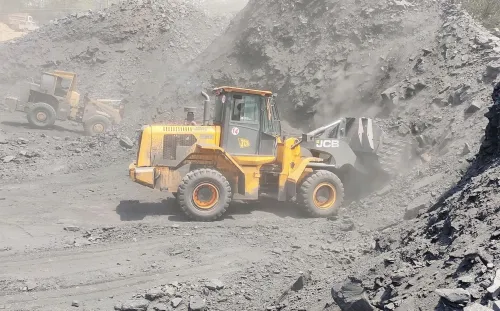
The year 2025 marked a significant leap in the nation’s mineral resource development, with a total of 141 mineral blocks auctioned successfully by December 5, 2025. This encompassed 79 blocks auctioned for Mining Lease (ML) and 62 blocks awarded as Composite Licence (CL).
This represents the highest number of blocks auctioned in a single year since the auction system was established in 2015, indicating faster processes and increased participation from both state and industry stakeholders. Notably, Assam and Uttarakhand auctioned mineral blocks for the first time during this period, marking their entry into the auction landscape of India.
Since the commencement of the auction regime in 2015, a total of 585 mineral blocks have been successfully auctioned nationwide.
This year, Madhya Pradesh and Rajasthan led in the number of blocks auctioned, with 33 and 22 respectively. Among the minerals, Limestone had the highest number of auctions (41), followed by Iron Ore (32) and Bauxite (22).
A Mining Dashboard was launched on April 4, 2025, enabling near real-time monitoring of auctioned mineral blocks, related clearances, and delays. This Dashboard is a vital tool for expediting the operationalization of mineral blocks by tracking key milestones like the issuance of letter of intent (LoI), execution of lease agreements, and obtaining statutory approvals. With both public and private access options, it enhances transparency and accountability while allowing for close scrutiny by both State and Central Governments.
In a significant development, the Union Cabinet approved the establishment of the National Critical Mineral Mission (NCMM) in January 2025 with a financial commitment of Rs 16,300 crore and anticipated investments of Rs 18,000 crore from public sector undertakings and other firms. This Mission is intended to ensure a sustainable long-term supply of critical minerals and reinforce India’s critical mineral value chains, covering all phases from mineral exploration and mining to beneficiation, processing, and recovery from end-of-life products.
India has also joined a new US-led multilateral Minerals Security Partnership to establish secure supply chains for critical minerals, aimed at reducing reliance on China. This initiative will assist in securing essential minerals for Indian industries.
On December 4, 2025, discussions were held with the International Energy Agency to enhance collaboration in the critical minerals value chain, improve data-driven partnerships, and explore joint ventures to bolster India’s clean energy ecosystem. Additionally, memorandums of understanding have been established with Argentina, Mongolia, Japan, and Bolivia to accelerate mineral exploration and production.
Public sector enterprises under the Ministry of Mines, such as the National Aluminium Company (NALCO) and Hindustan Copper, have demonstrated impressive performance in 2025. NALCO reported a net profit of Rs 5,325 crore in FY 2024-25 with revenues reaching Rs 16,788 crore. The company maintained its status as the lowest-cost producer of bauxite and alumina globally in 2024.
Hindustan Copper Limited achieved a 54 percent increase in profit before tax, reaching Rs 633.51 crore in FY 2024-25, up from Rs 410.43 crore in FY 2023-24.
Point of View
Fostering both economic growth and environmental responsibility.
NationPress
30 Sept 2026
Frequently Asked Questions
What are the key reforms in India's mining sector in 2025?
The key reforms include the MMDR Amendment Act, the establishment of the National Critical Mineral Mission, streamlined auction processes, and enhanced funding for mineral exploration and development.
How many mineral blocks were auctioned in 2025?
A total of 141 mineral blocks were successfully auctioned by December 5, 2025, the highest in any single year since the auction regime began.
What is the significance of the National Critical Mineral Mission?
The National Critical Mineral Mission aims to secure a sustainable supply of critical minerals and strengthen value chains from exploration to recovery, promoting long-term mineral security in India.
Which states auctioned mineral blocks for the first time in 2025?
Assam and Uttarakhand auctioned mineral blocks for the first time in 2025, marking their entry into the auction landscape of India.
What was the profit of NALCO in FY 2024-25?
NALCO recorded a net profit of Rs 5,325 crore in FY 2024-25, maintaining its position as the lowest-cost producer of bauxite and alumina in the world.