National Supercomputing Mission deploys 40 systems, hits 68 petaflops capacity

Synopsis
India's National Supercomputing Mission has crossed 68 petaflops across 40 deployed systems — a landmark that signals the country's intent to make high-performance computing a foundational layer for AI, climate modelling and drug discovery, not just academic research. With India generating 20% of the world's data, the infrastructure gap this mission is closing is strategic, not merely scientific.
Key Takeaways
The National Supercomputing Mission (NSM) has deployed 40 supercomputers with a combined capacity of 68 petaflops as of September 2026 .
The mission was launched in April 2015 with an outlay of approximately ₹4,500 crore , jointly steered by DST and MeitY .
India generates nearly 20 per cent of the world's data, driving demand for advanced computing infrastructure.
Applications include crop-yield prediction , disease-outbreak tracking , drug discovery , flood forecasting , and climate modelling .
Implementation is led by C-DAC, Pune and IISc, Bengaluru ; indigenous servers, software and cooling systems are also being developed.
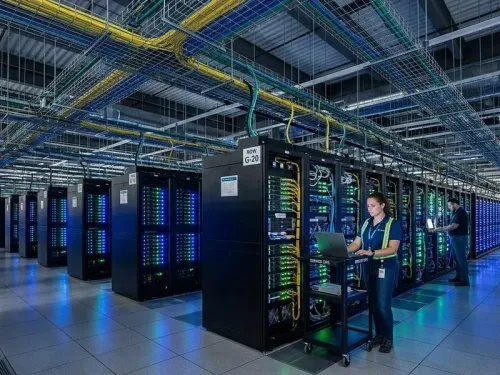
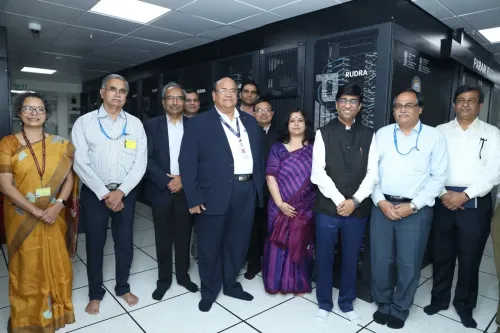
India's supercomputing infrastructure has reached a significant milestone, with the National Supercomputing Mission (NSM) deploying 40 supercomputers with a combined computing capacity of 68 petaflops (PF) as of September 2026, the government announced on 4 October 2026. The mission is expanding high-performance computing (HPC) access across research and academic institutions for applications spanning artificial intelligence, weather forecasting, healthcare, disaster management, and space research.
India's Supercomputing Journey
India's foray into supercomputing dates back to the early 1990s with the development of PARAM 8000, widely regarded as a landmark in indigenous computing history. The current push is far more expansive: the NSM, launched in April 2015 with an outlay of approximately ₹4,500 crore, is jointly steered by the Department of Science and Technology (DST) and the Ministry of Electronics and Information Technology (MeitY). Implementation is being carried out by the Centre for Development of Advanced Computing (C-DAC), Pune, and the Indian Institute of Science (IISc), Bengaluru.
Why High-Performance Computing Matters Now
The government noted that India generates nearly 20 per cent of the world's data, creating an urgent need for processing infrastructure capable of handling large-scale computation. Supercomputers achieve this by combining large numbers of processors that perform calculations simultaneously, enabling complex simulations and massive dataset analysis at speeds unachievable by conventional systems.
Notably, the scale of computing demand has grown sharply alongside the expansion of AI applications, climate modelling requirements, and the data generated by India's digital economy. HPC is no longer a purely academic resource — it is increasingly strategic infrastructure.
Societal and Scientific Applications
The government highlighted a range of applications already delivering direct societal benefits under the NSM. These include crop-yield prediction, disease-outbreak tracking, drug discovery, and flood forecasting for river-affected zones. On the scientific side, HPC is being deployed across Computational Biology, Weather Prediction and Climate Modelling, Disaster Management, Big Data Analytics, and Astrophysics.
Building Indigenous Capabilities
A key thrust of the NSM is technological self-reliance. Beyond deploying imported or hybrid systems, India is also developing indigenous technologies covering servers, software, cooling systems, and networking. The mission explicitly aims to build domestic HPC capabilities rather than remain dependent on foreign infrastructure — a strategic consideration that has gained urgency amid global semiconductor and technology supply-chain uncertainties.
What Comes Next
With 40 systems already live and a clear mandate to expand, the NSM's next phase is expected to deepen access for universities and research bodies beyond premier institutions. The convergence of AI workloads, climate modelling demands, and India's data generation trajectory means the pressure on computing infrastructure will only intensify — making the mission's continued scaling a national priority rather than a niche scientific programme.
Point of View
But the number needs context: China's top supercomputer alone exceeds 1,000 petaflops, and US systems are in a similar league. The NSM's real value proposition is not raw global ranking but democratised access — getting HPC into state universities and second-tier research bodies that have historically depended on foreign collaborators for compute time. The indigenous technology push is strategically sound, but delivery timelines on domestic servers and cooling systems deserve scrutiny; similar self-reliance mandates in defence and semiconductors have repeatedly slipped. If the next phase of the mission genuinely expands access beyond the IITs and IISc, it could become a force-multiplier for India's broader AI and climate research ambitions.
NationPress
4 Oct 2026
Frequently Asked Questions
What is the National Supercomputing Mission (NSM)?
The National Supercomputing Mission is a government initiative launched in April 2015 with an outlay of approximately ₹4,500 crore to build a national high-performance computing ecosystem in India. It is jointly steered by the Department of Science and Technology (DST) and the Ministry of Electronics and Information Technology (MeitY), and implemented by C-DAC, Pune and IISc, Bengaluru.
How many supercomputers has India deployed under the NSM?
As of September 2026, the NSM has deployed 40 supercomputers with a combined computing capacity of 68 petaflops. These systems are accessible across research and academic institutions for a range of scientific and societal applications.
What applications are India's supercomputers being used for?
India's HPC infrastructure supports applications including artificial intelligence, weather prediction, climate modelling, crop-yield forecasting, disease-outbreak tracking, drug discovery, flood forecasting, astrophysics, and disaster management. The systems process massive datasets and run complex simulations far faster than conventional computing infrastructure.
Why is high-performance computing a priority for India right now?
India generates nearly 20 per cent of the world's data, and emerging applications such as AI, climate modelling and space research require increasingly powerful computing infrastructure. The government has identified HPC as critical for accelerating scientific discovery, technological innovation, and strategic national applications.
Is India developing its own supercomputing technology?
Yes. Under the NSM, India is building indigenous technologies covering servers, software, cooling systems and networking, alongside expanding its deployed infrastructure. The mission explicitly aims to reduce dependence on foreign HPC systems and develop domestic capabilities in high-performance computing.