What is the significance of the PARAM Rudra supercomputer inaugurated at IIT Bombay?
Synopsis
The inauguration of the PARAM Rudra supercomputer at IIT Bombay marks a pivotal moment for India's indigenous supercomputing capabilities, promising to enhance research and innovation across multiple fields. This initiative showcases the government's commitment to advancing technology while fostering collaboration among academic institutions and industries.
Key Takeaways
PARAM Rudra inaugurated at IIT Bombay enhances computational capabilities.
It operates at a capacity of 3 Peta FLOPS .
Supports research in AI, biotechnology , and more.
Utilizes indigenous technology and advanced cooling systems.
Part of the National Supercomputing Mission initiative for self-reliance.
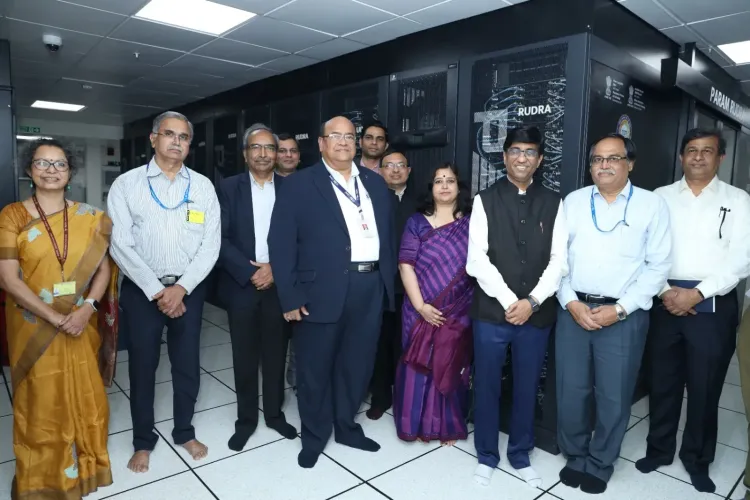
Mumbai, Jan 9 (NationPress) The PARAM Rudra supercomputing facility has officially opened its doors at the Centre for Development of Advanced Computing (C-DAC) within the Indian Institute of Technology (IIT) Bombay.
This high-performance computing (HPC) system boasts a capacity of 3 Peta FLOPS and has been created and implemented under the Build Approach of the National Supercomputing Mission (NSM).
PARAM Rudra is constructed on indigenous Rudra servers, designed by C-DAC and manufactured in India, reflecting the government's Make in India initiative.
The supercomputer is powered by C-DAC’s homegrown software stack and utilizes advanced Direct Contact Liquid Cooling (DCLC) technology to improve efficiency.
“This facility will greatly enhance computational research, aiding over 200 faculty members and 1,200 students at IIT Bombay, as well as researchers across the country,” stated Prof. Abhay Karandikar, Secretary of the Department of Science & Technology (DST), during the inauguration.
He emphasized that the facility will drive innovation in fields such as artificial intelligence, biotechnology, and advanced manufacturing, while also fostering support for startups and industry-related research.
“The Rudra-based cluster represents a significant step in India’s journey towards indigenous supercomputing and highlights the necessity for ongoing investments in HPC systems, software, microprocessors, and networking to reach exascale computing,” remarked Sunita Verma, Group Coordinator at the Ministry of Electronics and Information Technology (MeitY).
Dr. Hemant Darbari, NSM Mission Director, noted that with this addition, a total of 38 supercomputers with a combined capacity of 44 Peta FLOPS have been deployed across India under the NSM.
Additionally, he mentioned that the PARAM Rudra facility at IIT Bombay will enhance research opportunities for numerous institutions in and around Mumbai, facilitating collaboration and scientific advancements.
The National Supercomputing Mission is collaboratively led by MeitY and DST, with C-DAC and IISc Bengaluru acting as the implementing agencies.
This mission aims to establish a comprehensive indigenous supercomputing ecosystem through four primary pillars: supercomputing infrastructure, applications development, research and development, and human resource development.
Point of View
The government is not only fostering innovation but also empowering academic institutions and industries. This move signifies a crucial step towards self-reliance in the field of supercomputing.
NationPress
29 Sept 2026
Frequently Asked Questions
What is the PARAM Rudra supercomputer?
The PARAM Rudra supercomputer is a high-performance computing system inaugurated at IIT Bombay, designed to enhance computational research and innovation.
What is the capacity of PARAM Rudra?
PARAM Rudra has a computing capacity of 3 Peta FLOPS.
How does PARAM Rudra support research?
It supports over 200 faculty members and 1,200 students, facilitating research across multiple fields including AI and biotechnology.
What technology does PARAM Rudra utilize?
The supercomputer uses an indigenous software stack and advanced Direct Contact Liquid Cooling (DCLC) technology.
What is the goal of the National Supercomputing Mission?
The mission aims to create a comprehensive indigenous supercomputing ecosystem focusing on infrastructure, applications, research, and human resource development.