Will India’s Solar Capacity Reach 216 GW by FY28?
Synopsis
India is set to reach an impressive solar capacity of 216 GW by FY28, significantly boosting its energy generation through the Production Linked Incentive scheme. Explore how government initiatives, manufacturing expansion, and export potential will shape the future of solar energy in the country.
Key Takeaways
India's solar capacity is expected to reach 216 GW by FY28.
Production Linked Incentive scheme is crucial for growth.
Current installed solar capacity is 127.3 GW .
Exports of solar products have increased significantly.
Domestic manufacturing capacity is set to expand by 100 GWp .
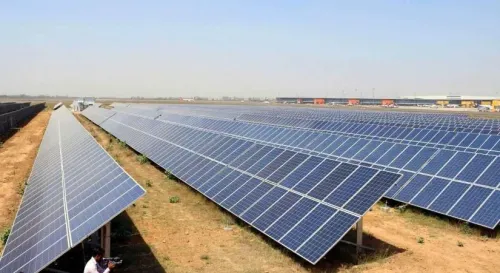
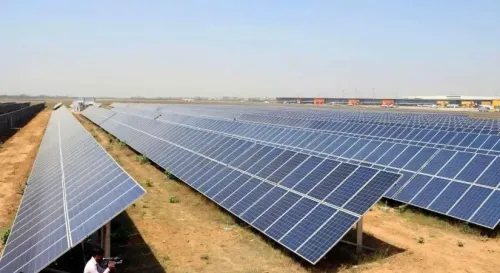
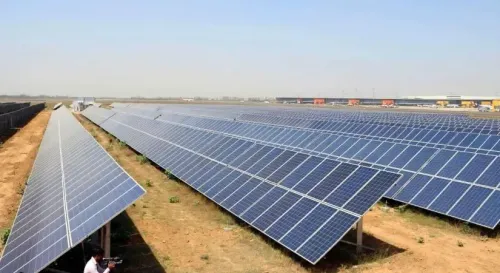
New Delhi, Nov 3 (NationPress) India is projected to achieve approximately 216 GW of solar capacity, generating 305 billion units by FY28, fueled by robust applications under the Production Linked Incentive scheme, according to a report released on Monday.
The PLI initiative is facilitating swift capacity growth, while efficiency improvements—where typically 1,700-2,200 panels (at 500 watts peak) are installed for every 1 MW of solar energy—are enhancing scale benefits in project implementation, as mentioned in the report from CareEdge Advisory, a division of the ratings firm CareEdge Ratings.
CareEdge Advisory highlighted that India’s installed solar capacity rose to 127.3 GW by September 2025, up from 3.9 GW in FY15, contributing around 25.7 percent of the total installed capacity.
Furthermore, India's exports of solar photovoltaic (PV) products have increased by more than 10 times between FY19 and FY25, primarily targeting the US market, as per the report.
Government policies like PLI, Basic Customs Duty (BCD), and the Approved List of Models and Manufacturers (ALMM) have bolstered domestic solar module capacity to 100 GW, positioning India as the fourth largest globally.
By the close of FY28, India's module manufacturing capacity is expected to expand by an additional 100 GWp, nearly three to four times the yearly average module demand of 50-60 GWp over the next three years, according to the report.
The domestic cell manufacturing capacity is anticipated to reach 100 GWp in the same timeframe, with capital expenditure surpassing Rs 55,000 crore, driven by initiatives for backward integration, the advisory indicated.
CareEdge Advisory forecasts that by FY28, India will need around 36-47 crore solar panels (at 500 Wp) to meet its targeted solar capacity of 215 to 220 GW.
The advisory mentions that module production will increasingly depend on exports, while cell production is expected to surpass domestic demand in the medium term. This suggests that in the forthcoming years, India’s output of modules and cells will exceed local requirements, making exports a pivotal growth driver for the sector.
However, the advisory pointed out that the early stage of upstream integration, persistent reliance on Chinese supply chains, and sluggish progress in renewable capacity enhancement due to systemic challenges pose medium-term risks.
Point of View
I firmly believe that India's commitment to expanding its solar capacity is not just a step towards energy independence; it’s a pivotal move in the global fight against climate change. The alignment of government initiatives with market demand highlights a promising future for sustainable energy in India, firmly establishing the nation as a key player on the global renewable energy stage.
NationPress
25 Sept 2026
Frequently Asked Questions
What is the expected solar capacity of India by FY28?
India is anticipated to reach a solar capacity of approximately 216 GW by FY28.
How does the Production Linked Incentive scheme contribute to solar energy growth?
The PLI scheme facilitates rapid capacity expansion and enhances efficiency in solar project execution.
What is India's current installed solar capacity?
As of September 2025, India's installed solar capacity stands at 127.3 GW.
Which countries does India primarily export solar PV products to?
India's solar PV exports have surged primarily to the United States.
What are the potential risks to India's solar capacity growth?
Medium-term risks include reliance on Chinese supply chains and slow progress in renewable capacity augmentation.