South Korea banks tighten credit loans as leveraged stock buying surges
Synopsis
South Korea's biggest banks are pulling back on credit loans just as a supercharged KOSPI rally — from 6,500 to 8,400 points in a single month — has driven retail investors into leveraged equity bets. With household loans posting their sharpest monthly jump since August 2024, regulators are now forcing lenders to act before the debt-fuelled rally turns into a systemic risk.
Key Takeaways
South Korean banks Hana and Shinhan have tightened credit loan criteria under pressure from financial authorities.
Outstanding household bank loans rose 6.9 trillion won to 1,181.8 trillion won in May — the sharpest monthly gain since August 2024 .
Unsecured loans jumped 3.7 trillion won in May, the largest increase since April 2021 .
The Bank of Korea linked the surge directly to rising retail investment in the equity market.
KOSPI surged from 6,500 to the 8,400-point range in May on semiconductor stock gains.
On Friday, KOSPI was trading up 7.81% at 8,370.41 as of 11:20 am local time .
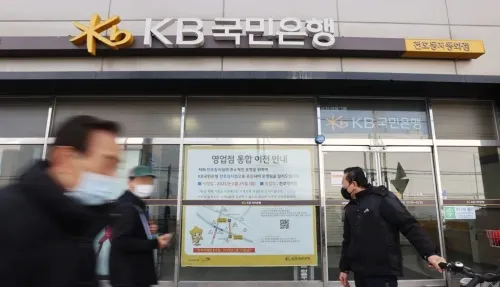
South Korean banks are moving swiftly to curb a sharp rise in credit loans after customers borrowed heavily to invest in equities, according to financial sources on Friday, 12 June. The clampdown follows mounting pressure from the country's financial authorities, as household lending hit its fastest growth pace in nearly two years.
Key Developments
Major lenders including Hana Bank and Shinhan Bank have tightened eligibility criteria and caps on credit loans, according to reports. The move comes after outstanding household loans extended by banks surged 6.9 trillion won (approximately US$4.5 billion) to 1,181.8 trillion won in May — accelerating sharply from the previous month's gain of 2.1 trillion won, according to data from the Bank of Korea (BOK).
The monthly increase marked the steepest on-month growth since August 2024, when household loans rose 9.2 trillion won from the prior month.
Mortgage and Unsecured Loans Both Climb
Mortgage loans rose 3.2 trillion won on-month in May, up from a 2.7 trillion-won gain in April. Unsecured and other household loans jumped 3.7 trillion won in May, reversing a decline of 600 billion won the previous month. Notably, this was the largest single-month increase in unsecured loans since April 2021, when such lending rose 11.8 trillion won.
The Bank of Korea attributed the surge in non-mortgage lending directly to rising individual participation in the booming equity market.
Stock Market Rally Fuels Borrowing
The benchmark Korea Composite Stock Price Index (KOSPI) rallied strongly in May, driven by outsized gains in semiconductor shares. The index surged from the 6,500-point level to the 8,400-point range during the month — a move that appears to have drawn retail investors into leveraged positions.
On Friday, KOSPI was trading up 606.46 points, or 7.81%, at 8,370.41 as of 11:20 am local time, after opening sharply higher. The index held above the 8,000-point mark as institutional and foreign investors snapped up blue-chip technology stocks. The rally was partly fuelled by US President Donald Trump's remarks that raised hopes for a resolution to the Iran conflict.
Regulatory Pressure Mounts
South Korea's financial authorities have been signalling concern over the pace of household debt accumulation, particularly credit linked to equity investment. The tightening by Hana and Shinhan signals that lenders are responding to regulatory guidance rather than waiting for formal mandates. This comes amid a broader pattern: South Korean regulators have previously intervened in mortgage markets when credit growth outpaced macroprudential targets.
With the KOSPI still trading at elevated levels, the sustainability of the rally — and the risk embedded in leveraged retail positions — will remain a key concern for both banks and policymakers in the weeks ahead.
Point of View
And regulators are right to be concerned — retail investors borrowing to chase momentum rarely exit cleanly when the tide turns. What is less clear is whether tightening credit limits at individual banks is sufficient, or whether a more systemic macroprudential tool — such as a loan-to-income cap on equity-linked credit — is warranted. South Korea has used such instruments in the mortgage market before; the equity credit channel may now need the same discipline.
NationPress
26 Sept 2026
Frequently Asked Questions
Why are South Korean banks tightening credit loans?
South Korean banks are tightening credit loan criteria and limits because household lending surged at its fastest pace in nearly two years in May, driven by customers borrowing to invest in stocks. Financial authorities have been pressuring lenders to curb this growth before it becomes a systemic risk.
How much did South Korean household loans grow in May?
Outstanding household loans extended by banks rose 6.9 trillion won to 1,181.8 trillion won in May, according to Bank of Korea data. This was the sharpest on-month increase since August 2024.
Which banks have tightened credit loan limits?
Hana Bank and Shinhan Bank are among the major lenders that have tightened eligibility criteria and caps on credit loans, according to reports. Other major lenders are also reportedly following suit under regulatory guidance.
What drove the surge in unsecured household loans?
The Bank of Korea attributed the rise in non-mortgage loans primarily to growing individual participation in the equity market. Unsecured loans rose 3.7 trillion won in May — the largest monthly increase since April 2021.
How has the KOSPI performed recently?
The KOSPI benchmark surged from around 6,500 points to the 8,400-point range in May, driven by strong gains in semiconductor shares. On Friday it was trading up 7.81% at 8,370.41 as of 11:20 am local time, supported by institutional and foreign buying of blue-chip tech stocks.