New Labour Codes capacity-building programme held in Madhya Pradesh
Synopsis
A government capacity-building drive on India's new Labour Codes reached Madhya Pradesh, with MoLE officials, EPFO, and DGLW jointly briefing employers and state authorities on compliance obligations — a signal that the Centre is stepping up its push to translate notified codes into ground-level implementation.
Key Takeaways
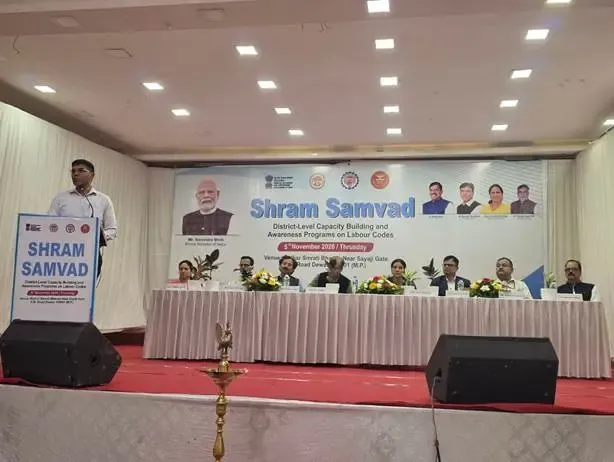
A district-level capacity-building programme on the new Labour Codes was held in Madhya Pradesh on 8 November 2026 .
Datta delivered the keynote, covering key features of all four Labour Codes .
EPFO and DGLW representatives covered the PMVBRY and PM-SYM social security schemes.
Sessions focused on practical compliance guidance for employers, HR, legal, and finance professionals .
The programme aimed to strengthen Centre-State coordination and accelerate ground-level adoption of the labour reform framework.
A district-level capacity-building programme on the new Labour Codes was held in Madhya Pradesh on 8 November 2026, bringing together officials from the Central Government and state government alongside industry representatives to deepen awareness and strengthen compliance readiness. The Ministry of Labour and Employment (MoLE) said the event supported the effective adoption and implementation of all four Labour Codes.
Programme Objectives
The session was designed to enhance understanding among employers, HR, legal, and finance professionals about the Labour Codes and the rules framed under them. A parallel objective was to strengthen institutional capacity on labour reforms, worker welfare, and social protection, while promoting Centre-State coordination and broader stakeholder engagement.
Key Sessions and Speakers
S.R. Datta, Director at MoLE, delivered the keynote address outlining the core features of the new Labour Codes. Multiple technical sessions were conducted by MoLE officials, focusing on compliance requirements for employers under each of the four Labour Codes and the Central Rules notified under them. The sessions offered practical guidance on statutory obligations, helping participants understand the operational realities of the new framework.
Representatives from the Employees' Provident Fund Organisation (EPFO) and the Directorate General of Labour Welfare (DGLW) also addressed participants, covering the Pradhan Mantri Viksit Bharat Rozgar Yojana (PMVBRY) and the Pradhan Mantri Shram Yogi Maandhan (PM-SYM) scheme, respectively.
Q&A and Participant Engagement
An interactive question-and-answer session allowed participants to raise specific queries on compliance requirements, employer obligations, and social security provisions. According to the official statement, the exchange helped attendees gain greater clarity on the operational aspects of the new labour framework.
Context and Significance
India's new Labour Codes — which consolidate 29 central labour laws into four broad codes covering wages, industrial relations, social security, and occupational safety — have been notified by the Centre but await full implementation across states. District-level capacity-building exercises such as this one are part of the government's push to accelerate state-level readiness and ensure uniform compliance. Madhya Pradesh is among the states that have framed draft rules under the codes. The Centre has repeatedly underscored that effective implementation depends on sustained coordination between central and state machinery and industry.
Point of View
Largely because state-level rule-making and enforcement infrastructure lag behind central intent. District-level workshops are a necessary but insufficient fix — the deeper bottleneck is political will in states to finalise rules and resource the inspection machinery to enforce them. The inclusion of EPFO and DGLW alongside MoLE signals an attempt at whole-of-government alignment, but without measurable compliance targets, these events risk being procedural exercises rather than genuine reform accelerators.
NationPress
8 Nov 2026
Frequently Asked Questions
What are the new Labour Codes that the programme covered?
India's new Labour Codes consolidate 29 central labour laws into four codes: the Code on Wages, the Industrial Relations Code, the Code on Social Security, and the Occupational Safety, Health and Working Conditions Code. The Madhya Pradesh programme briefed employers and state officials on compliance requirements under all four codes and the Central Rules framed under them.
Who participated in the Madhya Pradesh Labour Codes programme?
The programme brought together Central Government and state government officials, along with industry representatives including employers and HR, legal, and finance professionals. MoLE Director S.R. Datta delivered the keynote address, and sessions were also led by EPFO and DGLW representatives.
What social security schemes were covered at the event?
EPFO representatives covered the Pradhan Mantri Viksit Bharat Rozgar Yojana (PMVBRY), while DGLW representatives addressed the Pradhan Mantri Shram Yogi Maandhan (PM-SYM) scheme, both of which form part of the social protection framework linked to the new Labour Codes.
Why is the government holding district-level Labour Codes capacity-building programmes?
The new Labour Codes have been notified by the Centre but require state-level rule implementation to come into full effect. District-level programmes aim to close the awareness and compliance gap among employers and state agencies, ensuring consistent understanding of statutory obligations before full enforcement begins.
What is the current status of Labour Codes implementation in Madhya Pradesh?
Madhya Pradesh is among the states that have drafted rules under the new Labour Codes, though full implementation is still pending. The capacity-building programme is part of the Centre's broader effort to accelerate state readiness and ensure coordinated rollout across the country.