South Korea AI race: Lee vows all-out push at 2.4GW data centre
Synopsis
Lee Jae Myung calls the AI contest “a silent war at the national level” and promises the full weight of the state behind it. GS Group's 2.4GW Donghae campus, worth up to 120 trillion won, is billed as Asia's largest AI infrastructure facility. It also marks Seoul's attempt to take AI investment beyond its traditional hubs.
Key Takeaways
President Lee Jae Myung pledged on 28 November 2026 to mobilise all government resources to make South Korea a global AI leader.
GS Group broke ground on a 2.4-gigawatt AI data centre campus in Donghae , Gangwon province.
The project runs in two phases of 1.2 GW each, with the first phase targeted for operation in 2029 .
The overall project is estimated to be worth up to 120 trillion won ($89.79 billion) , including GPUs and memory chips.
Lee described the global AI race as “a silent war at the national level.”
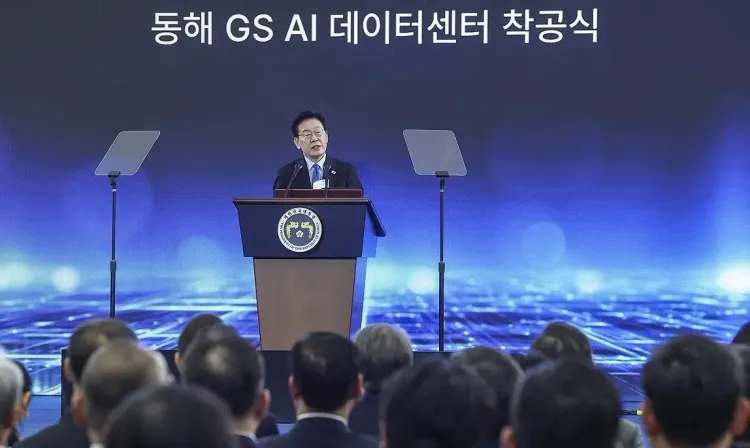
South Korean President Lee Jae Myung on Saturday, 28 November 2026, pledged to mobilise all government resources to make South Korea a leading nation in the global artificial intelligence (AI) race. He made the pledge at the groundbreaking ceremony for GS Group's AI data centre in Donghae, in the eastern province of Gangwon, his office said.
The 2.4-gigawatt campus is one of three major megaprojects the government announced in June. According to reports, the facility is expected to become one of Asia's largest AI infrastructure complexes once completed.
Key Developments at the Donghae Ceremony
At the event, Lee called the global contest for AI technology “a silent war at the national level.” He pledged all-out efforts to secure South Korea's place at the front of the field.
“The government will mobilise all its capabilities to ensure South Korea firmly establishes itself as a leading country that sets global standards and charts the way forward,” Lee said.
He added that the data centre would “serve as a catalyst for attracting early investment from global companies.”
Those present included GS Group Chairman Huh Tae-soo, Science and ICT Minister Bae Kyung-hoon and other officials.
What the Presidential Office Said
The presidential office, Cheong Wa Dae, presented the project as a major boost for Gangwon. “The project will be the first megaproject in the Gangwon region and become Asia's largest AI infrastructure facility,” it said.
“It will serve as a key driver of new growth and vitality for the regional economy,” the office added.
Project Scale, Phases and Timeline
The project will be built in two phases, each with a planned capacity of 1.2 GW. The Donghae facility belongs to the first phase, which is targeted for completion and operation in 2029.
GS Group said the overall project could be worth up to 120 trillion won ($89.79 billion). That estimate includes the cost of graphics processing units and memory chips.
Notably, a large share of the projected outlay covers computing hardware rather than physical construction alone. This reflects how much of the value in modern AI infrastructure lies in the chips that power it.
Why It Matters
This comes amid intensifying global competition over AI computing capacity, in which countries are racing to build the data infrastructure that underpins advanced AI models. By placing the first megaproject in Gangwon, the government is also signalling that it wants AI investment to spread beyond the country's traditional industrial and capital-region hubs.
For Gangwon, the project is described as the region's first such megaproject. Officials expect it to bring new economic activity to an area that has not been at the centre of the country's technology build-out.
What Happens Next
The immediate focus will be on delivering the first 1.2 GW phase on schedule by 2029. The government will also be looking to see whether the Donghae campus draws the early foreign investment Lee has promised. How quickly Seoul turns its rhetoric into steady capacity on the ground will shape its standing in the AI race in the years ahead.
Point of View
Much like ports or power grids, and the 120 trillion won figure shows how heavily the bet rests on chips rather than concrete. That is both South Korea's edge, given its memory-chip strength, and its risk, because hardware costs and global demand cycles can shift sharply before 2029. For India, which is chasing its own AI compute and data-centre ambitions, the lesson is the pairing of state backing with a named private builder and a phased timeline. Whether Lee's “silent war” delivers will depend on execution, power supply and real foreign investment, not ceremonial groundbreakings.
NationPress
28 Nov 2026
Frequently Asked Questions
What did President Lee Jae Myung pledge on AI?
Lee pledged to mobilise all government resources to make South Korea a leading country in the global AI race. He made the pledge on 28 November 2026 at the groundbreaking of GS Group's AI data centre in Donghae.
How big is GS Group's AI data centre in Donghae?
The campus is planned at 2.4 gigawatts, built in two phases of 1.2 GW each. Officials say it will become Asia's largest AI infrastructure facility.
How much will the GS Group AI data centre project cost?
The overall project is estimated to be worth up to 120 trillion won ($89.79 billion), according to the company. This includes the cost of graphics processing units and memory chips.
When will the Donghae AI data centre become operational?
The first phase, which includes the Donghae facility, is targeted for completion and operation in 2029.
Why is the project important for Gangwon province?
It is the first government megaproject in the Gangwon region. The presidential office says it will be a key driver of new growth and vitality for the regional economy.