South Korea science minister pushes 'full-stack' AI ambition amid funding gap
Synopsis
South Korea's science minister has put a number to the country's AI ambition gap — the entire government AI budget barely matches one US big tech firm's spend. With four teams competing for state-backed frontier model status and 260,000 NVIDIA GPUs in play, Seoul is making its most structured push yet to become a full-stack AI power — but the funding arithmetic remains a serious obstacle.
Key Takeaways
Science Minister Bae Kyung-hoon pledged on 31 May to make South Korea a 'full-stack' AI provider, including frontier model development.
Stanford University's AI Index ranked South Korea the third-largest AI power globally in the prior year.
South Korea's entire government AI budget is reportedly comparable only to the AI investment of one US big tech company .
Four teams — LG AI Research , SK Telecom , Upstage , and Motif Technologies — advanced to the second round of the state-backed foundation model selection; results expected in early August .
The ministry is deploying more than 260,000 NVIDIA GPU units and pushing adoption of domestically produced NPU chips for AI infrastructure.
Bae described job displacement and wealth concentration as 'inevitable' AI-era problems, advocating universal access to AI agents over direct cash redistribution.
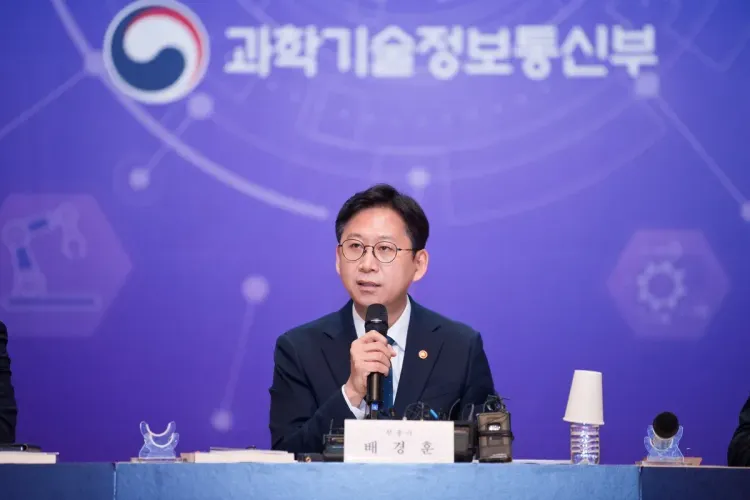
South Korea's Science Minister Bae Kyung-hoon on Friday, 31 May pledged intensified government support for the country's artificial intelligence sector, declaring that South Korea must now pursue the development of a frontier AI model capable of competing with leading systems from the United States and China. Speaking at a press conference in Seoul, Bae outlined a vision of South Korea as a 'full-stack' AI provider — covering chips, infrastructure, foundation models, and applications end to end.
Where South Korea Stands
Bae acknowledged significant progress, noting that Stanford University's AI Index ranked South Korea as the third-largest AI power in the world last year. However, he was candid about the investment shortfall, particularly in infrastructure. 'I think the government budget earmarked for AI is only close to the amount of investments from one U.S. big tech company,' he said, underscoring the scale gap between Seoul's public commitments and the firepower of Silicon Valley's largest players.
Foundation Model Race Under Way
The minister's remarks come as a government-led selection process for South Korea's homegrown AI foundation models is actively under way. Four teams — LG AI Research, SK Telecom Co., and startups Upstage and Motif Technologies Inc. — cleared the first round of evaluation. The second-round results are expected to be announced in early August, with the survivors set to receive state backing for frontier model development.
GPU Buildout and Local Chip Push
On the infrastructure front, the Science Ministry is working to expand data centre capacity, leveraging more than 260,000 GPU units secured from NVIDIA Corp. last year. Bae also highlighted a parallel push to integrate neural processing units (NPUs) — advanced chips used in AI machine learning — produced by domestic South Korean manufacturers, signalling a deliberate effort to reduce dependence on foreign semiconductor suppliers.
AI Wealth Distribution Enters Policy Debate
Bae also weighed in on one of the more contentious domestic debates: how to redistribute the windfall profits generated by the AI boom. Discussions within the South Korean government have included proposals for public redistribution of tax surpluses and corporate profits from the country's major chipmakers, with a presidential official previously drawing attention for suggesting 'citizen dividends.' Bae stopped short of endorsing that proposal, instead framing equitable AI access as the more sustainable path. 'One of the ways to address this issue is to establish a system where every person has access to and can utilise at least one AI agent ... allowing everyone to participate in economic activities through AI and ensuring equal opportunities for all,' he said. He described job displacement and wealth concentration as 'inevitable problems in the AI era' that policy must actively address.
What Comes Next
The second round of the foundation model selection process will be a key near-term milestone, with results due in early August. How Seoul bridges its infrastructure investment gap — and whether the NPU localisation push gains traction — will determine whether South Korea's full-stack ambition moves from policy rhetoric to competitive reality.
Point of View
Not a messaging one. South Korea has genuine strengths: a ranked AI index position, world-class chip manufacturing, and a competitive foundation model field. But full-stack ambition requires full-stack investment, and the current fiscal envelope does not match the stated goal. The citizen dividend debate, meanwhile, signals that the domestic political cost of the AI transition is arriving faster than the industrial dividends — a tension Seoul has not yet resolved.
NationPress
14 Oct 2026
Frequently Asked Questions
What does South Korea's 'full-stack' AI ambition mean?
It means South Korea aims to develop and control every layer of AI technology — from chips and data centre infrastructure to foundation models and end-user applications — rather than relying on foreign providers for any critical component. Minister Bae Kyung-hoon outlined this vision at a press conference on 31 May 2025.
Which companies are competing for South Korea's state-backed AI foundation model?
Four teams cleared the first round: LG AI Research, SK Telecom Co., and startups Upstage and Motif Technologies Inc. Second-round results are expected in early August, after which survivors will receive government support to develop frontier-level AI models.
How large is South Korea's AI infrastructure investment?
The government has secured more than 260,000 NVIDIA GPU units for data centre expansion and is also promoting domestically produced NPU chips. However, Minister Bae acknowledged that the entire government AI budget is roughly equivalent to the AI investment of a single US big tech company — a gap he described as a key challenge.
What is the debate over AI wealth redistribution in South Korea?
South Korean policymakers are debating how to share the economic gains from the AI and chipmaking boom, including proposals for citizen dividends funded by corporate profits and tax surpluses. Minister Bae argued instead for universal access to AI agents as a more equitable solution, framing job displacement and wealth concentration as unavoidable consequences of the AI era.
How does South Korea rank globally in AI?
Stanford University's AI Index ranked South Korea as the third-largest AI power in the world as of last year, behind the United States and China. Despite this ranking, the country's public investment in AI infrastructure lags significantly behind both leading nations.