AI to boost productivity, governance and inclusion in India: MeitY's S. Krishnan

Synopsis
At the Governance Summit 2026 in New Delhi, MeitY Secretary S. Krishnan made the case for AI as India's next big inclusion lever — from gram panchayats to digital commerce. With cognitive job displacement acknowledged as a real concern, the government's bet is that equitable AI deployment can outpace the disruption it causes.
Key Takeaways
Krishnan addressed the Governance Summit 2026: Inclusive AI for Viksit Bharat on 25 May 2026 in New Delhi .
He identified AI as a transformative tool for productivity, governance, financial inclusion, healthcare, education, and manufacturing .
The summit featured four thematic panel discussions and a parallel roundtable on AI for last-mile public service delivery down to gram panchayats .
Ashwini Chhatre of ISB called for AI to be treated as a long-term national mission with equitable access safeguards.
Participants included IIT Madras , UNICEF India , and multiple central and state government ministries.
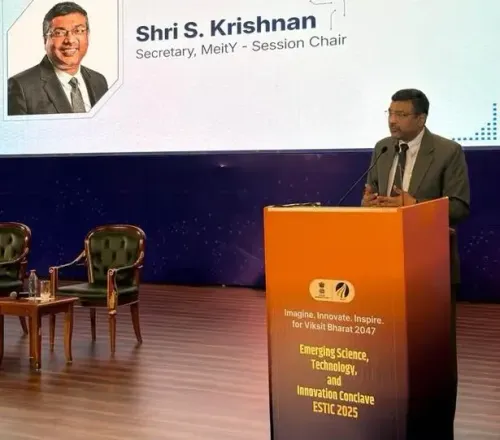
S. Krishnan, Secretary of the Ministry of Electronics and Information Technology (MeitY), on 25 May 2026 said that artificial intelligence presents India with a transformative opportunity to strengthen productivity, deepen financial inclusion, and widen access to critical sectors including healthcare, education, and manufacturing. His remarks came during the Governance Summit 2026: Inclusive AI for Viksit Bharat, held in New Delhi.
Key Developments at the Summit
The summit was jointly organised by MeitY and the Bharti Institute of Public Policy at the Indian School of Business (ISB). The day-long programme featured four thematic panel discussions covering AI's role in digital commerce, online safety for women and children, healthcare access and affordability, and job creation and digital entrepreneurship.
A parallel roundtable examined how AI can be operationalised for last-mile public service delivery, spanning state governments down to gram panchayats. The event drew participation from leading technology companies, IIT Madras, UNICEF India, and several central and state government ministries.
What the Government Said
Krishnan stressed the government's commitment to building an AI ecosystem that serves every citizen, including those at the margins of the digital economy. He acknowledged that concerns remain around AI's impact on cognitive jobs, but maintained that India is uniquely positioned to harness the technology for inclusive growth.
The MeitY secretary's remarks signal a clear policy direction: AI adoption must be broad-based, not concentrated among urban or economically privileged segments of the population.
Academic and Industry Perspective
Prof. Ashwini Chhatre, Associate Professor and Executive Director of the Bharti Institute of Public Policy at ISB, emphasised the need to translate AI ambitions into actionable governance frameworks. 'AI must be viewed as a long-term national mission shaping the future of the next generation and identifying as leapfrogging opportunities and the future of jobs as key dimensions of the emerging AI landscape,' he said.
Prof. Chhatre also stressed that access to AI opportunities must remain equitable through appropriate safeguards, social security mechanisms, and affirmative action — pointing to a gap between policy intent and implementation that policymakers must urgently close.
Broader Significance
The summit brought together senior government officials, industry leaders, academics, and civil society representatives to examine how AI can deepen inclusion, strengthen governance, and accelerate India's development agenda under the Viksit Bharat vision. This comes amid a global race to regulate and deploy AI responsibly, with India positioning itself as a voice for the Global South in shaping inclusive AI governance norms.
With the government's IndiaAI Mission already underway, the summit underscores a shift from aspirational AI rhetoric toward structured, sector-specific deployment strategies — particularly for public services that have historically struggled to reach the last mile.
Frequently Asked Questions
What was the Governance Summit 2026: Inclusive AI for Viksit Bharat?
It was a day-long summit jointly organised by MeitY and the Bharti Institute of Public Policy at ISB in New Delhi on 25 May 2026, focused on deploying AI for inclusive growth, governance, and public service delivery across India.
What did MeitY Secretary S. Krishnan say about AI in India?
Krishnan said AI offers India a transformative opportunity to boost productivity, improve governance and financial inclusion, and expand access to healthcare, education, and manufacturing. He also acknowledged concerns about AI's impact on cognitive jobs.
How does the summit connect to India's Viksit Bharat vision?
The summit examined how AI can be harnessed to deepen inclusion and accelerate India's development agenda under the Viksit Bharat framework, with a specific focus on reaching citizens at the margins of the digital economy, including through gram panchayat-level service delivery.
Who participated in the Governance Summit 2026?
The summit brought together senior government officials, industry leaders, academics, and civil society representatives, with participation from IIT Madras, UNICEF India, leading technology companies, and several central and state government ministries.
What did Prof. Ashwini Chhatre say about AI governance?
Prof. Chhatre, Executive Director of the Bharti Institute of Public Policy at ISB, called for AI to be treated as a long-term national mission and stressed that access must remain equitable through safeguards, social security mechanisms, and affirmative action.