Anurag Thakur: Congress loses every poll, turns to anarchy

Synopsis
BJP MP Anurag Thakur, posting from Chandigarh, charges that Congress loses continuously — across national, local and student-union polls, on EVMs or paper ballots alike — and that repeated defeats have pushed the party toward 'the politics of anarchy.'
Key Takeaways
BJP MP Anurag Thakur posted from Chandigarh on 3 November 2026 attacking Congress over serial electoral defeats.
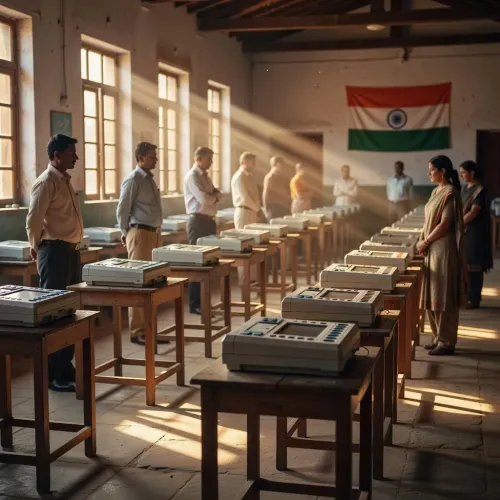
He argued Congress loses whether elections use EVMs or ballot papers , at every level — national, local, and student-union.
Thakur accused the party of resorting to 'the politics of anarchy' as a result of these losses.
Congress has periodically demanded a return to paper ballots after defeats in the 2019 and 2024 Lok Sabha elections.
The Election Commission and courts have repeatedly upheld EVM reliability across multiple electoral cycles.
No formal response from Congress leadership had been issued at the time of this report.
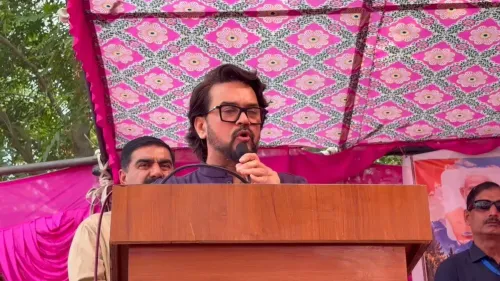
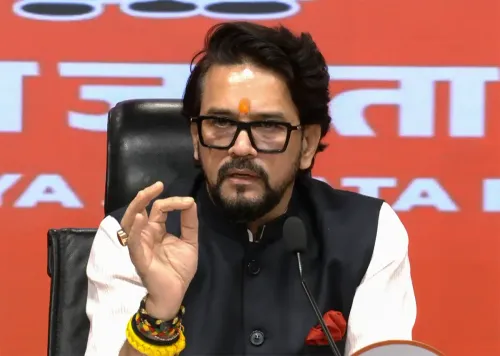
Whether the ballot is cast on an Electronic Voting Machine or a paper slip, in a national contest or a campus student-union vote — BJP MP Anurag Thakur says the result for the Indian National Congress is the same: defeat. Posting from Chandigarh on Tuesday, 3 November 2026, Thakur argued that serial losses have driven the party toward what he called 'the politics of anarchy.'
In Hindi, Thakur wrote: 'चुनाव चाहे ईवीएम से हो या बैलेट पेपर से, राष्ट्रीय हो, स्थानीय हो या छात्रसंघ के… कांग्रेस पार्टी की लगातार हार ही हो रही है, और इसी से बौखला कर ये अराजकता की राजनीति कर रही है।' In English: 'Whether elections are held on EVMs or ballot papers, national, local or student-union ones — the Congress party is continuously losing, and rattled by this, it is resorting to the politics of anarchy.'
The EVM debate Congress keeps returning to
Congress and some allied parties have periodically demanded a return to paper ballots ever since consecutive defeats in the 2019 and 2024 Lok Sabha elections. The argument — that Electronic Voting Machines are vulnerable to manipulation — has been raised on the floor of Parliament and in public campaigns stretching back to the early 2010s. The Election Commission of India and courts have consistently upheld EVMs across multiple electoral cycles, a defence the BJP has leaned on heavily in these exchanges.
Thakur's swipe is pointed precisely because it expands the scope beyond national polls. By including local body elections and student-union votes — contests where EVM tampering is a far harder case to make — he frames the EVM criticism as a convenient excuse rather than a principled position. The Chandigarh dateline, a Union Territory that doubles as joint capital of Punjab and Haryana, anchors the remark in a geography where campus and civic politics regularly produce flashpoints.
BJP's 'frustration thesis' as a political line
This is not an off-the-cuff observation — it is a well-worn BJP counter-narrative. Party spokespersons have consistently attributed opposition protests and institutional critiques to frustration over successive losses at national, state, and campus levels. Thakur, a former Union Minister who has long served as one of the party's most combative communicators, is sharpening that line for a specific moment and a specific geography.
The Congress has not yet issued a formal response to this particular remark. Whether the party chooses to rebut the 'anarchy' framing or pivot back to the EVM reliability argument will shape the next round of this recurring exchange.
In Indian politics, the loudest arguments about how votes are counted tend to erupt closest to the next time they will be cast. Watch this space.
Point of View
Designed to pre-empt any EVM controversy that might follow recent or upcoming campus and local elections in Chandigarh. By explicitly including student-union contests — where electronic machine tampering is nearly impossible to allege credibly — he stretches the argument to its logical limit, putting Congress on the defensive across every electoral tier simultaneously. The 'politics of anarchy' label is also doing specific work: it links EVM criticism to disorder and instability, framing institutional critique as a threat to democratic norms rather than a legitimate question. How Congress responds — whether it challenges the 'anarchy' charge head-on or doubles down on the EVM demand — will signal its communication strategy ahead of any upcoming electoral contests in the region.
NationPress
3 Nov 2026
Frequently Asked Questions
What did Anurag Thakur say about Congress and EVMs in Chandigarh?
BJP MP Anurag Thakur posted from Chandigarh on 3 November 2026 saying Congress loses continuously whether elections are held on EVMs or ballot papers — at national, local, or student-union level — and accused the party of resorting to 'the politics of anarchy' because of these repeated defeats.
Why does Congress demand a return to ballot papers instead of EVMs?
Congress and some allied parties have argued that Electronic Voting Machines are vulnerable to manipulation, particularly after defeats in the 2019 and 2024 Lok Sabha elections. The Election Commission and courts have consistently rejected these claims and upheld EVM reliability.
What is the BJP's standard response to Congress's EVM criticism?
BJP leaders, including Anurag Thakur, consistently argue that Congress raises EVM concerns only to explain away electoral defeats, and that the party's losses span all types of elections — not just those that could plausibly involve EVMs.
What is the significance of Chandigarh in this context?
Chandigarh is a Union Territory and the joint capital of Punjab and Haryana, where local body elections and university or college student-union elections are politically contested. Thakur's post was dateline-tagged to Chandigarh, anchoring his remarks in a specific political flashpoint.
Has Congress responded to Anurag Thakur's 'politics of anarchy' charge?
No formal response from Congress leadership to this specific remark had been issued at the time of this report.