CM Samrat Choudhary: India Defeating Poverty on Ground, Not Slogans
Synopsis
Bihar CM Samrat Choudhary amplified PM Modi's claim that India has moved from poverty slogans to ground-level results, citing the country's status as both the fastest-growing major economy and the fastest poverty reducer — a narrative anchored in the NITI Aayog's 2023 MPI data.
Key Takeaways
Bihar Chief Minister Samrat Choudhary shared a quote from Prime Minister Narendra Modi on November 3, 2026 , contrasting historical poverty slogans with present-day measurable outcomes.
The post targets the 'Garibi Hatao' slogan introduced by Prime Minister Indira Gandhi ahead of the 1971 general elections as a symbol of unfulfilled promises.
The NITI Aayog Multidimensional Poverty Index report (2023) documented a significant drop in India's poverty headcount ratio between 2013-14 and 2022-23 .
India has sustained GDP growth above 6 percent annually through much of the 2010s and 2020s, supporting its claim as the fastest-growing major economy.
The BJP narrative frames India's achievement as running both engines simultaneously: high economic growth and rapid poverty decline — a combination historically considered difficult.
The next NITI Aayog MPI update and Economic Survey poverty chapter will be key data tests for these claims.
For decades, generations of Indians grew up hearing the same promise — 'Garibi Hatao' — and watching it evaporate. Bihar Chief Minister Samrat Choudhary on Tuesday, November 3, 2026, shared a pointed quote attributed to Prime Minister Narendra Modi, drawing a sharp line between India's past of poverty slogans and what the current government frames as a present of measurable results.
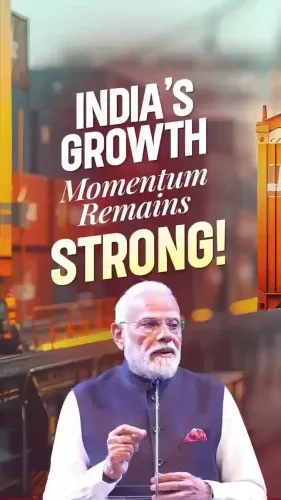
Quoting the Prime Minister, Choudhary wrote: 'Desh ki anek peedhiyaan 'Garibi Hatao' ke wadon aur daawon ke beech hi badi hui hain' — 'Many generations of this country grew up amid nothing but promises and claims of removing poverty. Earlier, the fight against poverty existed only in slogans. Today, India is defeating poverty on the ground.' The post concludes with Modi's signature framing: India is today both the fastest-growing economy and the fastest poverty reducer in the world.
From Indira Gandhi's 1971 Slogan to NITI Aayog's 2023 Numbers
The contrast being drawn is deliberate and historically loaded. 'Garibi Hatao' — 'Remove Poverty' — was introduced by Prime Minister Indira Gandhi ahead of the 1971 general elections, becoming one of the most iconic and, critics later argued, most unfulfilled political rallying cries in Indian history. It set a template: poverty as electoral currency, not governance target.
The current BJP narrative pivots sharply from that legacy. NITI Aayog's Multidimensional Poverty Index report of 2023 documented a significant reduction in India's poverty headcount ratio between 2013-14 and 2022-23, citing improvements across health, education, and living-standard indicators. The government has consistently pointed to direct benefit transfers, rural infrastructure, and welfare scheme saturation as the delivery mechanism behind those numbers.
The Twin-Engine Claim: Growth and Poverty Decline Together
The rhetorical power of Modi's framing — and by extension Choudhary's amplification — lies in its simultaneity. India has sustained GDP growth above 6 percent annually through much of the 2010s and 2020s, a record that places it among the world's fastest-expanding major economies. Conventionally, rapid growth can widen inequality even as aggregate incomes rise. The claim being staked here is that India has managed to run both engines at once: growth at the top, poverty decline at the bottom.
For Bihar — one of India's most populous and historically impoverished states — that dual claim carries particular resonance. As the state's Chief Minister, Choudhary's decision to amplify this message is also a political signal: that the BJP's development narrative is being owned at the state level, not just projected from Delhi.
What the Next Data Cycle Will Settle
The superlative claims — 'fastest' on both counts — will be tested when the next NITI Aayog Multidimensional Poverty Index update and the annual Economic Survey chapter on poverty and consumption trends are released. Those data points will either corroborate the ground-level victory being declared or complicate it. Until then, the government's case rests on the 2023 MPI report and the GDP growth trajectory.
Fifty-five years after 'Garibi Hatao' was coined, the argument has shifted from the slogan to the scorecard — and India's next poverty report will be the most-watched column on it.
Point of View
Especially in states like Bihar where poverty data is both politically sensitive and electorally potent. The 'slogans vs. results' framing is a deliberate attempt to reframe the Congress legacy on poverty as performative while positioning the Modi era as data-driven and outcome-oriented. The rhetorical risk is that the 'fastest poverty reducer' superlative remains contested in the absence of a post-2023 consumption survey update, making the claim vulnerable to opposition scrutiny. If the next NITI Aayog MPI report reinforces the trend, this narrative solidifies into a durable electoral asset; if it stalls, the very emphasis on data over slogans becomes a liability.
NationPress
3 Nov 2026
Frequently Asked Questions
What did Bihar CM Samrat Choudhary say about poverty in India?
Samrat Choudhary shared a quote from PM Narendra Modi stating that while many Indian generations grew up amid only poverty-removal promises, India today is defeating poverty on the ground and is simultaneously the world's fastest-growing economy and fastest poverty reducer.
What is 'Garibi Hatao' and who introduced it?
'Garibi Hatao' means 'Remove Poverty' and was introduced by Prime Minister Indira Gandhi ahead of the 1971 general elections as a central electoral slogan, later widely cited as a promise that went largely unfulfilled for decades.
What does the NITI Aayog Multidimensional Poverty Index say about India?
The NITI Aayog's 2023 MPI report documented a significant reduction in India's poverty headcount ratio between 2013-14 and 2022-23, measuring deprivation across health, education, and living-standard indicators.
Is India really the fastest growing major economy?
India has sustained GDP growth above 6 percent annually through much of the 2010s and 2020s, widely placing it among the fastest-expanding major economies globally, though the precise 'fastest' ranking depends on the comparison year and methodology.
Why did Bihar CM Samrat Choudhary share PM Modi's poverty quote?
Choudhary's amplification of Modi's poverty-reduction narrative is a political signal aligning Bihar's BJP leadership with the Centre's development record, particularly significant given Bihar's historical status as one of India's most impoverished states.