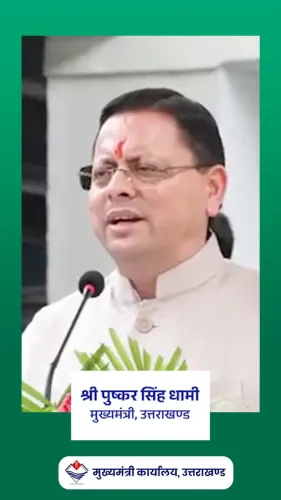
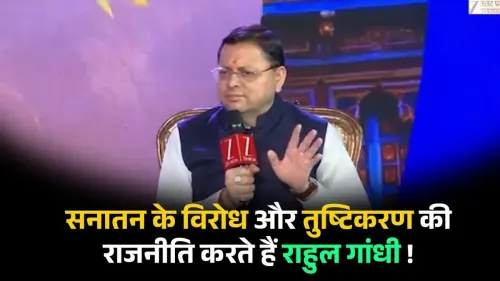
CM Dhami targets Congress over 'hatred for Sanatan'
Synopsis
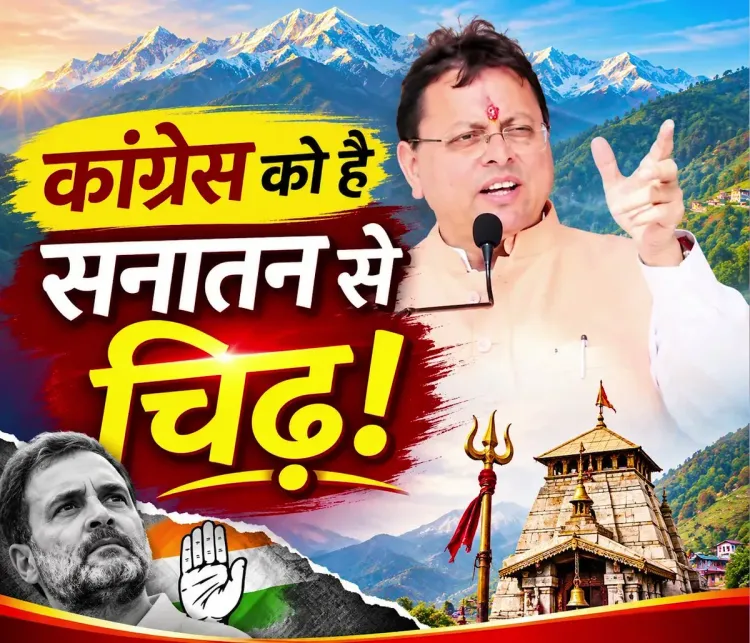
Uttarakhand CM Pushkar Singh Dhami accused the Indian National Congress of harbouring long-standing 'irritation and hatred' for Sanatan Dharma in a sharp social media post on 3 November 2026, reigniting a familiar BJP-Congress ideological battle over Hindu religious identity.
Key Takeaways
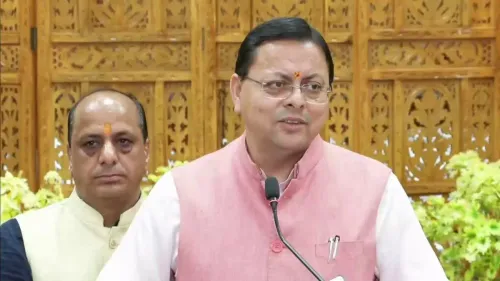
Pushkar Singh Dhami , Chief Minister of Uttarakhand and BJP leader, posted a pointed attack on Congress on 3 November 2026 .
He declared: 'Irritation and hatred for Sanatan: the old identity of Congress' — framing Congress's stance as historically anti-Hindu.
The post forms part of a well-established BJP rhetorical strategy of portraying Congress as hostile to majority Hindu sentiment.
Dhami governs a state home to major Hindu pilgrimage sites — Kedarnath, Badrinath, Haridwar, and Rishikesh — giving the Sanatan framing particular local resonance.
The specific trigger for the November 2026 post has not been independently confirmed.
No formal Congress response had been issued at the time of publication.
The ideological fault line between Hindutva politics and secular opposition is back at the centre of India's political conversation — sharpened this time by Uttarakhand Chief Minister Pushkar Singh Dhami, who on Tuesday, 3 November 2026, fired a pointed broadside at the Indian National Congress over its perceived attitude toward Hindu religious identity.
In a post on X, CM Dhami wrote: 'Sanatan se chidh aur nafrat, Congress ki purani pehchaan!' — translated as 'Irritation and hatred for Sanatan: the old identity of Congress!' The framing is blunt and deliberate, reducing what is a long, contested political argument to a single declarative verdict.
Sanatan Dharma as a political flashpoint
The term Sanatan Dharma — broadly denoting the eternal, classical tradition of Hinduism — has become one of the most charged phrases in contemporary Indian politics. BJP leaders have repeatedly invoked it to draw a stark contrast with the Congress party, accusing the opposition of being either indifferent or hostile to majority religious sentiment. Dhami's post fits squarely within that long-running rhetorical campaign.
Congress, for its part, has historically positioned itself on a secular plank, emphasising pluralism and minority rights — a stance that BJP's messaging architecture consistently reframes as antagonism toward Hindu culture. The charge of 'Sanatan se nafrat' (hatred for Sanatan) is designed to land with precisely that emotional force among the Hindu majority voter base.
Dhami's consistent cultural positioning in Uttarakhand
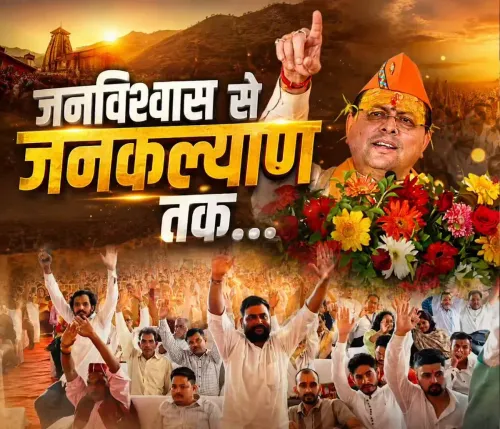
Pushkar Singh Dhami, who leads a state that is home to some of Hinduism's most sacred pilgrimage sites — including Kedarnath, Badrinath, Haridwar, and Rishikesh — has made the promotion of Hindu cultural priorities a defining pillar of his governance. His administration has pursued measures ranging from pilgrimage infrastructure upgrades to policy debates on Uniform Civil Code implementation in the state. Aligning himself visibly with the defence of Sanatan Dharma is both a religious and a political calculus in a constituency where devotional identity and electoral identity overlap substantially.
The post carries a video — the contents of which are not independently verifiable — suggesting the message is likely part of a broader campaign communication or public-address clip rather than a spontaneous remark.
A well-worn playbook, sharpened for the moment
BJP leaders routinely deploy this framing — Congress as the party that 'looks down' on Hindu tradition — as a proven voter-consolidation tool. The argument has roots in decades of ideological contestation between the Rashtriya Swayamsevak Sangh (RSS)-aligned nationalist movement and the Nehruvian secular consensus. What changes with each election cycle is not the argument itself but the specific trigger that makes it feel urgent again. The specific event or statement that prompted Dhami's 3 November 2026 post is not yet independently confirmed, but the rhetoric is clearly calibrated for effect.
Congress has yet to issue a formal response to this particular post. Given the scale of such exchanges in Indian political discourse, a counter-statement from party spokespersons is typical — and likely.
In a democracy where faith and politics are permanently intertwined, Dhami has just re-lit a fire that never fully goes out.
Point of View
Dhami implies Congress has a structural, not incidental, problem with Hindu religious sentiment, which is a far more damaging charge than accusing it of a one-off misstep. For a Chief Minister whose political capital is built on devotional Uttarakhand, doubling down on this identity-politics lever ahead of any political season is low-risk, high-reward signalling to the BJP's core voter base. Congress faces the familiar trap of either engaging on BJP's chosen terrain or staying silent — both choices carry costs.
NationPress
4 Nov 2026
Frequently Asked Questions
What did Uttarakhand CM Dhami say about Congress and Sanatan Dharma?
On 3 November 2026 , CM Dhami posted that 'irritation and hatred for Sanatan Dharma is the old identity of Congress,' accusing the party of a historically hostile stance toward Hindu religious tradition.
What is Sanatan Dharma and why is it politically significant in India?
Sanatan Dharma broadly refers to the eternal classical tradition of Hinduism. It has become a charged political term in India, with BJP leaders invoking it to frame debates over religious identity and to contrast their Hindutva politics with Congress's secular positioning.
Why does BJP repeatedly accuse Congress of being anti-Hindu?
BJP frames Congress's secularism and minority-outreach policies as evidence of bias against the Hindu majority. This narrative is a core voter-consolidation strategy that BJP leaders use consistently across election cycles.
What is Pushkar Singh Dhami's political stance on Hindu issues?
Pushkar Singh Dhami , CM of Uttarakhand, has made Hindu cultural priorities central to his governance — including pilgrimage infrastructure development and debate over a Uniform Civil Code — reflecting the devotional character of his constituency.
Has Congress responded to Dhami's Sanatan Dharma remark?
No formal Congress response had been issued at the time of publication, though BJP-Congress exchanges on religious identity typically draw rapid counter-statements from party spokespersons.