Elon Musk's Tesla Roadster briefly lifts off in flying car demo at SpaceX Texas facility
Synopsis
Elon Musk's Tesla Roadster briefly left the ground at a SpaceX facility in Texas, powered by a thruster system built into the electric sports car's platform. With a 0-to-60 time of under one second, a 300-mile range, and a top speed above 230 mph, the Roadster is making extreme claims — but Tesla has yet to give a commercial timeline for the flying feature, and regulatory hurdles loom large.
Key Takeaways
Tesla CEO Elon Musk unveiled a new Roadster prototype on 16 October 2026 at a SpaceX facility in Texas .
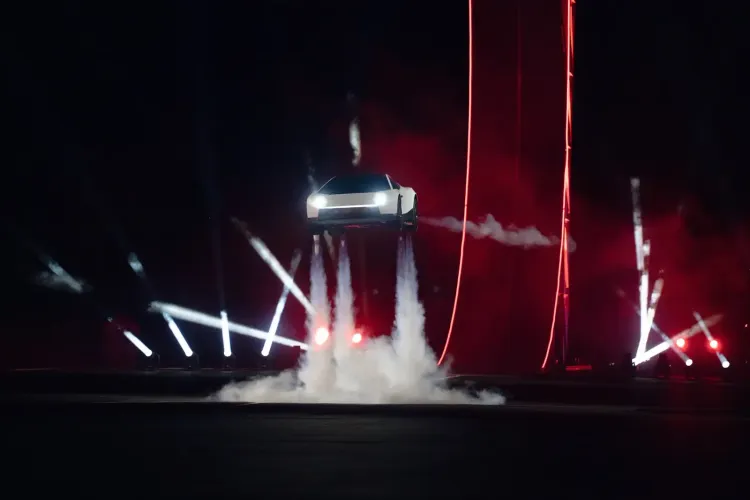
The prototype briefly became airborne using a system combining high-pressure air tanks and thruster technology with its EV platform.
The vehicle reportedly accelerated from 0 to 60 mph in under one second in a separate performance run.
Tesla claims a driving range of approximately 300 miles and a top speed exceeding 230 mph .
No commercial deployment timeline was provided; road and airspace legality will depend on local regulations, according to Musk .
The Roadster project was first announced nearly a decade ago and has faced multiple delays.
Tesla CEO Elon Musk on Friday, 16 October 2026, unveiled a new iteration of the Tesla Roadster sports car at a SpaceX facility in Texas, where a prototype briefly became airborne during a live demonstration — drawing widespread comparisons to a flying car. The event marks the most dramatic public showcase yet for a project first announced nearly a decade ago.
What Happened at the Demonstration
The prototype navigated an elevated curved track before lifting off the ground for a short distance, landing safely thereafter. Musk shared footage of the event on X, and Tesla subsequently released additional videos of the demonstration on social media. Executives present at the event described the test as evidence that flying-car technology is edging closer to practical reality.
The Propulsion System Behind the Lift
According to Tesla, the showcase featured a specialised propulsion system that integrates the electric vehicle platform with high-pressure air tanks and thruster technology. The system is reportedly designed to generate lift and refine vehicle dynamics through strategically positioned thrusters that help govern movement while the vehicle is off the ground. The combination of an EV drivetrain with pneumatic thruster architecture represents a significant engineering departure from conventional automotive design.
Performance Figures Unveiled
Beyond the airborne demonstration, the event included a separate performance run in which the Roadster accelerated from 0 to 60 miles per hour in under one second — a figure that would place it among the quickest production-oriented vehicles ever demonstrated publicly. Tesla also stated the vehicle is expected to deliver a driving range of approximately 300 miles and a top speed exceeding 230 miles per hour.
Commercial Timeline and Regulatory Hurdles
Despite the enthusiasm surrounding the demonstration, Tesla did not provide a timeline for the commercial deployment of the airborne capability. Musk acknowledged that road — and airspace — legality for such a vehicle would depend on local regulations, suggesting that regulatory clearance could be a significant barrier before any consumer version reaches the market. The company has consistently positioned the Roadster as its flagship performance model, intended to showcase the outer limits of electric-vehicle engineering. Notably, the project was first announced nearly a decade ago and has seen multiple delays, making the latest demonstration both a milestone and a reminder of the long road to production.
Industry Context and What Comes Next
This comes amid a broader global race in the advanced air mobility sector, with companies including Joby Aviation, Archer, and several Chinese manufacturers pursuing electric vertical take-off and landing (eVTOL) vehicles. Tesla's approach — adapting a ground-based sports car with thruster technology rather than building a dedicated aircraft — is a distinct strategic bet. Critics and industry observers will be watching closely for concrete production timelines, safety certification pathways, and whether the airborne feature will be offered on the standard consumer version or remain a limited-edition capability.
Point of View
But the absence of a commercial timeline is the real headline. Tesla has been promising a next-generation Roadster for nearly a decade, and every demonstration so far has been followed by silence on delivery dates. The thruster-based lift system is genuinely novel, but it sits in a regulatory no-man's land — neither a certified aircraft nor a road-legal vehicle with airborne capability. Until Tesla tables a certification roadmap with the FAA and local transport authorities, the 'flying car' framing is more marketing theatre than product announcement. The 0-to-60 and top-speed claims deserve similar scrutiny: prototype demonstrations under controlled conditions rarely translate cleanly to production specifications.
NationPress
16 Oct 2026
Frequently Asked Questions
What did Elon Musk unveil at the SpaceX Texas facility?
Elon Musk unveiled a new prototype of the Tesla Roadster that briefly lifted off the ground during a demonstration, using a propulsion system combining high-pressure air tanks and thruster technology. The event also featured a performance run in which the vehicle accelerated from 0 to 60 mph in under one second.
How does the Tesla Roadster's flying system work?
According to Tesla, the system integrates the electric vehicle platform with high-pressure air tanks and strategically placed thrusters that generate lift and help control movement while the vehicle is airborne. It is not a traditional winged aircraft design but rather a ground vehicle augmented with pneumatic thruster architecture.
When will the flying Tesla Roadster be available to buy?
Tesla has not provided a commercial deployment timeline for the airborne capability. Elon Musk acknowledged that road and airspace legality would depend on local regulations, suggesting significant regulatory hurdles remain before any consumer version could reach the market.
What are the performance specifications of the new Roadster?
Tesla claims the Roadster can accelerate from 0 to 60 mph in under one second, offers a driving range of approximately 300 miles, and has a top speed exceeding 230 mph. These figures are based on prototype demonstrations and have not been independently verified.
How does this compare to other flying car projects?
Unlike dedicated electric vertical take-off and landing (eVTOL) companies such as Joby Aviation and Archer, Tesla is adapting a ground-based sports car with thruster technology rather than building a purpose-built aircraft. The regulatory pathway for such a hybrid vehicle is less established than for dedicated eVTOL platforms currently seeking FAA certification.