Is Pakistan’s Short-Term Stabilization Leading to a Failing State?

Synopsis
A recent report highlights the troubling trend of declining real incomes in Pakistan, suggesting that while macroeconomic indicators may show improvement, the reality points towards a failing state. The contrast between nominal income growth and rising inflation underscores a critical economic dilemma.
Key Takeaways
Real incomes are falling in Pakistan despite some macroeconomic stabilization.
Income inequality is increasing, particularly in urban areas.
Inflation has significantly eroded purchasing power for households.
A shift to supply-side economics may be necessary for sustainable growth.
The education system needs urgent reforms to improve productivity.
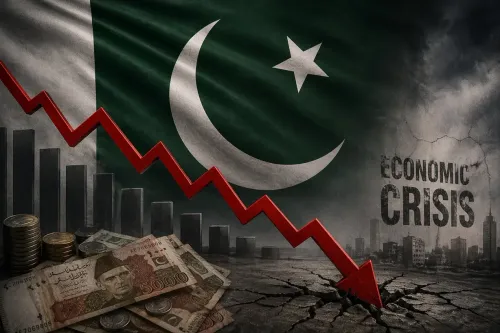
New Delhi, Jan 14 (NationPress) The absence of sustained economic growth has caused real incomes to decline, resulting in a 'failing Pakistan' despite indications of macroeconomic stabilization and reforms, according to a report released on Wednesday.
The Express Tribune highlighted findings from the Household Integrated Economic Survey (HIES), which reveal that while headline economic indicators may appear improved, the accompanying social metrics tell a different story.
Real GDP growth has averaged merely 2.47 percent in recent years, aligning closely with the population growth rate of approximately 2.55 percent. This stagnation means that per-capita output has essentially remained unchanged, the report indicates.
Growth rates fluctuated from a contraction in 2019-20 to a high of 5.97 percent in 2021-22, before tapering off into the mid-single digits in more recent years.
Although nominal household incomes have nearly doubled since 2018, the highest inflation rates witnessed in the past 50 years have significantly diminished purchasing power for most families.
Income inequality is particularly stark in urban areas, where affluent households earn above Rs 1,46,920, while the poorest earn less than Rs 42,412. Since 2018-19, the income of the top quintile has surged by 119.25 percent, compared to only 80.45 percent for the lowest quintile, demonstrating faster gains for wealthier households.
Over the last decade, Pakistan adopted a demand-side strategy by utilizing Chinese investment as a so-called 'game changer', but this approach has not yielded the desired results, the report states.
In contrast, supply-side economics posits that sustainable economic growth hinges on lowering tax rates, simplifying business operations, cutting government expenditure, maintaining sound monetary policy, promoting free trade, and embracing privatization.
To foster productivity and wealth creation, Pakistan must establish a coherent supply-side economic policy; failing to do so risks repeating cycles of short-term stabilization.
Another recent report indicates that Pakistan's economic underperformance is partly attributed to its educational and skills systems, which struggle to translate human potential into productivity.
Insufficient public investment in education, outdated curricula, inadequate teacher training, limited vocational opportunities, and poor research funding have resulted in persistent skill shortages and elevated youth unemployment, the report notes.
Point of View
It's crucial to bring attention to the economic challenges facing Pakistan. This report serves as a wake-up call, emphasizing the need for sustainable growth strategies that prioritize equitable wealth distribution and robust educational reforms. The nation must address these systemic issues to avoid falling into a cycle of temporary fixes.
NationPress
8 Oct 2026
Frequently Asked Questions
What does the report say about Pakistan's economic growth?
The report states that Pakistan's real GDP growth has averaged only 2.47% in recent years, which is barely in line with the population growth rate of 2.55%, leading to stagnation in per-capita output.
How has inflation affected household incomes in Pakistan?
Despite nominal household incomes nearly doubling since 2018, the highest inflation in 50 years has severely reduced purchasing power for many families.
What is the main issue regarding income inequality in urban areas?
In urban areas, income inequality is stark, with the richest households earning significantly more than the poorest, highlighting a growing divide.
What approach has Pakistan taken towards its economic policy?
Pakistan has previously adopted a demand-side approach but has seen limited success. The report suggests a shift towards supply-side economics for sustainable growth.
What challenges does Pakistan face in its education system?
The education system suffers from low public spending, outdated curricula, inadequate teacher training, and limited vocational pathways, contributing to high youth unemployment.