India's ₹69,725 crore shipbuilding package: Maritime financing and capacity push

Synopsis
India has committed ₹69,725 crore to overhaul its shipbuilding industry — covering cost subsidies, a ₹25,000 crore maritime fund, and greenfield clusters in three states. With infrastructure status now accorded to large Indian-flagged vessels and a 400-vessel order pipeline in place, this is the most structurally ambitious maritime push India has attempted, timed to capitalise on global supply-chain shifts away from dominant shipbuilding nations.
Key Takeaways
The government approved a ₹69,725 crore package to revamp India's shipbuilding industry, announced in Lok Sabha on 25 July .
A Shipbuilding Financial Assistance Scheme worth ₹24,736 crore will address cost disadvantages of Indian shipyards versus global competitors.
A Maritime Development Fund of ₹25,000 crore — split into a ₹20,000 crore investment fund and a ₹5,000 crore interest incentivisation fund — will provide long-term sector financing.
The Shipbuilding Development Scheme (SbDS) of ₹19,989 crore targets annual output of 4.5 million gross tonnage via greenfield and brownfield expansion.
In-principle approval granted for three greenfield clusters in Andhra Pradesh , Gujarat , and Tamil Nadu .
Infrastructure status notified for Indian-flagged vessels of 10,000 GT and above from 19 September 2025 ; extended to 1,500 GT and above if built in India.
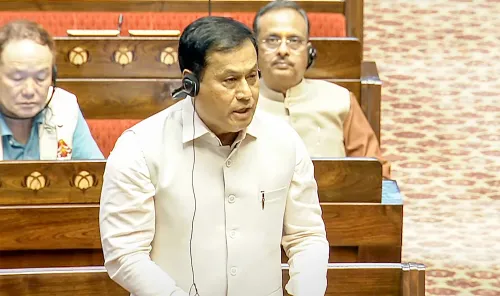
The Indian government has approved a ₹69,725 crore comprehensive package to revamp domestic shipbuilding capacity, maritime financing, and workforce skilling, Union Minister of Ports, Shipping and Waterways Sarbananda Sonowal informed the Lok Sabha on 25 July. The multi-pronged initiative targets cost competitiveness, long-term financing, and output expansion as India seeks to position itself as a credible force in global shipbuilding.
Key Components of the Package
The package rests on three major pillars. First, a Shipbuilding Financial Assistance Scheme with an outlay of ₹24,736 crore is designed to offset the cost disadvantages Indian shipyards face against established global competitors. Second, a Maritime Development Fund with a corpus of ₹25,000 crore will provide long-term financing to the shipbuilding and broader maritime sector — comprising a Maritime Investment Fund of ₹20,000 crore and an Interest Incentivisation Fund of ₹5,000 crore. Third, a Shipbuilding Development Scheme (SbDS) worth ₹19,989 crore aims to expand India's annual output capacity to 4.5 million gross tonnage through a combination of greenfield clusters and brownfield expansion.
Greenfield Clusters and Demand Aggregation
The government has granted in-principle approval for three greenfield shipbuilding clusters in Andhra Pradesh, Gujarat, and Tamil Nadu under the SbDS. Alongside this, a fleet acquisition plan covering more than 400 vessels has been prepared to provide long-term order visibility to Indian shipyards — a demand-side lever that complements the supply-side capacity push.
Policy Reforms and Infrastructure Status
Beyond direct financial support, the government has undertaken structural policy reforms. Infrastructure status was formally notified for Indian-flagged commercial vessels of 10,000 Gross Tonnage (GT) and above on 19 September 2025, and extended to vessels of 1,500 GT and above when constructed in India. This classification unlocks access to priority financing channels and lower borrowing costs — a significant structural change for an industry historically starved of affordable capital.
Strategic Vision: Maritime India 2030 and 2047
According to the Ministry of Ports, Shipping and Waterways, 'These targets have been set to position India as a competitive global shipbuilding force in line with the vision contained in Maritime India Vision 2030 and Maritime Amrit Kaal Vision 2047 documents.' The dual-horizon framework signals that the current package is intended as the foundation of a generational industrial shift, not a one-cycle intervention. This comes amid growing global interest in supply-chain diversification away from dominant shipbuilding nations, presenting India with a structural window of opportunity.
What Comes Next
With greenfield cluster approvals in place and the fleet acquisition pipeline defined, the near-term focus shifts to implementation — disbursement timelines, yard-level capacity audits, and skilling outcomes. The success of the scheme will ultimately be measured against India's current marginal share of global shipbuilding output, which remains well below its stated ambitions.
Point of View
725 crore package is the first time financial architecture has been built to match the rhetoric. The critical question is execution: past industrial schemes have struggled with disbursement delays and capacity targets that existed on paper longer than in practice. The infrastructure-status notification for large vessels is the most consequential structural reform here, because it changes the financing calculus for private yards in ways that direct subsidies alone cannot. Whether the three greenfield clusters in Andhra Pradesh, Gujarat, and Tamil Nadu translate into operational capacity — or remain approvals on file — will determine if this is a turning point or another ambitious blueprint.
NationPress
25 Jul 2026
Frequently Asked Questions
What is the ₹69,725 crore India shipbuilding package?
It is a comprehensive government package approved to strengthen domestic shipbuilding capacity, maritime financing, and skilling. The package includes three major schemes — a financial assistance scheme, a maritime development fund, and a shipbuilding development scheme — totalling ₹69,725 crore.
What is the Maritime Development Fund and how large is it?
The Maritime Development Fund has a corpus of ₹25,000 crore, comprising a ₹20,000 crore Maritime Investment Fund for long-term financing and a ₹5,000 crore Interest Incentivisation Fund. It is designed to provide affordable, long-term capital to the shipbuilding and broader maritime sector.
Which states will get the new greenfield shipbuilding clusters?
The government has granted in-principle approval for three greenfield shipbuilding clusters in Andhra Pradesh, Gujarat, and Tamil Nadu under the Shipbuilding Development Scheme (SbDS). These clusters are intended to expand India's annual shipbuilding output to 4.5 million gross tonnage.
What does infrastructure status for vessels mean for the shipbuilding industry?
Infrastructure status, notified for Indian-flagged commercial vessels of 10,000 GT and above from 19 September 2025, allows the maritime sector to access priority financing at lower borrowing costs — a structural advantage that has historically been unavailable to Indian shipyards. Vessels of 1,500 GT and above also qualify if constructed in India.
How does the 400-vessel fleet acquisition plan support Indian shipyards?
The fleet acquisition plan covering more than 400 vessels provides long-term order visibility to domestic shipyards, reducing demand uncertainty that has historically deterred capacity investment. It functions as a demand-aggregation mechanism to complement the supply-side financial incentives in the package.