Is the Sliding Rupee a Sign of Weakness? SBI Research Weighs In

Synopsis
The rupee's recent dip beyond the 90 mark against the US dollar has raised eyebrows, but SBI Research clarifies that this trend does not reflect economic weakness. Instead, key factors such as global uncertainty and trade negotiations are at play. Read on to uncover the insights behind this financial movement.
Key Takeaways
Rupee crosses 90 against the US dollar.
Decline not indicative of economic weakness.
Influencing factors include global uncertainties and trade delays.
Concerns over trade deficit are overstated.
Significant US tariffs impact Indian exports.
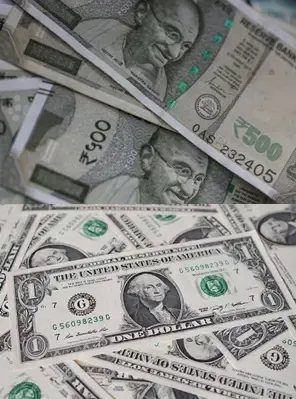
New Delhi, Dec 4 (NationPress) The Indian rupee has crossed the critical threshold of 90 against the US dollar; however, this decline is not indicative of weakness, according to a recent report released on Thursday.
The findings from SBI Research suggest that the recent fall is primarily influenced by global uncertainties, delays in the US-India trade negotiations, and capital outflows from foreign portfolios, rather than any weakening of India's economic fundamentals.
The report identifies three main factors contributing to the rupee's recent decline: uncertainty surrounding the India-US trade agreement, foreign capital withdrawals following two years of robust inflows, and the Reserve Bank of India's deliberate decision to minimize excessive intervention in the currency market.
Moreover, the offshore non-deliverable forward (NDF) market is witnessing increased activity, while the US dollar index appears to be strengthening.
Contrary to popular belief, concerns related to a widening trade deficit are not entirely accurate, according to the report.
From April to October, India's goods and services deficit was recorded at $78 billion, only marginally higher than the $70 billion seen in the same timeframe last year.
Analysts argue that negative perceptions regarding trade statistics have been overstated.
Since April 2, when the US imposed significant tariff increases on several countries, the Indian rupee has depreciated about 5.5% against the dollar — a steeper decline than most major global currencies.
The 50% tariff rate levied on India surpasses the tariffs imposed on China, Vietnam, Indonesia, and Japan.
The report indicates that this is a significant factor contributing to the current downward pressure on the rupee, despite India’s ongoing efforts to diversify its exports and establish new free-trade agreements.
Approximately $45 billion worth of Indian exports, primarily in labor-intensive sectors, are anticipated to be directly affected by the US tariffs, the report concludes.
Point of View
The current fluctuation of the rupee is a reflection of broader global economic factors rather than a direct indicator of India's economic health. The nation's ongoing efforts to diversify trade relationships and strengthen its economic foundations are crucial in navigating these challenges. It is essential to maintain a balanced viewpoint and to avoid panic in the face of market fluctuations.
NationPress
3 Oct 2026
Frequently Asked Questions
What caused the rupee to drop past 90?
The decline is attributed mainly to global uncertainties, delays in trade agreements, and foreign portfolio outflows.
Is this decline a sign of economic weakness?
No, SBI Research indicates that the drop does not reflect a deterioration in India's economic fundamentals.
What impact do US tariffs have on Indian exports?
About $45 billion worth of Indian exports, mainly labor-intensive goods, are expected to be affected by the US tariffs.