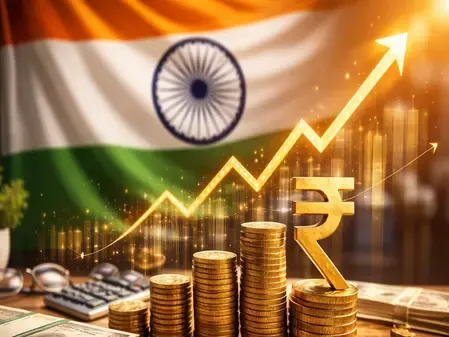
Rupee may hit 100 per dollar by June 2027 as AI capex slowdown redirects FPI flows

Synopsis
Axis Bank Research is forecasting the rupee at 100 to the dollar by June 2027 — not a panic call, but a structural argument: low forex reserve adequacy, $200 billion in short RBI positions, and global savings under pressure from geopolitical debt. The one counterweight is a potential AI capex slowdown that could flip FPI flows back toward India.
Key Takeaways
Axis Bank Research projects the Indian rupee at 100 per US dollar by June 2027 , citing structural fundamentals over near-term stability.
A slowdown in global AI capital expenditure could reverse FPI outflows and redirect savings toward India, potentially narrowing the financeable CAD to 0.8% of GDP .
India's forex reserve adequacy is flagged as low on both traditional measures and the IMF's ARA metric , with the RBI holding approximately $200 billion in short FX positions maturing beyond one year.
Around $150 billion of those maturities fall in the three-to-five-year bucket, posing a medium-term external liability risk.
A separate report projects India's GDP growth at 7.8% in Q2 FY27 , supported by domestic demand, corporate earnings, and credit growth.
The Indian rupee could depreciate to 100 against the US dollar by June 2027, according to a report by Axis Bank Research released on Wednesday, 11 November 2026. The forecast comes despite recent currency stability, with the report arguing that underlying structural pressures will ultimately outweigh near-term momentum.
AI Capex Slowdown and FPI Reversal
The Axis Bank Research report highlighted that a slowdown in the global artificial intelligence (AI) capital expenditure cycle could trigger a reversal of recent foreign portfolio investor (FPI) outflows, potentially redirecting global financial savings toward Indian assets. Such a shift, the report noted, could bring India's financeable current account deficit (CAD) back to 0.8 per cent of GDP — a level considered manageable by analysts tracking emerging market flows.
Forex Reserve Adequacy and External Liabilities
The report flagged that India's foreign exchange reserve adequacy remains low across both traditional measures and the International Monetary Fund's (IMF) Assessing Reserve Adequacy (ARA) metric, underscoring the need to rebuild buffers. Notably, the Reserve Bank of India (RBI) reportedly holds significant short foreign exchange positions, with approximately $200 billion in maturities exceeding one year — including around $150 billion in the three-to-five-year maturity bucket. These sizeable external liabilities were cited as a key vulnerability in the currency outlook.
Structural Pressures Beyond Crude Oil
The report challenged a widely held view that lower crude oil prices alone could stabilise the rupee. It pointed out that the currency began losing value even when the current account deficit was relatively low, suggesting the depreciation is driven by deeper structural forces rather than the trade balance alone. 'Continued squeezing of global savings owing to fading of the peace dividend also limits availability of savings to chase India assets,' the report stated. Rising government debt globally amid geopolitical conflicts was also flagged as a factor that could limit the pool of capital available for Indian assets.
India's Growth Outlook Remains Resilient
Separately, another report projected that India's economy is likely to sustain strong growth momentum in Q2 FY27, with gross domestic product (GDP) expected to expand by approximately 7.8 per cent. The forecast was supported by resilient domestic demand, robust corporate performance, and strong credit growth — factors that analysts say could attract longer-term capital even as near-term currency headwinds persist.
What to Watch Next
The trajectory of the rupee will hinge on several variables: the pace at which global AI investment normalises, the direction of FPI flows in the coming quarters, RBI's ability to rebuild forex reserves, and whether crude oil prices provide any cushion. With the June 2027 timeline less than eight months away, currency markets and policymakers will be watching each of these indicators closely.
Point of View
And the reasoning is structural rather than speculative. The more revealing detail is the RBI's $200 billion short FX position: that is a large contingent liability that constrains the central bank's ability to defend the currency aggressively if outflows accelerate. The AI capex pivot is an interesting wild card, but redirecting FPI flows back to India assumes global risk appetite recovers cleanly — a fragile assumption in a world of rising sovereign debt and unresolved geopolitical conflicts. India's 7.8% growth story is real, but growth alone has not historically been sufficient to anchor a currency facing structural CAD and low reserve adequacy simultaneously.
NationPress
11 Nov 2026
Frequently Asked Questions
Why could the Indian rupee reach 100 per US dollar by June 2027?
Axis Bank Research projects the rupee at 100 to the dollar by June 2027 due to structural pressures including low forex reserve adequacy, significant RBI short FX positions of around $200 billion, and declining global savings that limit capital available for Indian assets. The report argues these fundamentals will outweigh recent near-term currency stability.
How could a slowdown in AI capital expenditure affect India's currency?
A deceleration in the global AI investment cycle could reduce returns in markets that have attracted heavy capital, potentially triggering a reversal of FPI outflows and redirecting global financial savings toward India. This, according to the Axis Bank Research report, could help narrow India's financeable current account deficit to 0.8% of GDP.
What is India's forex reserve adequacy concern?
The report notes that India's foreign exchange reserves are inadequate by both traditional benchmarks and the IMF's Assessing Reserve Adequacy metric, signalling the need to rebuild buffers. The RBI also reportedly holds approximately $200 billion in short foreign exchange positions maturing beyond one year, including $150 billion in the three-to-five-year bucket.
Will lower crude oil prices save the rupee?
Not necessarily, according to the report. The rupee began depreciating even when the current account deficit was low, suggesting the pressure is structural rather than purely oil-driven. A decline in crude prices alone may not meaningfully alter the currency's outlook, the report cautioned.
What is India's GDP growth forecast for Q2 FY27?
A separate report projects India's GDP growth at approximately 7.8% in Q2 FY27, supported by resilient domestic demand, strong corporate performance, and healthy credit growth, even amid broader global uncertainties.