SBI hands ₹8,813 crore dividend cheque to Centre for FY26

Synopsis
India's largest bank handed the Centre a ₹8,813 crore dividend cheque for FY2025-26 — a figure that signals SBI's sharpest profitability recovery in years and gives the government meaningful non-tax revenue headroom. SBI Chairman C.S. Setty paired the handover with a pointed message: stop watching the Sensex and bet on India's long-term structural story.
Key Takeaways
SBI presented a dividend cheque of ₹8,813 crore to the Central government for FY 2025-26 on 8 June .
Setty handed the cheque to Finance Minister Nirmala Sitharaman in New Delhi .
The payout reflects SBI's strong financial performance and contributes to the government's non-tax revenue receipts .
Setty backed a rate pause by the RBI's MPC, saying it would 'stabilise conditions and ensure smooth growth.' He also urged investors to look beyond the Sensex and focus on India's long-term structural transformation.
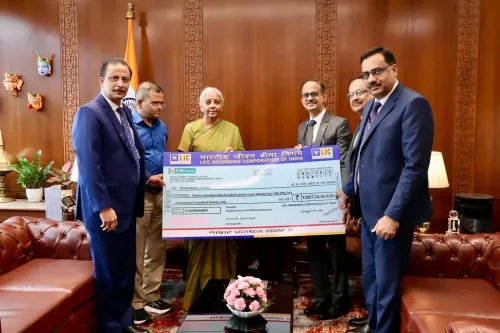
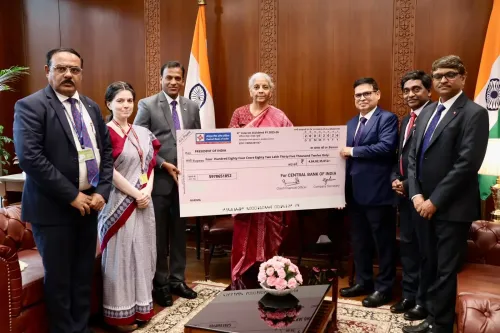
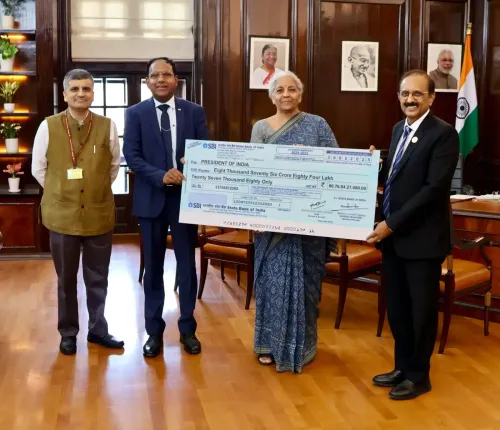
State Bank of India (SBI), the country's largest public sector lender, on Monday, 8 June presented a dividend cheque of ₹8,813 crore to the Central government for the financial year 2025-26. The cheque was handed over by SBI Chairman C.S. Setty to Union Finance Minister Nirmala Sitharaman in New Delhi, adding a substantial sum to the government's non-tax revenue receipts for the year.
The Handover
The Finance Minister's Office confirmed the development on social media platform X, noting that FM Sitharaman received the dividend cheque directly from SBI Chairman C.S. Setty. The post quoted: 'Finance Minister Nirmala Sitharaman receives a dividend cheque of Rs 8,813 crore for FY 2025-26 from C S Setty, Chairman of State Bank of India.'
The payout is a direct reflection of SBI's strong financial performance over the past fiscal year, reinforcing the bank's role as a consistent and significant contributor to the government's revenue base.
What the Dividend Signals
For the Centre, dividend receipts from public sector undertakings (PSUs) and state-owned banks form a critical pillar of non-tax revenue. SBI's contribution at ₹8,813 crore underscores the bank's robust profitability cycle, which has been driven by improved asset quality, rising net interest margins, and expanding digital operations in recent years.
This comes amid a broader trend of public sector banks returning to financial health after years of elevated non-performing assets (NPAs). Notably, SBI's dividend payout to the government has grown steadily, reflecting the institution's deepening earnings base.
Setty on Rates and India's Growth Story
Speaking at an industry event in Mumbai earlier this month, SBI Chairman Setty weighed in on the monetary policy outlook, saying that a rate pause by the Reserve Bank of India's (RBI) Monetary Policy Committee (MPC) would help stabilise economic conditions. 'Broadly, the market expects that there could be a rate pause at this juncture. Inflation dynamics remain important, but I think a pause would definitely help stabilise conditions and ensure smooth growth,' he said.
Setty also urged investors to adopt a long-term view of India's economic trajectory, cautioning against an over-reliance on short-term equity market movements. 'Do not look only at the Sensex… look at India as a long-term story,' he said, pointing to structural reforms in banking, digital infrastructure, financial inclusion, and physical infrastructure as the real drivers of value.
SBI's Broader Role in India's Economy
SBI continues to occupy a central position in India's banking and digital payments ecosystem. Under Setty's leadership, the bank has consistently highlighted the country's strong macroeconomic fundamentals even as global uncertainties — from geopolitical tensions to volatile commodity prices — have clouded the external environment.
With the government's fiscal consolidation agenda in focus, regular and growing dividend flows from state-owned enterprises like SBI provide the Centre with greater headroom to manage its expenditure commitments without widening the deficit.
What Comes Next
Markets and analysts will watch SBI's quarterly earnings closely to gauge whether the profitability momentum that enabled this payout is sustainable through FY27. The RBI's next MPC decision, which Setty has flagged as pivotal, will also shape the bank's net interest income outlook in the months ahead.
Point of View
813 crore dividend from a single state-owned bank is not just a fiscal footnote — it is evidence of how dramatically PSB balance sheets have turned around from the NPA crisis of the previous decade. The more telling signal, however, is Setty's dual message: a quiet lobby for a rate pause at the RBI and a public call to reframe India as a structural, not cyclical, investment. For a chairman of the country's largest lender to steer the narrative away from near-term market volatility suggests SBI itself is positioning for a longer credit cycle — and wants policy conditions that support it.
NationPress
24 Sept 2026
Frequently Asked Questions
How much dividend did SBI pay to the government for FY26?
SBI paid a dividend of ₹8,813 crore to the Central government for the financial year 2025-26. The cheque was presented by SBI Chairman C.S. Setty to Finance Minister Nirmala Sitharaman on 8 June.
Why does SBI pay a dividend to the Central government?
The Central government is the majority shareholder in SBI, making it entitled to a share of the bank's profits in the form of dividends. These receipts form part of the government's non-tax revenue and help manage its fiscal position.
What did SBI Chairman C.S. Setty say about RBI interest rates?
Setty said at an industry event in Mumbai that a rate pause by the RBI's Monetary Policy Committee would help stabilise economic conditions and support smooth growth. He noted that while inflation dynamics remain important, the market broadly expects a pause at this juncture.
What is SBI's view on India's economic outlook?
SBI Chairman Setty urged investors not to focus solely on short-term stock market movements, advising them to 'look at India as a long-term story.' He pointed to reforms in banking, digital infrastructure, financial inclusion, and physical infrastructure as structural growth drivers.
How does SBI's dividend contribute to the Centre's finances?
Dividends from public sector banks and enterprises are a key source of non-tax revenue for the Central government. SBI's ₹8,813 crore payout for FY26 provides the Centre with additional fiscal headroom to fund expenditure without widening the deficit.