Sitharaman Receives ₹484 Cr Dividend from Central Bank of India
Synopsis
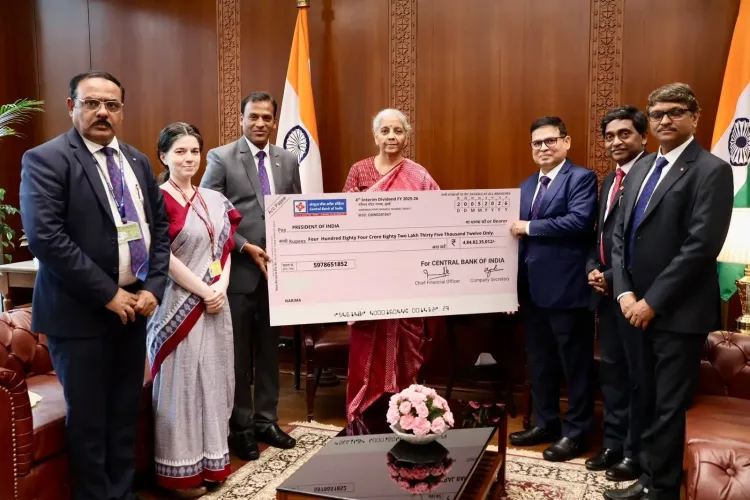
Union Finance Minister Nirmala Sitharaman on 29 May 2026 received a ₹484 crore dividend cheque for FY 2025-26 from Central Bank of India MD and CEO Kalyan Kumar, adding to the government's non-tax revenue as PSU bank dividend season gets under way.
Key Takeaways
₹484 crore dividend cheque for FY 2025-26 handed over to Finance Minister Nirmala Sitharaman by Central Bank of India .
Kalyan Kumar , MD and CEO of Central Bank of India , presented the cheque on 29 May 2026 .
PSU bank dividends are a key non-tax revenue stream for the Union government , helping contain the fiscal deficit.
RBI's 2021 dividend distribution guidelines require banks to meet capital and NPA thresholds before paying dividends.
Dividend payments from other major PSU banks such as SBI and Bank of Baroda are expected in the same quarter.
The aggregate dividend inflow will be measured against FY 2026-27 budget estimates for non-tax revenue.
Union Finance Minister Nirmala Sitharaman on Friday, 29 May 2026 received a dividend cheque of ₹484 crore for FY 2025-26 from Kalyan Kumar, Managing Director and Chief Executive Officer of Central Bank of India, marking another scheduled transfer of public sector bank earnings to the central government.
Context
Central Bank of India, one of the twelve government-owned banks that remained after the consolidation round completed in 2020, has the central government as its majority shareholder. Dividend payments from such banks flow directly into the Union government's non-tax revenue, providing a predictable fiscal cushion alongside tax receipts. The cheque handed over by Kalyan Kumar represents the bank's profit distribution to its principal shareholder for the financial year ending March 2026.
Dividend season for public sector banks typically runs from May to August each year, following the finalisation of annual results and formal board approvals. The Finance Minister or her office customarily receives these cheques in a brief ceremonial handover, which is then communicated publicly.
Policy Backdrop
The Reserve Bank of India's 2021 dividend distribution guidelines set out clear thresholds — including minimum capital adequacy ratios and non-performing asset levels — that banks must satisfy before paying dividends. These norms were designed to ensure that only financially sound institutions return profits to shareholders, including the government, rather than drawing down capital buffers.
The broader context is one of recovery. After the 2015–2018 asset quality review exposed large hidden bad loans across state-owned banks, the government undertook a multi-year recapitalisation exercise. That exercise has since borne fruit: most public sector banks have returned to profitability, and dividend inflows to the Centre have grown into a reliable non-tax revenue line, helping manage the fiscal deficit without additional market borrowing.
Stakeholders and Impact
For the Union government, dividends from public sector undertakings and banks form a significant component of non-tax revenue budgeted each fiscal year. Every cheque received — whether from banks, insurance companies, or other central public sector enterprises — reduces the gap between expenditure and receipts, easing pressure on borrowing targets.
For Central Bank of India itself, the ability to pay a ₹484 crore dividend signals a sufficiently healthy balance sheet, meeting the RBI's prescribed thresholds on capital and asset quality. It also reinforces depositor and investor confidence in the institution's financial standing after years of restructuring.
What's Next
Attention will now turn to dividend cheques expected from other major public sector banks — including State Bank of India and Bank of Baroda — in the same quarter. The aggregate of these payments will determine how closely actual non-tax revenue tracks the estimates built into the FY 2026-27 Union Budget. A strong dividend season could provide additional fiscal headroom ahead of the mid-year review.
Point of View
A robust dividend season reduces pressure on market borrowings and strengthens the optics of fiscal consolidation ahead of the mid-year budget review. The timing — early in the financial year — also sets a positive tone for the broader PSU dividend cycle, with larger banks yet to report. Cumulatively, these transfers reflect a structural shift in how the government extracts value from its banking stakes, moving from recapitalisation injections to steady return flows.
NationPress
15 Oct 2026
Frequently Asked Questions
Why did Central Bank of India give a cheque to Nirmala Sitharaman?
The government is the majority shareholder of Central Bank of India , so the bank pays it an annual dividend from its profits. The cheque of ₹484 crore for FY 2025-26 was formally handed to Finance Minister Nirmala Sitharaman as the government's representative.
What is the dividend amount paid by Central Bank of India to the government in FY 2025-26?
Central Bank of India paid a dividend of ₹484 crore to the Union government for FY 2025-26 .
Who is Kalyan Kumar of Central Bank of India?
Kalyan Kumar is the Managing Director and Chief Executive Officer of Central Bank of India , the public sector lender nationalised in 1969 .
How do PSU bank dividends help the Indian government's finances?
Dividends from public sector banks form part of the Union government's non-tax revenue, reducing the gap between expenditure and receipts and easing the need for additional market borrowing to manage the fiscal deficit.
Which other PSU banks are expected to pay dividends to the government in 2026?
Major public sector banks including State Bank of India and Bank of Baroda are expected to hand over dividend cheques in the same May–August 2026 window, with the total contributing to FY 2026-27 non-tax revenue targets.