Ramaswamy Challenges Ex-Ohio Health Chief on Covid IFR Claim

Synopsis
Vivek Ramaswamy publicly challenged former Ohio Health Director Amy Acton on July 17, 2026, alleging she claimed Covid-19's infection fatality rate was 50% — far above the sub-1% scientific consensus — reigniting post-pandemic debates over the accuracy of early official health communications.
Key Takeaways
Ramaswamy posted on July 17, 2026 , alleging Amy Acton claimed a 50 per cent Covid-19 infection fatality rate.
Scientific seroprevalence studies have consistently placed the Covid-19 IFR well below 1 per cent for the general population.
Acton led Ohio 's pandemic response in 2019-2020 , overseeing one of the first US statewide stay-at-home orders.
Ramaswamy is founder of Strive Asset Management and a former co-lead of the DOGE advisory effort.
The post reflects a broader, ongoing partisan debate over accountability for early pandemic-era data communications in the United States .
The specific quote and context attributed to Acton have not been independently verified from available records.
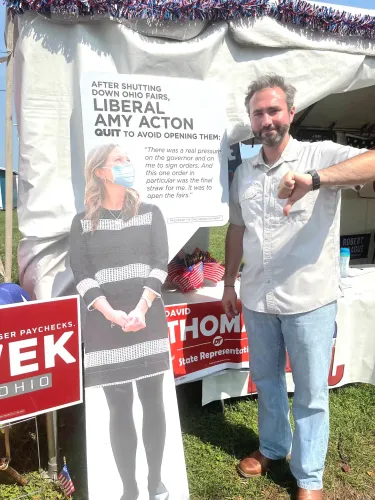
Entrepreneur Vivek Ramaswamy took to X on Friday, July 17, 2026, to publicly challenge Amy Acton, the former Director of the Ohio Department of Health, alleging she had claimed Covid-19's infection fatality rate (IFR) was 50 per cent — a figure Ramaswamy called sharply at odds with the scientific record.
Context
In his post, Ramaswamy wrote: 'The Covid-19 infection fatality rate was well under 1%, but Amy Acton claims it was 50%. Tells you exactly how Dr. Acton makes 'data-driven decisions.' Can't make this stuff up.' The remark is a pointed critique of the credibility of Acton's public health communications, framing a gap between stated figures and what epidemiological data has since established.
The scientific consensus, built on seroprevalence studies conducted across multiple countries through 2020 and 2021, placed the overall Covid-19 IFR well below 1 per cent for most age groups, though the figure varied significantly by age, underlying conditions, and access to healthcare. An IFR of 50 per cent would have implied mortality comparable to diseases such as Ebola.
Policy Backdrop
Amy Acton served as Ohio's top public health official from 2019 to 2020 and was a prominent face of the state's early pandemic response, including the issuance of one of the first statewide stay-at-home orders in the United States in March 2020. Early pandemic modelling at the time drew on limited data and produced a wide range of mortality projections, some of which proved to be significant overestimates.
Ramaswamy's critique is part of a sustained post-pandemic debate over how initial fatality projections were communicated to the public and whether those figures were used to justify restrictions that may not have been proportionate. Similar questions have been raised by researchers and policymakers examining the gap between early epidemiological models and later real-world data.
Stakeholders and Impact
The exchange touches directly on questions of accountability for Ohio residents who lived under emergency orders shaped by early pandemic data. For public health institutions more broadly, the debate over how uncertainty was communicated in 2020 remains a live issue, with implications for public trust in future health emergencies.
Ramaswamy, as a former co-lead of the US Department of Government Efficiency (DOGE) advisory effort and a 2024 Republican presidential candidate, has consistently positioned himself as a critic of institutional overreach during the pandemic. His current role as founder and executive chairman of Strive Asset Management keeps him in public discourse on governance and accountability.
What's Next
The post is likely to draw responses from public health advocates and former officials who may contest Ramaswamy's characterisation of events. Legislative reviews of pandemic-era data handling remain a possibility in several US states, and renewed scrutiny of early official communications could become a feature of the broader political conversation ahead of the 2026 midterm cycle.
Whether Acton or her representatives respond publicly will determine how far this specific exchange travels. The broader pattern, however — post-pandemic accountability debates playing out on social media between political figures and former public health officials — shows no sign of abating.
Point of View
Using a specific — though as yet unverified — attribution to a named official to make a broader argument about institutional credibility. The framing mirrors a well-worn playbook on the right: identifying a concrete, checkable claim by a public health figure and contrasting it with settled data to delegitimise the broader policy apparatus that figure represented. For Acton, who became a polarising symbol of executive public health power in Ohio, the attack is not new in kind, but Ramaswamy's national platform amplifies it considerably. The exchange is a preview of how pandemic-era decisions will continue to be relitigated as political currency well into the 2026 election cycle.
NationPress
17 Jul 2026
Frequently Asked Questions
What did Vivek Ramaswamy say about Amy Acton and Covid-19?
Ramaswamy posted on July 17, 2026, alleging that Amy Acton, former Ohio Health Director, had claimed Covid-19's infection fatality rate was 50 per cent, which he contrasted with the scientific consensus of well under 1 per cent.
What is the actual Covid-19 infection fatality rate?
Seroprevalence studies conducted globally through 2020 and 2021 placed the overall Covid-19 IFR well below 1 per cent for most age groups, though it varied significantly by age and underlying health conditions.
Who is Vivek Ramaswamy?
Vivek Ramaswamy is an entrepreneur and founder of Strive Asset Management. He was a 2024 Republican presidential candidate and served as co-lead of the US Department of Government Efficiency (DOGE) advisory effort.
What is the broader debate over Covid-19 fatality rate estimates?
Early pandemic models in 2020 used limited data and produced wide-ranging mortality projections. As more data emerged from seroprevalence studies, the IFR was revised sharply downward, prompting ongoing debate over whether initial figures used to justify restrictions were accurate or appropriately communicated.