Ramaswamy Contrasts Ohio's 'Pro-Freedom' vs 'Socialist' Governors
Synopsis
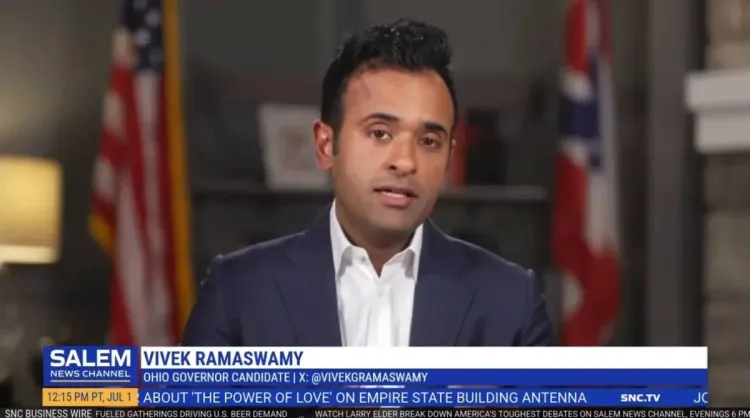
Entrepreneur Vivek Ramaswamy on 2 July 2026 contrasted Ohio's 'most pro-freedom Governor' with what he called the state's 'first socialist Governor', closing with a pointed line on voter accountability — a salvo aimed squarely at the 2026 Ohio gubernatorial race.
Key Takeaways
Vivek Ramaswamy posted on X on 2 July 2026 contrasting two ideological visions of Ohio's gubernatorial leadership.
He described one as the 'most pro-freedom Governor' and another as the 'first socialist Governor' in Ohio 's history, without naming either.
His closing line — 'the government we elect is the one we deserve' — frames the upcoming election as a matter of civic responsibility.
Ohio has been under continuous Republican gubernatorial control since 2011 ; Governor Mike DeWine has held office since 2019 .
The post comes ahead of the November 2026 Ohio gubernatorial election, with candidate announcements and primaries still being watched closely.
Ramaswamy's national profile from his 2024 presidential run and DOGE role amplifies his commentary well beyond Ohio .
Entrepreneur and former DOGE co-lead Vivek Ramaswamy took to X on 2 July 2026 to draw a sharp ideological contrast between what he called the 'most pro-freedom Governor' and the 'first socialist Governor' in Ohio's history, closing with a pointed remark on democratic accountability.
Context
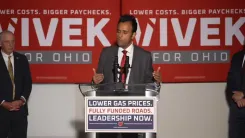
Ramaswamy's post reads: 'The most pro-freedom Governor in our state's history vs. the first socialist Governor in our state's history. In the end, the government we elect is the one we deserve.' The framing is a direct ideological provocation aimed at Ohio voters ahead of what is expected to be a competitive November 2026 gubernatorial cycle. Ramaswamy, who was born and raised in Ohio, has long positioned himself as a voice for limited-government conservatism.
The post does not name either governor explicitly, but it sets up a stark binary: a Republican model of governance emphasising individual freedom against a Democratic model that Ramaswamy characterises as socialist. The closing line — 'the government we elect is the one we deserve' — is a rhetorical device invoking civic responsibility and electoral consequence.
Policy Backdrop
Ohio has been under continuous Republican gubernatorial control since 2011. Republican Governor Mike DeWine, who has held office since 2019, won re-election in 2022 by defeating Democrat Nan Whaley. The state's executive politics have broadly mirrored national fault lines over taxation, regulation, and the scope of government authority.
The post participates in a well-established partisan tradition of framing Democratic governance as an expansion of state power and Republican governance as a defence of personal liberty. This rhetoric intensified across the United States following the 2024 federal election cycle, as both parties sharpened their messaging on the role of government at the state level.
Stakeholders and Impact
Ohio voters are the immediate audience for this kind of messaging. The state has a significant base of independent and working-class voters who have historically been sensitive to economic arguments about government overreach and taxation. Ramaswamy's framing targets this constituency by anchoring the choice in moral and philosophical terms rather than policy specifics.
For the Republican Party in Ohio, the post signals that Ramaswamy intends to remain an influential voice in shaping how the party's gubernatorial contest is framed. His national profile — built through his 2024 presidential run and his role as co-lead of the Department of Government Efficiency (DOGE) advisory effort — gives his commentary an outsized reach beyond the state.
What's Next
All eyes in Ohio are on candidate announcements, primary contests, and early polling ahead of the November 2026 gubernatorial election. Ramaswamy's post is likely to fuel debate about which candidates fit the ideological labels he has deployed. Whether he himself enters the Ohio governor's race remains a question that political observers in the state are closely watching.
The broader implication is clear: as 2026 midterm-cycle politics heat up across the United States, state-level governance is being contested not just on policy grounds but on fundamental questions of political philosophy — and Ramaswamy is positioning himself at the centre of that debate in his home state.
Point of View
Using philosophical labels rather than policy specifics to set the terms of debate. The 'freedom vs socialism' binary is a tested rhetorical framework in American conservative politics, and deploying it at the state level signals an effort to nationalise what is fundamentally a local contest. His closing line on deserving the government one elects adds a moralistic edge that is characteristic of his broader political brand. The post stops short of a formal candidacy signal, but it clearly stakes out the ideological ground on which any such announcement would be built.
NationPress
1 Oct 2026
Frequently Asked Questions
What did Vivek Ramaswamy say about Ohio governors?
On 2 July 2026, Ramaswamy posted on X contrasting what he called the 'most pro-freedom Governor' with the 'first socialist Governor' in Ohio's history, and said voters get the government they deserve.
Is Vivek Ramaswamy running for Ohio governor in 2026?
Ramaswamy has not formally announced a gubernatorial candidacy as of this post, but his comments about Ohio's leadership are being closely watched for signals ahead of the November 2026 election.
Who is the current Governor of Ohio?
Republican Mike DeWine has been Ohio's governor since 2019, having won elections in 2018 and 2022, when he defeated Democrat Nan Whaley.
What is the 2026 Ohio governor election about?
The November 2026 Ohio gubernatorial election is expected to contest fundamental questions of governance philosophy, with Republicans emphasising limited government and Democrats pushing back on that framing.
What is Vivek Ramaswamy's connection to Ohio?
Ramaswamy was born and raised in Ohio and has consistently commented on the state's politics, most recently framing its gubernatorial contest in terms of freedom versus socialism.