SEBI reviewing IPO proceeds disclosure framework for better transparency: Chairman Pandey

Synopsis
SEBI Chairman Tuhin Kanta Pandey has signalled a sweeping review of how companies report the use of public-issue funds — prioritising quality over quantity of disclosures. With related-party transaction rules and a double-penalty safeguard for cross-listed firms also in the pipeline, the regulator is moving toward a leaner, more outcomes-driven compliance framework.
Key Takeaways
SEBI is reviewing the framework for monitoring and disclosing the utilisation of funds raised through public issues, announced on 22 August 2026 .
Chairman Tuhin Kanta Pandey emphasised that transparency should be measured by the quality and timeliness of information, not its volume.
SEBI has already strengthened material event disclosure norms through materiality thresholds and defined timelines .
The regulator plans to refine rules governing related-party transactions to make compliance more practical for issuers.
SEBI is considering a framework to prevent entities listed on multiple stock exchanges from being penalised more than once for the same violation.
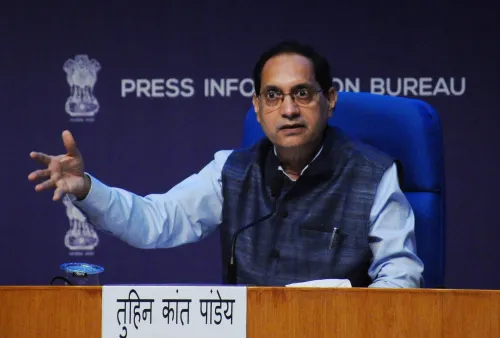
The Securities and Exchange Board of India (SEBI) is reviewing the framework that governs the monitoring and disclosure of funds raised through public issues, with the goal of making disclosures more timely and simplifying compliance requirements for companies. SEBI Chairman Tuhin Kanta Pandey announced this on Saturday, 22 August 2026, at the Institute of Directors' Annual Directors' Conclave 2026 in New Delhi.
What the Review Covers
Pandey said the regulator is examining the existing framework for tracking and reporting the utilisation of issue proceeds. The objective is to ensure disclosures reach investors in a timely manner while reducing the compliance burden on listed companies. He drew a clear distinction between disclosure volume and disclosure quality, arguing that the two are not the same.
'True transparency is not the volume of information. It is the quality, timeliness and usefulness of information,' Pandey said, adding that disclosure requirements must help investors make informed decisions rather than simply increase reporting obligations.
Strengthening Material Event Disclosures
The SEBI chief noted that the regulator has progressively tightened norms around the disclosure of material events and information. These measures include the introduction of materiality thresholds and defined timelines, aimed at improving consistency and ensuring that critical information reaches investors without delay.
Pandey stressed that meaningful corporate governance depends not only on the act of disclosure but on the relevance and quality of information made available to market participants.
Related-Party Transaction Rules to Be Refined
SEBI also plans to further refine the framework governing related-party transactions, according to Pandey. The proposed changes are intended to make compliance requirements clearer and more practical for issuers, while continuing to protect investor interests.
Avoiding Double Penalties for Cross-Listed Entities
On the broader regulatory architecture, Pandey underlined the need for proportionate regulation and the elimination of duplicate compliance requirements. In this context, SEBI is reportedly considering a framework to ensure that entities listed on multiple stock exchanges are not penalised more than once for the same violation.
'The objective is to make regulation more efficient while preserving its purpose,' he said. The move signals a shift toward a more calibrated, outcomes-focused regulatory posture as Indian capital markets deepen and the listed-company universe expands.
Point of View
Regulatory arbitrage and disproportionate punishment risk chilling legitimate cross-listing activity. The real test will be whether SEBI's forthcoming framework sets enforceable quality standards for disclosures, or merely reorganises existing paperwork obligations.
NationPress
22 Aug 2026
Frequently Asked Questions
What is SEBI reviewing regarding IPO proceeds disclosure?
SEBI is reviewing the framework that governs how companies monitor and disclose the utilisation of funds raised through public issues. The aim is to make these disclosures more timely and to reduce compliance complexity for listed companies.
Who announced the SEBI disclosure framework review and when?
SEBI Chairman Tuhin Kanta Pandey announced the review on 22 August 2026 at the Institute of Directors' Annual Directors' Conclave 2026 in New Delhi.
What changes are planned for related-party transaction rules?
SEBI plans to refine the framework governing related-party transactions to make compliance requirements clearer and more practical for issuers, while continuing to protect investor interests. Specific revised guidelines have not yet been released.
Why is SEBI considering a framework against double penalties for cross-listed companies?
SEBI is considering a framework to ensure that entities listed on multiple stock exchanges are not penalised more than once for the same violation. The objective, as stated by Chairman Pandey, is to make regulation more efficient without diluting its purpose.
What has SEBI already done to improve material event disclosures?
SEBI has progressively tightened norms around material event disclosures by introducing materiality thresholds and defined timelines, aimed at improving consistency and ensuring investors receive critical information without delay.