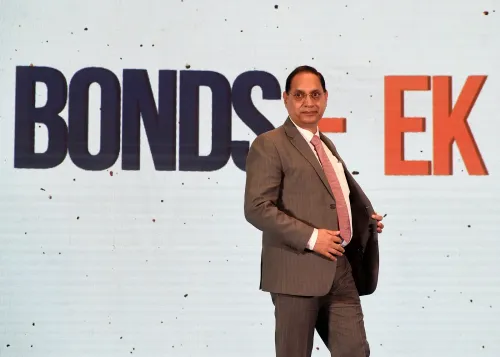
SEBI bond tokenisation pilot in 6–9 months, Pandey outlines reform push

Synopsis
SEBI is set to pilot bond tokenisation within six to nine months — a concrete timeline for one of India's most-discussed fintech-meets-fixed-income reforms. With corporate bond issuances crossing ₹9 lakh crore but secondary liquidity still shallow, the regulator is betting that tokenisation, a new market-making framework, and RBI-coordinated derivatives products can finally close the gap between India's booming equity markets and its underdeveloped debt segment.
Key Takeaways
SEBI Chairman Tuhin Kanta Pandey confirmed a bond tokenisation pilot within six to nine months at the ICICI Securities India Investor Conference on 8 June .
Corporate bond issuances have crossed ₹9 lakh crore , but secondary market liquidity remains shallow.
Overall market capitalisation stands at around 128% of GDP ; mutual fund assets have exceeded ₹80 lakh crore .
SEBI is developing a market-making framework for corporate bonds in coordination with the RBI , which has issued draft guidelines on total return swaps and bond derivatives.
Variable net worth requirements for stock brokers are under review; no final decision has been taken yet.
Securities and Exchange Board of India (SEBI) Chairman Tuhin Kanta Pandey on Monday, 8 June said the markets regulator is on track to launch a bond tokenisation pilot within six to nine months, as part of a sweeping reform agenda aimed at deepening India's capital markets. Pandey made the remarks at the ICICI Securities India Investor Conference in Mumbai.
Bond Tokenisation: What SEBI Is Planning
The upcoming pilot is designed to make fixed-income instruments more accessible and operationally efficient for a broader set of investors. Pandey described bond tokenisation as a key step toward improving participation in India's debt markets. 'The regulator is expected to roll out a pilot for bond tokenisation within six to nine months,' he said, signalling a concrete timeline for an initiative that has long been discussed in regulatory circles.
This comes amid rapid growth in India's bond issuance landscape, with corporate bond issuances having crossed ₹9 lakh crore. Despite that scale, SEBI acknowledged that secondary market liquidity remains relatively shallow — a structural gap the tokenisation pilot, alongside other reforms, is intended to address.
Corporate Bond Market and RBI Coordination
On the corporate bond market, Pandey said SEBI is developing a market-making framework to improve liquidity in secondary trading. He also underlined that coordination with the Reserve Bank of India (RBI) is critical for the next phase of reforms, particularly around products such as total return swaps and corporate bond derivatives, for which the central bank has already released draft guidelines earlier this year. 'These products are expected to move forward once the regulatory framework is finalised,' Pandey explained.
Broader Market Strength: The Numbers
Pandey pointed to macro-level indicators that reflect the growing centrality of capital markets in India's financial system. Overall market capitalisation has risen to around 128 per cent of GDP, while mutual fund assets have climbed beyond ₹80 lakh crore. A revised SEBI methodology — using granular market-level data and wider instrument coverage — now presents what the regulator describes as a more accurate picture of this strength. 'Together, these developments show a clear shift: Capital markets are increasingly becoming a core avenue for household savings and wealth creation,' Pandey stated.
Broker Capital Norms Under Review
In another significant reform area, SEBI is reviewing variable net worth requirements for stock brokers. Pandey said the proposal remains under examination and no final decision has been taken, indicating that the framework could be recalibrated to balance capital adequacy with operational flexibility for intermediaries. The review also encompasses IPO price discovery and foreign investor access, both of which form part of SEBI's wider agenda for the year.
What This Means for Investors
The convergence of bond tokenisation, a market-making framework, and revised broker norms signals a structural push to bring India's fixed-income market closer to the scale and efficiency of its equity segment. Notably, this reform cluster arrives as household financial savings are increasingly flowing into market instruments rather than traditional bank deposits — a trend SEBI appears keen to sustain and formalise. The next key milestone will be the finalisation of the RBI-SEBI regulatory framework for bond derivatives, after which the tokenisation pilot timeline is expected to firm up further.
Point of View
But the deeper challenge is structural: India's corporate bond market has grown in issuance volume while remaining illiquid in secondary trading — a contradiction that market-making frameworks alone have not resolved in the past. The real test is whether the RBI-SEBI coordination on derivatives actually produces tradeable instruments at scale, or stalls in inter-regulatory friction as it has before. Meanwhile, the broker net worth review is worth watching closely: tightening capital norms could consolidate the intermediary landscape, squeezing smaller players and concentrating market access — an outcome that sits awkwardly alongside SEBI's stated goal of broadening household participation in capital markets.
NationPress
22 Oct 2026
Frequently Asked Questions
What is SEBI's bond tokenisation pilot?
It is a planned regulatory experiment by SEBI to digitise bonds using blockchain or distributed ledger technology, making fixed-income instruments more accessible and tradeable. SEBI Chairman Tuhin Kanta Pandey said the pilot is expected to launch within six to nine months.
Why is secondary bond market liquidity a concern in India?
Despite corporate bond issuances crossing ₹9 lakh crore, trading activity in the secondary market remains thin relative to the overall size of the system. This makes it harder for investors to buy or sell bonds efficiently, limiting the market's appeal compared to equities.
How does RBI coordination factor into SEBI's bond market reforms?
The RBI has already released draft guidelines on total return swaps and corporate bond derivatives. SEBI's Pandey said these products will move forward once the joint regulatory framework is finalised, making RBI-SEBI alignment a critical dependency for the next phase of debt market reform.
What changes are being considered for stock broker capital norms?
SEBI is reviewing variable net worth requirements for stock brokers to potentially recalibrate the balance between capital adequacy and operational flexibility. Pandey confirmed the proposal is still under examination and no final decision has been announced.
How large are India's capital markets currently?
India's overall market capitalisation has risen to approximately 128% of GDP, and mutual fund assets have surpassed ₹80 lakh crore, reflecting the growing role of capital markets as a vehicle for household savings and wealth creation.