Semicon India 2026: Industry leaders say semiconductor ecosystem enters high-growth phase
Synopsis
Industry leaders at Semicon India 2026 declared India's semiconductor sector has crossed a turning point — but the consensus came with a clear caveat: factories alone won't build a world-class industry. From raw materials and gases to domestic markets and simplified taxation, the ecosystem gaps are as significant as the ambitions, and how quickly India closes them will determine whether this high-growth phase delivers on its promise.
Key Takeaways
Industry leaders at Semicon India 2026 on 18 September 2026 declared India's semiconductor industry has entered a high-growth phase .
Addverb CEO Sangeet Kumar said indigenous technology development will gradually replace overseas dependency over the next 10 years .
Horiba India President Rajiv Gautam stressed that a competitive industry needs raw materials, gases, equipment, supply chains and talent — not just factories.
Celesta Capital's Sriram Viswanathan flagged unresolved regulatory, taxation and incentive complexity as key barriers to ecosystem growth.
Industry leaders called for stronger domestic procurement policies and local markets to sustain Indian semiconductor companies.
Global interest in India as a semiconductor hub is rising, driven by supply-chain diversification trends worldwide.
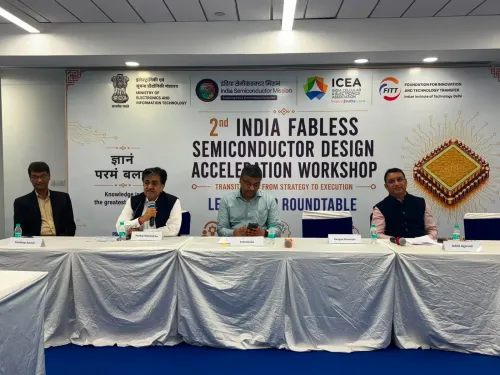
India's semiconductor industry has entered a phase of rapid expansion, with government incentives, rising global demand and growing domestic technological capabilities expected to drive large-scale investments, innovation and job creation over the coming decade, industry leaders said on the second day of Semicon India 2026 in New Delhi on 18 September 2026.
Automation and Indigenous Technology at the Forefront
Sangeet Kumar, Co-founder and CEO of Addverb, said his company — fully India-based with two manufacturing facilities in Noida — is showcasing automation and robotics solutions at Semicon India 2026, including reel storage systems, automated storage and retrieval systems, humanoid robots designed to transport FOUPs, and compact robots for assembly lines.
Kumar said government policies and incentive schemes would be a key catalyst for sectoral growth. 'Over the next 10 years, this sector will witness tremendous growth due to government policies and incentive schemes. In the initial phase, a significant portion of the technology will come from overseas, but gradually India will develop its own indigenous technologies,' he said.
Ecosystem Beyond Factories: Raw Materials, Equipment, Talent
Rajiv Gautam, President of Horiba India Pvt Ltd, said India's semiconductor journey gained momentum through initiatives led by Prime Minister Narendra Modi and the launch of the India Semiconductor Mission. He noted that the initial focus on setting up manufacturing units alone was soon recognised as insufficient for building a globally competitive industry.
'A strong semiconductor industry requires an entire ecosystem, including raw materials, gases, equipment, supply chains and skilled talent,' Gautam said. He added that Horiba, which has been part of the semiconductor industry in Japan for 73 years, is contributing to the development of this wider ecosystem in India.
Policy Momentum Energising Youth and Entrepreneurs
Suchitra Banerjee, CEO of Ajnavision, said strong policy-level emphasis on semiconductor development was generating greater interest among young people and entrepreneurs. Anil Chaudhary, Head of Department at Delta Electronics India, echoed that sentiment, noting that India's progress in the sector had been faster than expected.
'The morale of people working in the industry is extremely high because the country has made remarkable progress in a very short period,' Chaudhary said. He added that the global community, which had long recognised India's potential, was now seeing that potential increasingly reflected in semiconductor capabilities and talent.
Challenges Remain: Regulation, Taxation, Domestic Markets
Sriram Viswanathan, Founding Managing Partner at Celesta Capital, acknowledged the government was moving in the right direction but pointed to unresolved structural challenges. 'Regulatory, taxation and incentive-related issues need to be simplified. At the same time, greater focus is required on domestic procurement and building local markets,' he said, stressing that Indian companies need a robust domestic market where they can sell their products.
Ashok K. Chandak, President and CEO of the India Electronics and Semiconductor Association (IESA) and SEMI India, said roundtable discussions with representatives from various countries at Semicon India 2026 had been highly productive. This comes amid growing global interest in India as a credible alternative semiconductor hub, as supply-chain diversification accelerates worldwide.
With major fabrication and OSAT investments already announced and the India Semiconductor Mission disbursing its first tranches, the sector's next test will be translating summit optimism into verified industrial output and skilled employment at scale.
Point of View
And the ecosystem depth that leaders describe as essential — local gas suppliers, specialised equipment makers, a deep talent pipeline — is still years away from maturity. Viswanathan's pointed remarks on regulatory and taxation complexity were the most consequential of the day, precisely because they were the least comfortable. A high-growth phase is only durable if the domestic market can absorb what Indian fabs produce; without that, India risks becoming another assembly node rather than a genuine semiconductor power.
NationPress
18 Sept 2026
Frequently Asked Questions
What is Semicon India 2026?
Semicon India 2026 is a major industry conference and exhibition held in New Delhi focused on India's semiconductor sector, bringing together domestic companies, global players, investors and policymakers to discuss investment, technology and ecosystem development.
What did industry leaders say about India's semiconductor growth at Semicon India 2026?
Leaders from companies including Addverb, Horiba India, Delta Electronics India and Celesta Capital said India's semiconductor industry has entered a rapid expansion phase, driven by government incentives and rising global interest. They noted that progress had been faster than expected, though significant ecosystem gaps in regulation, taxation and domestic markets still need to be addressed.
What is the India Semiconductor Mission?
The India Semiconductor Mission is a government initiative, linked to schemes led by Prime Minister Narendra Modi, aimed at developing a domestic semiconductor manufacturing and design ecosystem. It provides financial incentives for setting up fabrication plants, OSAT facilities and design centres across India.
What challenges does India's semiconductor ecosystem still face?
According to Sriram Viswanathan of Celesta Capital, key challenges include regulatory complexity, taxation issues and insufficient focus on domestic procurement and local market development. Other leaders noted that building a full ecosystem — covering raw materials, gases, equipment, supply chains and skilled talent — remains a long-term work in progress.
Why does a strong domestic market matter for India's semiconductor ambitions?
Industry leaders argue that Indian semiconductor companies need a robust domestic market to sell their products and achieve the scale required to be globally competitive. Without strong domestic procurement policies, companies risk remaining dependent on export markets, leaving them vulnerable to global demand fluctuations.