How Are Sensex and Nifty Reacting to the US Fed Rate Cut?
Synopsis
The Indian stock markets are experiencing notable volatility following the US Federal Reserve's recent rate cut. As investors navigate this uncertain landscape, the Sensex and Nifty indices fluctuate, revealing critical insights into market dynamics.
Key Takeaways
Sensex opened at 84,312, down 79 points.
Nifty fell to 25,750, down 8 points.
IT sector leads with gains of 0.70% .
Key support for Nifty at 25,600-25,650 .
Resistance noted at 25,850-25,900 .
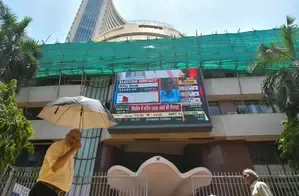
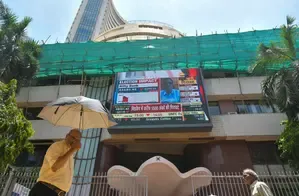
Mumbai, Dec 11 (NationPress) The Indian stock market began the day on a volatile note on Thursday, oscillating between gains and losses, following the announcement of a 25-basis-point rate cut by the US Federal Reserve on Wednesday.
The Sensex, which started off slightly up, quickly dipped into negative territory, trading at 84,312 during early sessions, reflecting a decrease of 79 points or 0.09 percent. Similarly, the Nifty index reversed its early gains, sliding to 25,750, down by 8 points or 0.03 percent.
According to analysts, from a technical perspective, the Nifty has immediate support at 25,600–25,650, while the 25,850–25,900 zone remains a significant resistance that has consistently obstructed upward momentum.
They noted, “A decisive breakout above this resistance band is crucial to regain bullish momentum. In contrast, a persistent move below the identified support range could prolong the current consolidation phase.”
Among early gainers on the Sensex were Infosys, Eternal, Tata Steel, Maruti Suzuki, Adani Ports, HCL Tech, SBI, TCS, L&T, and Tech Mahindra, with increases of up to 1.1 percent. However, stocks like Titan, Power Grid, Bharti Airtel, NTPC, Asian Paints, ITC, Reliance Industries, Bajaj Finserv, and ICICI Bank exerted downward pressure on the market.
In the broader market, the Nifty MidCap index fell by 0.17 percent, while the Nifty SmallCap index dropped 0.32 percent.
Sector-wise, IT stocks led the charge, with the Nifty IT index climbing 0.70 percent, followed by the Nifty PSU Bank index up 0.65 percent, the Nifty Metal index gaining 0.4 percent, and the Nifty Auto index increasing 0.12 percent.
Conversely, FMCG stocks faced challenges, pushing the Nifty FMCG index down by 0.26 percent.
Analysts stated that domestic markets are cautiously tracking global cues as investors evaluate the implications of the Fed’s recent rate cut on capital flows and economic growth.
On the flow front, Foreign Institutional Investors (FIIs) divested equities worth Rs 1,651 crore on December 10, while Domestic Institutional Investors (DIIs) recorded net purchases exceeding Rs 3,752 crore.
Point of View
It's crucial to monitor how global monetary policy affects our national markets. The Fed's rate cut signifies a pivotal moment for investors, and while volatility is expected, it provides opportunities for strategic positioning in the Indian equity landscape. Our analysis will continue to reflect the evolving trends and their implications for our economy.
NationPress
22 Oct 2026
Frequently Asked Questions
What is causing the volatility in Indian stock markets?
The volatility is primarily due to the US Federal Reserve's recent decision to cut interest rates by 25 basis points, leading investors to reassess market conditions and potential impacts on capital flows.
What are the current levels of Sensex and Nifty?
As of early trading, the Sensex is at 84,312, down by 79 points, while the Nifty is at 25,750, down by 8 points.
Which sectors are performing well?
The IT sector is leading the gains, with the Nifty IT index rising by 0.70%. Other sectors like PSU banks and metals are also showing positive movement.
What should investors watch for moving forward?
Investors should keep an eye on the support levels for Nifty at 25,600-25,650 and the resistance levels at 25,850-25,900, as a breakout could signal bullish trends.
How are foreign and domestic institutional investors behaving?
FIIs sold equities worth Rs 1,651 crore, while DIIs made net purchases of over Rs 3,752 crore, indicating differing strategies amidst market fluctuations.