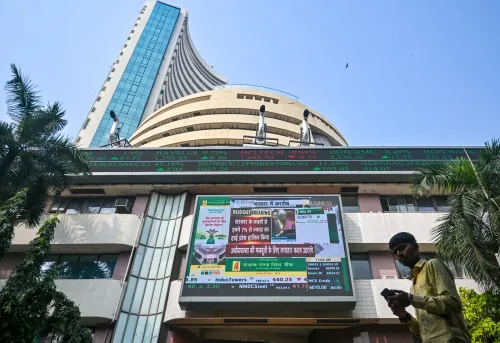
Sensex finds support at 71,000-71,200, Nifty targets 22,800: Analysts

Synopsis
Indian equities hit their eighth straight losing week, with the Sensex brushing a fresh 52-week low of 71,292.88 intra-day. Analysts now peg critical support at 71,000-71,200 and say a Nifty bounce toward 22,800 is possible — but only if global headwinds from crude, bond yields, and FII selling ease.
Key Takeaways
The Sensex lost 1,670.84 points over the week ending 4 October — its eighth consecutive week of losses.
The index touched a fresh 52-week intra-day low of 71,292.88 on Thursday before settling at 71,909.70 .
The Nifty50 declined more than 3 per cent for the week, closing Thursday at 22,421.95 .
Analysts place Sensex support at 71,000–71,200 and resistance at 72,300–72,500 .
Nifty50 initial upside target is 22,800 ; a break below the April low risks a slide to 21,700–22,000 .
Key market drivers to watch: FII flows , crude oil prices, global bond yields, and US macro data.
The Indian equity market extended its corrective phase for the eighth consecutive week as of 4 October, with benchmark indices closing sharply lower amid persistent foreign fund outflows, rising crude oil prices, and weak global cues. The Sensex shed 1,670.84 points across the week, while the Nifty50 declined more than 3 per cent, deepening an already prolonged bearish stretch.
Weekly and Thursday Session Losses
The selling pressure was relentless. The Sensex fell 1.52 per cent on Monday and continued to bleed through the week before dropping a further 0.79 per cent on Thursday. On that day, the index settled at 71,909.70, down 570.59 points, after briefly plunging as much as 1,187.41 points intra-day to touch a fresh 52-week low of 71,292.88. The Nifty50 closed at 22,421.95, shedding 198.50 points or 0.88 per cent, marking its fourth consecutive losing session.
What Is Weighing on the Market
Three factors have dominated the bearish narrative: sustained selling by foreign institutional investors (FIIs), elevated bond yields, and a fresh uptick in crude oil prices. Technically, the Sensex remains well below key moving averages — it is trading under the 50-day exponential moving average (EMA) of 75,544.56 and the 200-day EMA of 77,684.60, signalling that the broader structural trend is still under pressure. This is the longest corrective run for the index in recent memory, and analysts note it mirrors global risk-off dynamics tied to elevated US bond yields and energy price volatility.
Where Analysts See Support and Resistance
Despite the prevailing weakness, technical analysts point to oversold readings as a potential catalyst for a near-term relief rally. According to analysts, the immediate support zone for the Sensex lies between 71,000 and 71,200, while resistance is expected to emerge in the 72,300–72,500 range. For the Nifty50, market watchers have identified 22,800 as the initial upside target in a recovery scenario, followed by 23,100–23,200. However, a decisive break below the April low could negate any rebound and drag the index toward the 21,700–22,000 zone, analysts cautioned.
Hedged Approach Advised for Traders
Given the volatile conditions, analysts recommend that traders adopt a hedged approach rather than taking outright directional bets. Market experts said the near-term outlook will hinge on global cues, crude oil price trajectory, bond yield movements, and the pace of FII activity — all of which remain fluid. The proximity of technically significant support levels offers a sliver of hope for bulls, but without a reversal in the macro headwinds, any recovery could be shallow and short-lived.
Point of View
684 is striking: it signals that short-term oversold bounces are likely, but the larger trend has not turned. Analysts pointing to 22,800 as a Nifty target are offering a trader's trade, not an investor's thesis. Until FII selling reverses and crude peaks, relief rallies are likely to be sold into.
NationPress
4 Oct 2026
Frequently Asked Questions
Why has the Sensex been falling for eight consecutive weeks?
The Sensex has extended its corrective phase for eight straight weeks due to sustained selling by foreign institutional investors (FIIs), elevated global bond yields, and rising crude oil prices. Weak global cues have compounded domestic selling pressure, keeping sentiment broadly negative.
What is the key support level for the Sensex right now?
Analysts have placed the immediate support zone for the Sensex between 71,000 and 71,200. A hold above this range could enable a short-term relief rally, while a decisive break below it would signal further downside.
What is the Nifty50 target if markets recover?
Market watchers have identified 22,800 as the initial upside target for the Nifty50 in a recovery scenario, followed by 23,100-23,200. However, a break below the April low could drag the index toward the 21,700-22,000 zone.
What should traders do in the current volatile market?
Analysts advise a hedged approach rather than outright directional bets given current volatility. The near-term market direction will largely depend on global cues, crude oil prices, bond yield movements, and FII activity trends.
What was the Sensex's 52-week low this week?
The Sensex touched a fresh 52-week intra-day low of 71,292.88 on Thursday, 4 October, before recovering slightly to settle at 71,909.70, down 570.59 points or 0.79 per cent on the day.