KOSPI sinks 5.25% as AI valuation fears trigger Seoul stock rout
Synopsis
South Korea's KOSPI lost more than 5% in a single morning session on 30 October, triggering a rare circuit-breaker mechanism not seen in 11 trading days. The rout — led by Samsung's 6% drop and SK Hynix's near-9% plunge — signals that Wall Street's AI valuation anxiety has arrived decisively in Asia's tech-heavy markets.
Key Takeaways
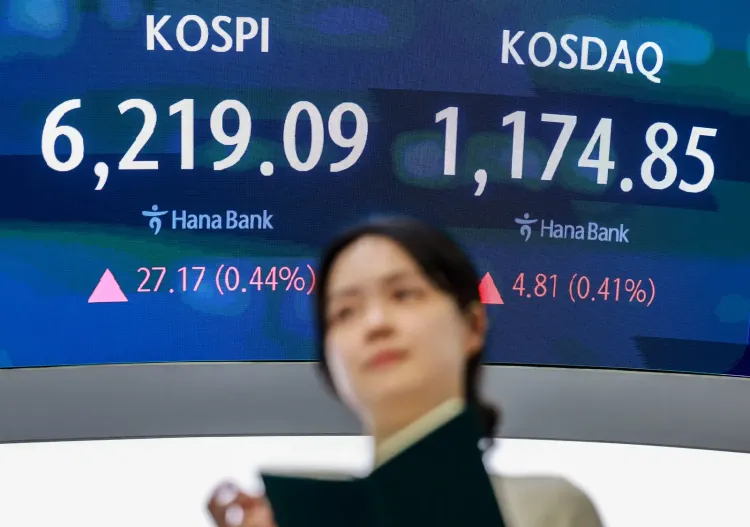
KOSPI fell 311.84 points (5.25%) to 5,626.02 as of 11:20 am on 30 October .
The Korea Exchange activated a sell-side sidecar for the first time in 11 trading days , suspending programme trading for five minutes.
Samsung Electronics dropped 6.03% and SK Hynix plunged 8.65% , leading losses among tech heavyweights.
Hanwha Aerospace slumped 12.24% after missing third-quarter earnings estimates due to delayed K9 howitzer deliveries to Poland.
Hyundai Motor fell 3.76% after cutting its annual sales target and investment plans.
Bank of Korea data showed average daily FX turnover hit a record $122.01 billion in Q3, a third consecutive quarterly high.
South Korea's benchmark Korea Composite Stock Price Index (KOSPI) plunged 311.84 points, or 5.25 percent, to 5,626.02 as of 11:20 am local time on Friday, 30 October, as renewed doubts over the sustainability of the artificial intelligence (AI) boom hammered technology shares and rattled investor confidence across Seoul markets. The index had opened 2.99 percent lower before extending its decline sharply through the morning session.
Circuit Breaker Activated
The scale of the sell-off was severe enough to prompt the Korea Exchange to activate a sell-side sidecar shortly after 10 am, suspending programme trading for KOSPI-listed shares for five minutes. According to exchange rules, a sell-side sidecar is triggered when the KOSPI 200 Futures Index falls 5 percent or more for at least one continuous minute. Notably, this was the first activation of the measure in 11 trading days, underscoring the unusual severity of Friday's decline.
Tech Giants and Heavyweights Lead Losses
Technology stocks bore the brunt of the rout. Samsung Electronics, the market's largest company by capitalisation, tumbled 6.03 percent, while chip manufacturer SK Hynix plunged a steeper 8.65 percent. The losses reflect deep anxiety over whether AI-driven demand for semiconductors can justify the lofty valuations that have built up over the past year — concerns that spilled over from an overnight sell-off on Wall Street.
The damage was not confined to tech. Leading automaker Hyundai Motor slipped 3.76 percent after the company lowered its annual sales target and trimmed investment plans, citing a challenging global business environment. Defence conglomerate Hanwha Aerospace fared worst among the major names, slumping 12.24 percent after reporting weaker-than-expected third-quarter earnings — the shortfall attributed to delays in delivering K9 self-propelled howitzers to Poland.
Currency and FX Market Snapshot
The Korean won traded at 1,337.8 won per US dollar as of 10:20 am, marginally firmer — up 1.7 won from the previous session's close. Separately, data released Friday by the Bank of Korea (BOK) showed that average daily foreign exchange turnover, including derivatives, rose to US$122.01 billion during the July–September quarter, up $570 million or 0.5 percent from the second quarter. This marks a third consecutive quarterly record for daily FX turnover since the first quarter of this year.
According to the BOK, the pace of increase slowed as robust export-driven FX activity was partly offset by a pullback in offshore investors' stock transactions. Combined exports and imports climbed to $173.9 billion in the third quarter from $154.7 billion the previous quarter, while foreigners traded approximately 1,154 trillion won ($862.8 billion) worth of equities per month in July and August — down from a monthly average of 1,285 trillion won in the second quarter.
The Broader Context
This comes amid a wider global reassessment of AI-linked equity valuations. Markets from New York to Tokyo have experienced periodic turbulence as investors question whether the capital expenditure cycle underpinning AI infrastructure can translate into near-term earnings. For South Korea — home to two of the world's largest memory chipmakers — any softening in AI demand signals carries outsized risk. Friday's session is the sharpest single-day fall for the KOSPI in recent weeks, and analysts will be watching whether overseas institutional flows stabilise or accelerate the decline into next week.
Point of View
The market is pricing in a scenario where AI capex enthusiasm cools faster than the supply chains built to serve it. The activation of the Korea Exchange's sidecar mechanism is a technical red flag, but the more telling signal is the breadth: autos, defence, and tech fell together, suggesting this is not sector-specific anxiety but a broad risk-off wave. If Wall Street's AI reassessment deepens, South Korea — with its disproportionate exposure to memory chips — has further to fall than most.
NationPress
30 Oct 2026
Frequently Asked Questions
Why did Seoul stocks fall sharply on 30 October?
South Korean stocks fell more than 5% on 30 October due to renewed concerns over the sustainability of the AI boom, which triggered heavy selling in technology shares following overnight losses on Wall Street. The KOSPI dropped 311.84 points to 5,626.02 in morning trade.
What is a sell-side sidecar and why was it triggered?
A sell-side sidecar is a circuit-breaker mechanism on the Korea Exchange that temporarily suspends programme trading for five minutes when the KOSPI 200 Futures Index falls 5% or more for at least one minute. It was triggered on Friday — for the first time in 11 trading days — as the KOSPI's sharp decline met that threshold shortly after 10 am.
Which stocks led the KOSPI decline?
Samsung Electronics fell 6.03% and SK Hynix plunged 8.65%, leading losses among technology heavyweights. Hanwha Aerospace was the hardest hit major stock, dropping 12.24% after missing third-quarter earnings expectations due to K9 howitzer delivery delays to Poland.
How did the Korean won and FX market perform on the same day?
The Korean won firmed slightly to 1,337.8 won per US dollar as of 10:20 am, up 1.7 won from the previous close. Separately, Bank of Korea data showed average daily FX turnover reached a record $122.01 billion in the third quarter — a third consecutive quarterly high.
What does the KOSPI fall mean for the broader AI trade?
The decline reflects growing investor scepticism about whether AI-driven demand for semiconductors can justify current valuations. South Korea is particularly exposed because Samsung and SK Hynix together supply a large share of global memory chips used in AI infrastructure, making Seoul markets a bellwether for global AI sentiment.