Can the SHANTI Bill 2025 Propel India Toward Nuclear Energy Self-Reliance?
Click to start listening
Synopsis
Discover how the SHANTI Bill 2025 can transform India's nuclear energy landscape. Aiming for self-reliance and compliance with clean energy goals by 2047, this legislation redefines nuclear governance and private participation while ensuring safety and environmental standards.
Key Takeaways
- The SHANTI Bill aims for India's self-reliance in nuclear energy.
- It opens doors for private investment while ensuring safety and environmental standards.
- The Bill consolidates existing nuclear legislation into a cohesive framework.
- It recognizes the broader applications of nuclear energy beyond power generation.
- Safety remains a top priority with stringent regulatory measures.
New Delhi, Dec 19 (NationPress) The Sustainable Harnessing and Advancement of Nuclear Energy for Transforming India (SHANTI) Bill, 2025, which has successfully passed through both the Lok Sabha and Rajya Sabha, is designed to facilitate self-reliance in the nuclear industry and achieve India's ambitious 2047 clean energy objectives.
The legislation aims to establish a supportive environment for clean and dependable energy while continuing India's longstanding commitment to the peaceful utilization of atomic energy.
This initiative is also indicative of India's adherence to international standards in nuclear governance.
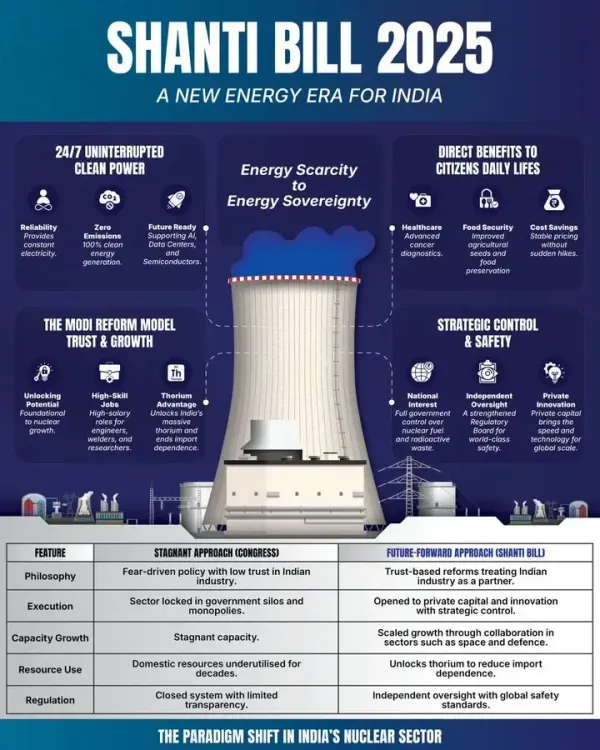
The Bill allows for responsible engagement of private entities and joint ventures to address resource limitations, minimize project durations, and aid the national aspiration of achieving 100 GW of nuclear capacity by 2047, all while ensuring national security and public welfare.
What are the Bill's key provisions?
This legislation consolidates and refines regulations from the Atomic Energy Act of 1962 and the Civil Liability for Nuclear Damage (CLND) Act, granting statutory recognition to the Atomic Energy Regulatory Board, thereby embedding it within the primary legislation.
With this Bill, the nuclear sector is opened to privatization, a strategic move to ensure self-sufficiency and meet India's clean energy targets for 2047, following the successful privatization of the space sector.
Nonetheless, private partners will be involved under specific conditions for exploration activities, while uranium mining beyond designated limits will remain exclusively under government control.
Additionally, management of spent nuclear fuel will always be under government oversight, following a clearly defined long-term storage and handling system. Strategic materials such as fissile material, source material, and heavy water will continue to be tightly regulated by the government.
The Bill also explicitly includes environmental and economic damages in its definition of nuclear harm. With dedicated investments in small modular reactors and research initiatives, the proposed law aspires to foster an ecosystem for clean, reliable energy.
Nuclear energy has broader applications beyond electricity generation, including uses in healthcare, agriculture, and industry. The Bill is set to bolster the industry to accommodate increasing demands from sectors such as data processing and healthcare, in tandem with renewable energy sources.
How does the Bill address safety concerns?
Union Minister of Science and Technology, Dr. Jitendra Singh, assured the Lok Sabha that nuclear safety standards remain intact and uncompromised, strictly adhering to the principles established in the Atomic Energy Act of 1962 - “safety first, production next.”
The safety framework encompasses a rigorous inspection protocol, including quarterly construction inspections, biannual operational inspections, five-year license renewals, and enhanced authority for the statutory Atomic Energy Regulatory Board, along with compliance with International Atomic Energy Agency standards.
Notably, India's nuclear facilities are located far from seismic fault lines, ensuring that radiation levels at Indian reactors are significantly below globally imposed safety limits.
How will the Bill function?
This proposed legislation is closely tied to India's long-term energy and climate goals, outlining a pathway for decarbonization by 2070.
Operationally, the Bill establishes guidelines for licensing and safety authorization for individuals involved in nuclear energy production or utilization, along with clear criteria for suspension or termination.
It aims to regulate the application of nuclear and radiation technologies across sectors such as healthcare, food and agriculture, industry, and research, while exempting research and developmental activities from licensing necessities.
Also, the Bill proposes a revised civil liability framework for nuclear incidents, confers statutory authority upon the Atomic Energy Regulatory Board, and enhances mechanisms for safety, security, safeguards, quality assurance, and emergency readiness.
It plans to establish new institutional structures, including an Atomic Energy Redressal Advisory Council, the appointment of Claims Commissioners, and a Nuclear Damage Claims Commission for severe nuclear damage cases, with the Appellate Tribunal for Electricity serving as the appellate authority.
This proposed legislation aims to harmonize the growth of nuclear energy with safety, accountability, and public interest, situating nuclear power within the broader national strategy for energy security and a low-carbon future.
Point of View
Emphasizing self-sufficiency in nuclear energy while balancing safety and public interests. As a national editor-in-chief, I believe that the integration of private entities with stringent regulatory frameworks is essential for advancing India’s energy independence in a sustainable manner.
NationPress
21/12/2025
Frequently Asked Questions
What is the SHANTI Bill 2025?
The SHANTI Bill 2025 is a legislative framework aimed at achieving self-reliance in nuclear energy while meeting India’s clean energy goals for 2047.
What are the main objectives of the SHANTI Bill?
The Bill seeks to create an ecosystem for clean energy, facilitate private investment, and uphold safety and environmental standards in the nuclear sector.
How does the Bill ensure safety in nuclear energy?
It maintains stringent safety standards, including a rigorous inspection regime and compliance with international safety guidelines.
What is the role of the Atomic Energy Regulatory Board under this Bill?
The Bill grants statutory authority to the Atomic Energy Regulatory Board, enhancing its powers to oversee safety and regulatory compliance.
Can private companies participate in nuclear energy production?
Yes, the Bill allows responsible private participation under defined conditions while retaining government control over strategic resources.