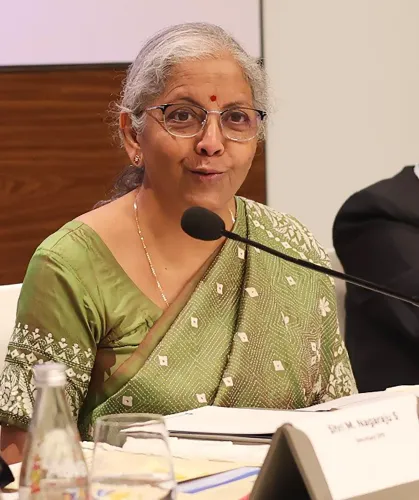
AI, semiconductors, quantum computing to power India's infrastructure: FM Sitharaman
Synopsis
Finance Minister Nirmala Sitharaman has mapped out India's next infrastructure frontier — not highways or power plants, but AI, semiconductors, and quantum computing. Her call for MSMEs to embrace AI and her projection of 10%-plus GDP growth signal a sharp pivot in how New Delhi frames economic ambition ahead of the next investment cycle.
Key Takeaways
Finance Minister Nirmala Sitharaman on 26 September 2026 said India's next big infrastructure bets must centre on AI , semiconductors , and quantum computing .
She urged MSMEs — which manufacture everything from basic components to aircraft parts — to adopt AI solutions to boost productivity and global competitiveness.
Sitharaman said India can achieve more than 10% GDP growth with sustained cross-sector collaboration.
She called for patient capital and new early-stage funding mechanisms for pre-revenue deep-tech and hardware startups.
She praised IIT Madras 's startup fund as a model for academia-industry-government collaboration.
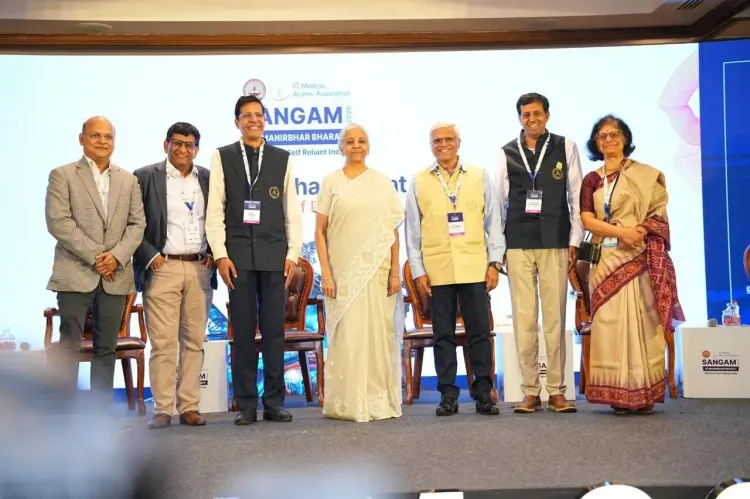
The remarks were made at the 7th IITMAA Sangam conference in Bengaluru , themed around 'Atmanirbhar Bharat' .
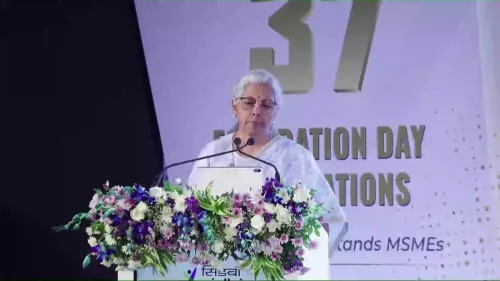
Finance Minister Nirmala Sitharaman on Saturday, 26 September 2026, said that the next phase of large-scale investments in India's infrastructure must prioritise artificial intelligence (AI), semiconductor chips, and quantum computing, while calling on MSMEs to adopt AI-driven solutions to sharpen productivity and compete on the global stage.
Sitharaman was addressing the 7th edition of IITMAA Sangam, the flagship annual conference of the IIT Madras Alumni Association (IITMAA), held in Bengaluru. The conference was organised around the theme 'Atmanirbhar Bharat – Building a Self-Reliant India', bringing together policymakers, corporate leaders, technology pioneers, academics, and startups.
Technology Must Reach Every Sector
Sitharaman underscored that technology and innovation must permeate every corner of the economy — from agriculture and renewable energy to advanced manufacturing. She credited India's ongoing transformation to sustained institution-building, restored investor confidence, and the opening of key sectors to private participation.
'India's transformation has been driven by sustained efforts to strengthen institutions, restore confidence and open sectors to private participation, while creating policies that enable young people, entrepreneurs and innovators to contribute to economic growth,' the Finance Minister said.
Space, Startups and Deep-Tech Funding
Highlighting the liberalisation of India's space sector, Sitharaman noted that Indian startups are now independently designing satellites and executing space missions — a development she cited as evidence of the country's expanding innovation ecosystem. She also stressed the urgent need for patient capital and new early-stage funding mechanisms specifically tailored to pre-revenue deep-tech and hardware startups, segments that have historically struggled to attract conventional venture financing.
In this context, she praised IIT Madras for launching a dedicated fund to mentor and support startups, calling it a model for how academia, industry, and government can collaborate effectively on innovation.
MSMEs and AI Adoption
Sitharaman placed particular emphasis on India's MSME sector, which she described as producing everything from basic components to aircraft parts. 'Our MSMEs, which produce everything from basic components to aircraft parts, need AI solutions to improve productivity and compete globally,' she said, adding that technology-led growth would require deeper cross-sector collaboration.
This comes amid a broader push by the Centre to integrate AI tools into India's small and medium enterprise base, where adoption rates remain uneven despite government-backed digital initiatives.
10% GDP Growth Within Reach
In a notably ambitious projection, Sitharaman said India has the capacity to achieve more than 10% GDP growth, but cautioned that this would require sustained effort across all sectors and a concerted drive to convert the country's talent, technology, and innovation base into measurable economic output. India's current GDP growth trajectory, while robust by global standards, has generally been tracked in the 6–8% range in recent years.
Who Was in the Room
The event was inaugurated by Education Minister Pralhad Joshi, alongside Vice Admiral Sanjay Sadhu, Controller of Warship Production and Acquisition at the Indian Navy; Prof V Kamakoti, Director of IIT Madras; Dr Sridhar Vembu, Chief Scientist and Co-founder of Zoho Corporation; Goda Ramkumar, Vice President of Data Science at Flipkart; Prof M Vidyasagar, FRS; and Dr Pratyush Kumar, Co-founder of Sarvam AI, among others. The high-profile gathering signals growing convergence between government, academia, and the private technology sector on India's self-reliance agenda.
The Finance Minister's remarks set a clear directional signal: future infrastructure spending will not be confined to roads and ports but will extend deep into the digital and frontier-technology stack.
Point of View
Semiconductors, and quantum computing as infrastructure is a meaningful rhetorical shift — but rhetoric and budget lines are different things. India's semiconductor ambitions, anchored by the India Semiconductor Mission, have attracted pledges but face well-documented execution gaps in fabrication talent and supply-chain depth. The 10%-plus GDP growth projection, while aspirational, sits well above most institutional forecasts and has not been accompanied by a published roadmap. The more actionable signal is the call for patient capital for deep-tech startups — a genuine gap that has historically pushed hardware founders toward the US and Singapore for early funding. Whether policy follows the speech is the only question that matters.
NationPress
26 Sept 2026
Frequently Asked Questions
What did Finance Minister Nirmala Sitharaman say about India's infrastructure?
Sitharaman said India's next large infrastructure investments must focus heavily on AI, semiconductor chips, and quantum computing, moving beyond traditional physical infrastructure. She made these remarks at the 7th IITMAA Sangam conference in Bengaluru on 26 September 2026.
Why did Sitharaman urge MSMEs to adopt AI?
She argued that MSMEs, which produce a wide range of goods from basic components to aircraft parts, need AI solutions to improve productivity and remain competitive in global markets. The call reflects a broader government push to digitise and modernise India's small and medium enterprise sector.
What GDP growth target did Sitharaman project for India?
Sitharaman said India can achieve more than 10% GDP growth, but stressed this would require greater effort across all sectors and sustained collaboration to convert talent, technology, and innovation into economic output.
What did Sitharaman say about funding for deep-tech startups?
She highlighted the need for patient capital and new early-stage funding mechanisms specifically designed for pre-revenue deep-tech and hardware startups, which typically struggle to access conventional venture financing. She cited IIT Madras's startup fund as a model for how academia, industry, and government can work together.
What was the IITMAA Sangam conference about?
The 7th edition of IITMAA Sangam, held in Bengaluru, was the flagship annual conference of the IIT Madras Alumni Association, themed around 'Atmanirbhar Bharat – Building a Self-Reliant India'. It brought together policymakers, corporate leaders, technology pioneers, academics, and startups to discuss drivers of India's strategic and economic self-reliance.