'Imagined in India': FM Sitharaman calls for innovation-led growth at AIMA
Synopsis
Finance Minister Nirmala Sitharaman has reframed India's industrial ambition: 'Made in India' is no longer enough. Speaking at AIMA's 53rd National Management Convention, she called for an 'Imagined in India' shift — where India owns the design, patents, and technology, not just the factory floor. It is a signal that the government's next growth narrative will be built around intellectual capital, not just manufacturing volume.
Key Takeaways
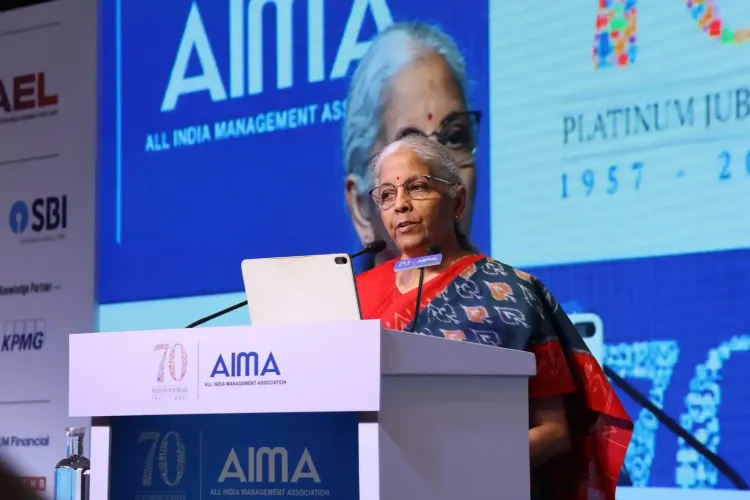
Finance Minister Nirmala Sitharaman addressed the 53rd National Management Convention of AIMA in New Delhi on 22 September 2026 .
She called for an 'Imagined in India' shift — products conceived, designed, and technologically developed in India, then marketed globally.
Sitharaman stressed that India must capture value from design , engineering , patents , software , and know-how , beyond manufacturing scale alone.
She urged greater professionalisation of family-owned businesses, including clearer ownership-management separation and succession planning.
On startups, she said the real goal is not creating unicorns but ensuring they endure and scale into large corporations.
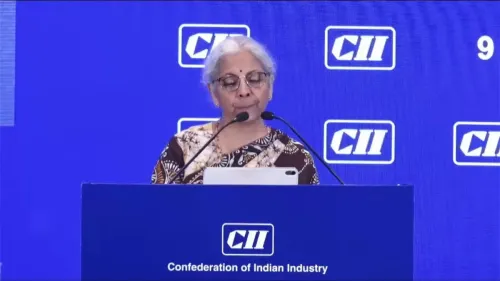
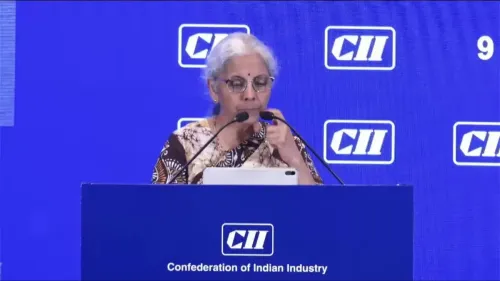
Finance Minister Nirmala Sitharaman on Tuesday, 22 September called on Indian businesses to move beyond the 'Made in India' paradigm and adopt an 'Imagined in India' approach — one where products are conceived, designed, and technologically developed on Indian soil before being taken to global markets. She made the remarks while addressing the 53rd National Management Convention of the All India Management Association (AIMA) in New Delhi.
The 'Imagined in India' Vision
Sitharaman argued that India's economic ambitions must now reach beyond assembly lines and production floors. "Our ambition must move from made in India to imagined in India. Products not only manufactured here, but conceived, designed, and technologically developed here, and then taken to the markets across the world," she said.
The minister underscored that India already possesses the foundational ingredients — market scale, entrepreneurial energy, and institutional capacity — needed to sustain significantly higher levels of economic growth. Execution, she cautioned, would determine whether these strengths are converted into durable national capabilities.
Capturing Value Beyond Manufacturing
While acknowledging that expanding manufacturing capacity remains important, Sitharaman stressed that India must increasingly claim value generated through design, engineering, software, patents, technology, and specialised know-how.
"Manufacturing scale is important, but the next stage is to capture more of the value that comes from design, engineering, patent, software, technology, and know-how," she noted. This framing positions India's next growth chapter as one driven by intellectual property and high-skill output rather than volume alone — a shift that economists have long argued is essential for India to move up global value chains.
Professionalising Family-Owned Businesses
Sitharaman also addressed a structural challenge at the heart of India's business ecosystem: the governance of family-owned enterprises. She called for a clearer separation between ownership and management, well-defined role responsibilities, robust succession planning, and proactive conflict resolution mechanisms.
The minister urged AIMA to expand practical training programmes covering governance, succession planning, delegation of authority, and conflict management for family businesses. Strengthening these foundations, she argued, would help businesses sustain growth across generations.
On Startups and Long-Term Value
Sitharaman offered a pointed perspective on India's startup culture, cautioning against an obsession with headline metrics. "The real prize is not how many unicorns we create, but how many endure, turning today's startups into tomorrow's large corporations," she said.
The remark reflects a broader policy concern: India has produced over 100 unicorns, yet only a handful have scaled into sustainable, globally competitive corporations. The finance minister's framing signals that durability and profitability — not valuation milestones — should define success. Going forward, her comments are likely to shape conversations around India's innovation policy and the role of AIMA in building management capacity for the next generation of enterprises.
Point of View
But the gap between aspiration and infrastructure is real. India's share of global patent filings remains modest, and R&D spending as a percentage of GDP has long lagged behind China, South Korea, and even Brazil. The call to capture value from design and intellectual property is overdue — but it requires sustained public investment in research institutions, IP courts, and deep-tech skilling that budget allocations have not yet fully reflected. The startup caveat is equally telling: a unicorn count that doesn't convert into enduring corporations is, in policy terms, a leaky bucket.
NationPress
22 Sept 2026
Frequently Asked Questions
What is the 'Imagined in India' concept proposed by FM Sitharaman?
'Imagined in India' is a vision articulated by Finance Minister Nirmala Sitharaman on 22 September 2026, calling for Indian businesses to conceive, design, and technologically develop products domestically before marketing them globally — going beyond the existing 'Made in India' manufacturing focus to capture higher value from design, patents, and know-how.
Where did FM Sitharaman make these remarks?
She was addressing the 53rd National Management Convention of the All India Management Association (AIMA) in New Delhi on Tuesday, 22 September 2026.
Why does Sitharaman want India to move beyond 'Made in India'?
The minister argued that manufacturing scale, while important, captures only part of economic value. Higher returns lie in design, engineering, software, and intellectual property — areas where India has growing capacity but has yet to fully monetise, according to her address at AIMA.
What did Sitharaman say about family-owned businesses?
She called for greater professionalisation, including a clearer separation between ownership and management, well-defined responsibilities, succession planning, and conflict resolution mechanisms. She also urged AIMA to expand practical training programmes tailored to family businesses.
What was FM Sitharaman's message on Indian startups and unicorns?
Sitharaman cautioned that the real measure of success is not how many unicorns India creates, but how many of them endure and scale into large corporations. She stressed durability and long-term value over valuation milestones.