Sitharaman pitches textile reforms, PM MITRA parks in Mumbai
Synopsis
Finance Minister Nirmala Sitharaman, speaking in Mumbai, outlined India's post-2020 textile reform drive under the '5F' framework, citing ₹27,000 crore in PM MITRA investment MoUs, the ₹1,480 crore National Technical Textiles Mission, and transformational FTAs for garment exporters.
Key Takeaways
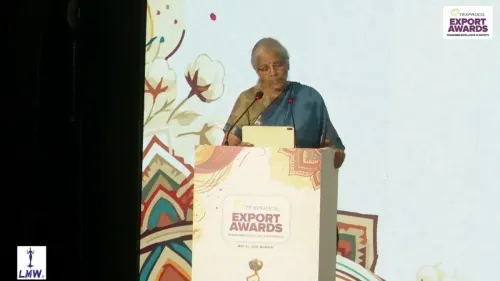
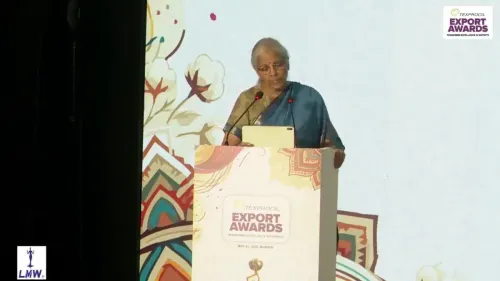
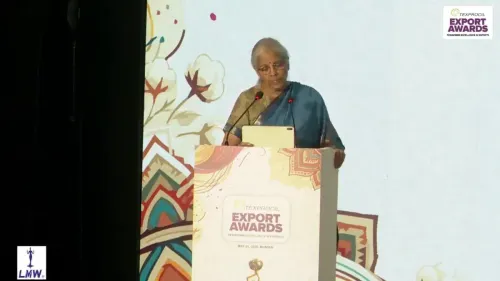
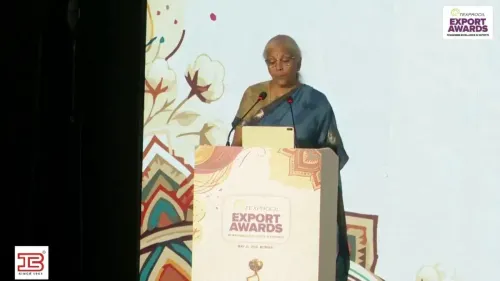
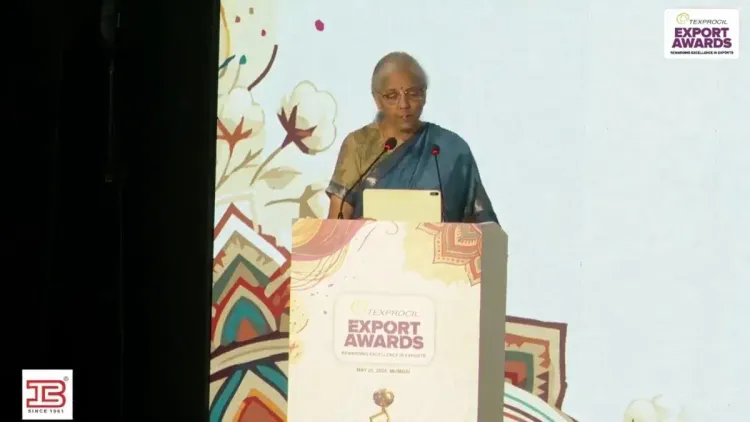
Finance Minister Nirmala Sitharaman addressed an audience in Mumbai on 25 May 2026 , outlining the government's textile reform agenda.
The PM MITRA Scheme is developing 7 integrated textile parks ; investment MoUs exceeding ₹27,000 crore have been signed.
The National Technical Textiles Mission (NTTM) was launched with an outlay of ₹1,480 crore to promote high-value textiles for defence, agriculture and healthcare.
The government's '5F' framework — Farm, Fiber, Factory, Fashion, Foreign — frames textiles within a broader post-2020 manufacturing reform push.
India's FTAs are expected to provide transformational market access for garment and apparel exporters.
The Mumbai address was the first in a series, signalling continued public communication on the textile and manufacturing reform agenda.
Union Finance Minister Nirmala Sitharaman, speaking in Mumbai on 25 May 2026, outlined the government's post-2020 textile reform push, highlighting the PM MITRA Scheme, the National Technical Textiles Mission (NTTM), and the transformative potential of India's free trade agreements for garment and apparel exporters.
Context
Sitharaman framed the government's textile agenda within the broader '5F' framework — Farm, Fiber, Factory, Fashion and Foreign — describing the pace of reform since 2020 as significantly accelerated. The formulation links primary production to manufacturing and global market integration, situating textiles at the heart of India's industrial ambitions. The address in Mumbai, posted as the first in a series, signals a sustained public communication effort around the sector.
The minister stated that investment MoUs exceeding ₹27,000 crore have already been signed under the PM MITRA umbrella, underlining early investor interest in the park model.
Policy Backdrop
The PM MITRA (PM Mega Integrated Textile Region and Apparel) Scheme is developing seven world-class textile parks with plug-and-play infrastructure designed to serve the full fibre-to-fashion value chain. The scheme was first announced in the Union Budget 2021-22 and builds on the earlier Scheme for Integrated Textile Parks introduced in 2005.
The National Technical Textiles Mission was approved by the Cabinet in 2020 with an outlay of ₹1,480 crore. Its mandate is to push India beyond conventional apparel into high-technology, high-value segments — including textiles for defence, agriculture, healthcare and infrastructure. Sitharaman underscored that India's textile future 'must include high-technology, high-value technical textiles' spanning these sectors.
Both schemes sit within the wider Atmanirbhar Bharat and Production-Linked Incentive (PLI) framework aimed at raising manufacturing's share of GDP and building globally competitive supply chains.
Stakeholders and Impact
The primary beneficiaries of the PM MITRA parks are textile manufacturers, garment exporters and technical textile firms that require integrated infrastructure to compete globally. The park model is intended to reduce logistics costs and create end-to-end ecosystems, from spinning to finished apparel.
India's ongoing and concluded free trade agreements (FTAs) are expected to open preferential market access for garment and apparel exporters. Sitharaman described these FTAs as 'transformational' for the sector, pointing to a strategic alignment between domestic manufacturing capacity-building and external market integration.
Technical textile firms stand to gain from the NTTM's research and market development support, particularly those supplying defence and healthcare sectors where import substitution remains a policy priority.
What's Next
Attention will turn to the pace of land acquisition, infrastructure tendering and operational readiness at the seven PM MITRA park sites across different states. The progress of ongoing FTA negotiations — particularly with major trading partners — will determine how quickly the promised export benefits materialise for the apparel sector.
With the Mumbai address marked as the first in a series, Sitharaman is expected to elaborate further on other dimensions of the textile and broader manufacturing reform agenda in subsequent posts and engagements. The government's ability to translate MoU commitments into ground-level investment and job creation will be the key metric for the sector in the months ahead.
Point of View
Linking agricultural inputs to global export markets in a single narrative arc. Anchoring the pitch in concrete numbers — ₹27,000 crore in MoUs and a ₹1,480 crore mission — gives the messaging a policy-substance backbone beyond sloganeering. The emphasis on technical textiles signals a strategic intent to move up the value chain rather than compete solely on low-cost apparel, which aligns with broader PLI-era thinking. However, the gap between MoU signings and operational park capacity will be the real test of whether the 'Reform Express' metaphor translates into durable manufacturing outcomes.
NationPress
10 Oct 2026
Frequently Asked Questions
What is the PM MITRA Scheme and how many parks are planned?
The PM MITRA (PM Mega Integrated Textile Region and Apparel) Scheme is a central government initiative to develop 7 world-class, integrated textile parks with plug-and-play infrastructure covering the full fibre-to-fashion value chain. Investment MoUs exceeding ₹27,000 crore have already been signed under the scheme.
What is the National Technical Textiles Mission (NTTM)?
The National Technical Textiles Mission was approved in 2020 with an outlay of ₹1,480 crore . It aims to develop high-technology, high-value technical textiles for sectors including defence, agriculture, healthcare and infrastructure, moving India beyond conventional apparel manufacturing.
What is the '5F' framework Nirmala Sitharaman mentioned?
The '5F' framework stands for Farm, Fiber, Factory, Fashion and Foreign . It is the government's conceptual structure linking primary textile inputs to manufacturing and global market integration, used to describe the post-2020 reform agenda for the sector.
How will India's FTAs help garment exporters?
India's free trade agreements are expected to provide preferential market access and lower tariff barriers for garment and apparel exporters. Finance Minister Sitharaman described these FTAs as 'transformational' for the sector, complementing domestic capacity built through PM MITRA parks.
Where did Nirmala Sitharaman make this textile policy statement?
Sitharaman made these remarks in Mumbai on 25 May 2026 . The address was shared on her official X account and was marked as the first in a series of posts on the topic.