Giriraj Singh Eyes $350 Bn Textile Target by 2030
Synopsis
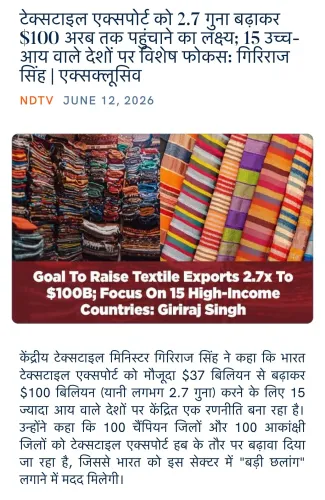
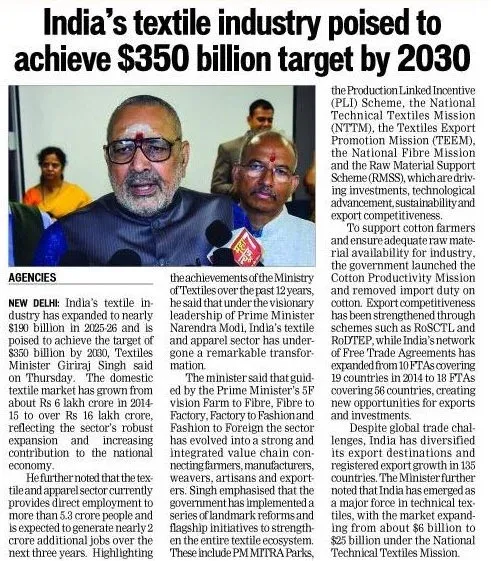
Union Textiles Minister Giriraj Singh on June 12, 2026, reaffirmed India's goal of building a $350 billion textile and apparel sector by 2030, anchoring the push on PLI, PM MITRA parks, NTTM, and TEEM initiatives, with the sector already employing over 5.3 crore people.
Key Takeaways
Union Textiles Minister Giriraj Singh has publicly reaffirmed the government's $350 billion textile and apparel target by 2030 .
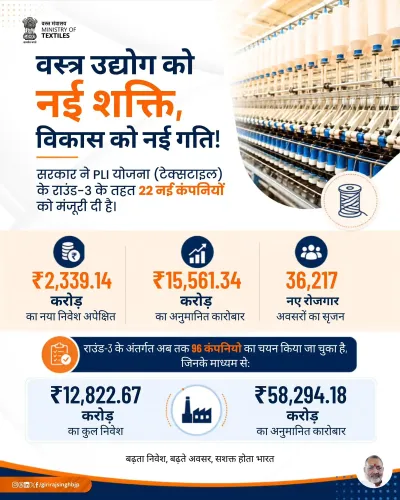
Four key policy instruments cited: PLI scheme (Rs 10,683 crore outlay), PM MITRA parks (7 locations), National Technical Textiles Mission (Rs 1,480 crore), and TEEM initiative .
India's textile sector currently employs more than 5.3 crore people , making it one of the country's largest employment generators.
The push is embedded within the Atmanirbhar Bharat and Make in India frameworks championed by PM Narendra Modi .
The policy shift toward technical textiles signals a move to higher-value products beyond traditional cotton garments.
Progress will be measured through PLI disbursement data , PM MITRA implementation milestones , and export and employment figures in upcoming economic surveys.
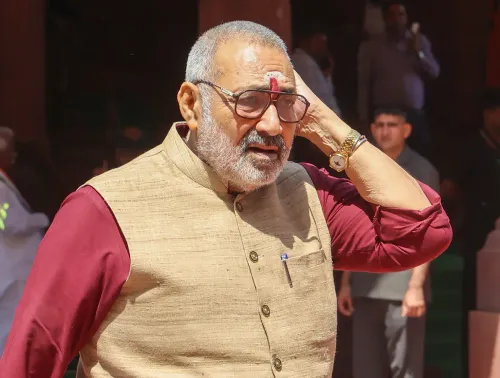
Union Textiles Minister Giriraj Singh on Friday, June 12, 2026, reaffirmed the government's commitment to scaling India's textile and apparel industry to a $350 billion target by 2030, citing a suite of flagship schemes and reform initiatives as the driving force behind the push.
Context
Posting on X, Singh listed four major policy instruments — the Production Linked Incentive (PLI) scheme, PM MITRA parks, the National Technical Textiles Mission (NTTM), and the TEEM initiative — as the pillars of this ambition. In his words: 'PLI योजना, PM MITRA पार्क, राष्ट्रीय तकनीकी वस्त्र मिशन (NTTM), TEEM तथा अन्य सुधारात्मक पहलों के माध्यम से हम भारत के टेक्सटाइल एवं अपैरल उद्योग को वर्ष 2030 तक $350 बिलियन के लक्ष्य तक पहुंचाने के लिए प्रतिबद्ध हैं' — translated: 'Through PLI, PM MITRA parks, NTTM, TEEM and other reform initiatives, we are committed to taking India's textile and apparel industry to the $350 billion target by 2030.'
The minister noted that the sector currently employs more than 5.3 crore people and described it as a foundational pillar of India's growth journey in the years ahead.
Policy Backdrop
The PLI scheme for textiles was cleared by the Union Cabinet in 2021 with an estimated outlay of Rs 10,683 crore over five years, targeting man-made fibre and apparel segments. The PM Mega Integrated Textile Region and Apparel (PM MITRA) parks initiative is designed to create world-class, plug-and-play textile clusters across seven locations in India.
The National Technical Textiles Mission, approved in 2020 with an outlay of Rs 1,480 crore over four years, focuses on research, innovation, and production of technical textiles — a deliberate move toward higher-value, diversified products beyond traditional cotton garments. Together, these schemes form part of the broader Atmanirbhar Bharat and Make in India frameworks launched under Prime Minister Narendra Modi.
Stakeholders and Impact
Singh underlined that these efforts are already generating new opportunities in investment, production, exports, and employment. Textile workers, apparel exporters, and MSME manufacturers across the value chain stand to benefit from the combined thrust of fiscal incentives and integrated infrastructure.
The minister credited the direction to Prime Minister Narendra Modi's leadership, stating that under his stewardship, India is registering a strong presence in the global textile and apparel sector. The sector's large employment base — spanning weavers, garment workers, and technical textile producers — makes its growth trajectory a matter of significant socioeconomic consequence.
What's Next
Implementation milestones for the seven PM MITRA parks and disbursement figures under the PLI scheme will be closely tracked through Ministry of Textiles reports and parliamentary updates. Export growth data and job creation numbers in forthcoming economic surveys will serve as early indicators of whether the $350 billion by 2030 trajectory is on course.
If the combined policy architecture delivers on its targets, India could significantly raise its share in global textile trade — a sector currently dominated by China, Bangladesh, and Vietnam — while deepening its manufacturing base under the #ViksitBharat2047 vision.
Point of View
Headline-friendly target number ahead of what is likely a period of ministerial accountability reviews. The $350 billion figure and the 5.3 crore employment count are forward-looking projections, and their credibility will hinge on verifiable PLI disbursements and PM MITRA park operationalisation timelines. The emphasis on technical textiles alongside traditional apparel reflects a strategic pivot that, if sustained, could reposition India in higher-margin global supply chains. Politically, the post reinforces the Modi government's manufacturing narrative as a differentiator heading into the second half of the decade.
NationPress
26 Oct 2026
Frequently Asked Questions
What is India's textile industry target by 2030?
Union Textiles Minister Giriraj Singh has stated that India aims to grow its textile and apparel industry to $350 billion by 2030 , supported by schemes such as PLI, PM MITRA parks, and the National Technical Textiles Mission.
What is the PM MITRA park scheme?
PM Mega Integrated Textile Region and Apparel (PM MITRA) is a government initiative to develop seven world-class, plug-and-play integrated textile clusters across India, designed to attract investment and boost production and exports.
How many people does India's textile sector employ?
According to Minister Giriraj Singh , India's textile and apparel sector currently employs more than 5.3 crore people , making it one of the country's largest sources of employment.
What is the PLI scheme for textiles?
The Production Linked Incentive (PLI) scheme for textiles was approved by the Union Cabinet in 2021 with an outlay of Rs 10,683 crore over five years , providing financial incentives to manufacturers of man-made fibre and technical apparel products.
What is the National Technical Textiles Mission?
The National Technical Textiles Mission (NTTM) is a central sector scheme approved in 2020 with an outlay of Rs 1,480 crore , focused on promoting research, innovation, and domestic production of technical textiles across multiple application areas.