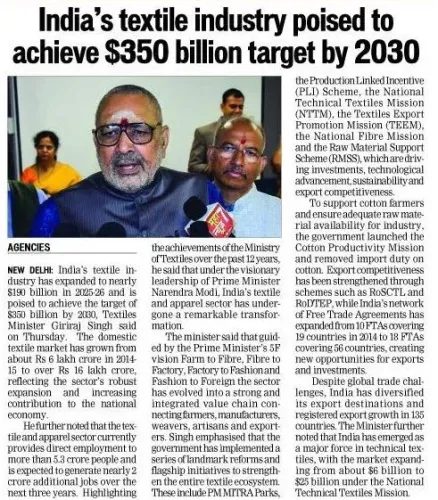
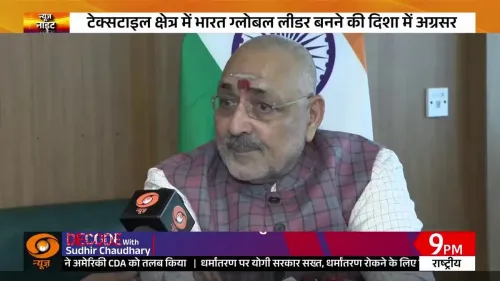
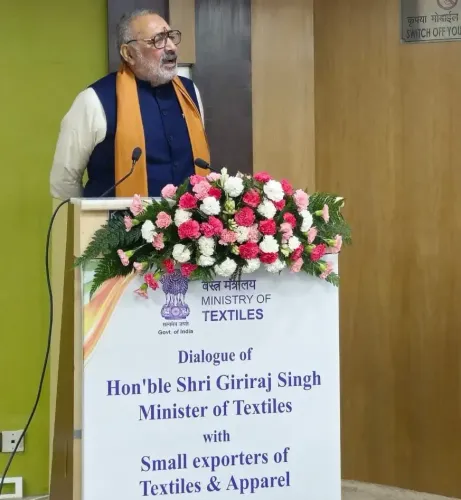
India's textile industry eyes $350 billion target by 2030: Giriraj Singh
Synopsis
India's textile sector has more than doubled in domestic market size since 2014 and is now targeting $350 billion by 2030 — a near-doubling from today's $190 billion. With 5.3 crore jobs already and 2 crore more projected, and FTAs now covering 56 countries, the ambition is large. Whether the policy pipeline can deliver at scale is the real question.
Key Takeaways
India's textile industry reached nearly $190 billion in 2025-26 , targeting $350 billion by 2030 .
The domestic market grew from ₹6 lakh crore in 2014-15 to over ₹16 lakh crore .
The sector directly employs more than 5.3 crore people ; 2 crore additional jobs projected over three years.
Key schemes include PM MITRA Parks , PLI , NTTM , TEEM , and the Cotton Productivity Mission .
India's FTA network has expanded from 10 FTAs (19 countries) in 2014 to 18 FTAs (56 countries).
Technical textiles market has grown from $6 billion to $25 billion under the NTTM .
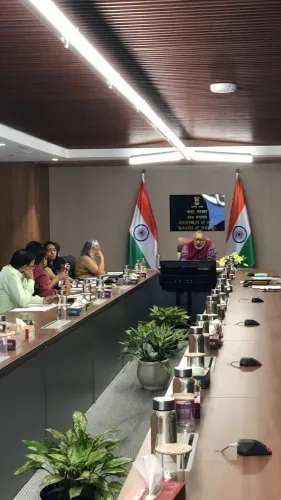
India's textile industry has grown to nearly $190 billion in 2025-26 and is on track to reach the $350 billion target by 2030, Textiles Minister Giriraj Singh said on Thursday, 11 June. The minister credited a decade of policy reforms and the Prime Minister's 5F vision for the sector's transformation into a globally competitive, integrated value chain.
Scale of Growth
The domestic textile market has more than doubled — expanding from approximately ₹6 lakh crore in 2014-15 to over ₹16 lakh crore today. The sector currently provides direct employment to more than 5.3 crore people and is expected to generate nearly 2 crore additional jobs over the next three years, according to Singh.
Policy Architecture Driving the Push
The government has rolled out a suite of flagship initiatives to strengthen the textile ecosystem. These include PM MITRA Parks, the Production-Linked Incentive (PLI) Scheme, the National Technical Textiles Mission (NTTM), the Textiles Export Promotion Mission (TEEM), the National Fibre Mission, and the Raw Material Support Scheme (RMSS). Together, these programmes are aimed at driving investment, technological advancement, sustainability, and export competitiveness.
To address raw material bottlenecks, the government launched the Cotton Productivity Mission and removed import duty on cotton, a move intended to support cotton farmers while ensuring adequate supply for manufacturers.
Export Expansion and Trade Agreements
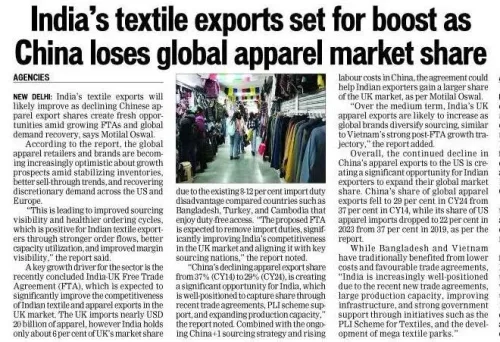
India's network of Free Trade Agreements has grown from 10 FTAs covering 19 countries in 2014 to 18 FTAs covering 56 countries, opening new corridors for textile exports and investment. Despite global trade headwinds, India has registered export growth across 135 countries by diversifying its destination markets. Export competitiveness has been further supported through the RoSCTL and RoDTEP schemes.
Technical Textiles: A Rising Segment
Singh highlighted India's emergence as a significant force in technical textiles, with the market expanding from approximately $6 billion to $25 billion under the National Technical Textiles Mission. This segment — covering industrial, medical, and defence applications — is increasingly seen as a high-value frontier for Indian manufacturers.
The Road to 2030
Guided by Prime Minister Narendra Modi's 5F vision — Farm to Fibre, Fibre to Factory, Factory to Fashion, and Fashion to Foreign — the sector aims to connect every node of the value chain, from farmers and weavers to exporters. With sectoral targets ambitious and global competition intensifying, execution of the pending policy pipeline will be closely watched by industry stakeholders in the months ahead.
Point of View
But the baseline trajectory makes it arithmetically plausible only if export growth accelerates sharply — India's textile exports have lagged peers like Bangladesh and Vietnam in key Western markets. The domestic market doubling to ₹16 lakh crore is real progress, but employment intensity is the harder metric: adding 2 crore jobs in three years would require every new scheme to fire simultaneously. The FTA expansion is strategically sound, yet utilisation rates on existing agreements have historically been low. The 5F vision is a compelling narrative; the test is whether PM MITRA Parks and PLI disbursements translate into factory-floor reality before 2030.
NationPress
19 Sept 2026
Frequently Asked Questions
What is India's textile industry target for 2030?
India aims to grow its textile industry to $350 billion by 2030, up from nearly $190 billion in 2025-26. Textiles Minister Giriraj Singh announced this on 11 June, citing a decade of policy reforms as the foundation.
How many jobs does India's textile sector currently provide?
The textile and apparel sector directly employs more than 5.3 crore people as of 2025. The government projects an additional 2 crore jobs will be created over the next three years through ongoing schemes.
What is the PM Modi 5F vision for textiles?
The 5F vision stands for Farm to Fibre, Fibre to Factory, Factory to Fashion, and Fashion to Foreign. It is a framework to integrate the entire textile value chain — connecting farmers, weavers, manufacturers, and exporters — to build a globally competitive sector.
Which government schemes are driving India's textile growth?
Key initiatives include PM MITRA Parks, the Production-Linked Incentive (PLI) Scheme, the National Technical Textiles Mission (NTTM), the Textiles Export Promotion Mission (TEEM), the National Fibre Mission, the Raw Material Support Scheme (RMSS), and the Cotton Productivity Mission.
How has India's technical textiles market grown?
India's technical textiles market has expanded from approximately $6 billion to $25 billion under the National Technical Textiles Mission. The segment covers industrial, medical, and defence applications and is seen as a high-value growth frontier.