FM Sitharaman Sets $100 Bn Textile Export Target for 2030
Synopsis
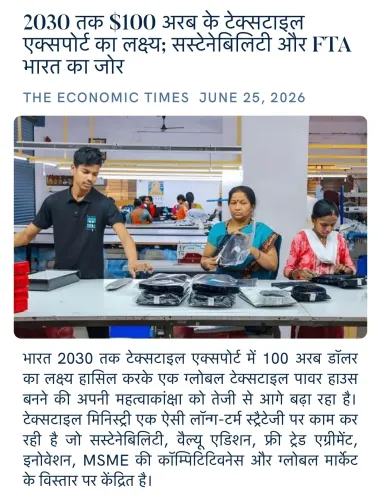
Finance Minister Nirmala Sitharaman, speaking in Mumbai, set targets of $100 billion in textile exports and $250 billion in production by 2030, linking them to the Viksit Bharat 2047 vision and flagging the need to significantly scale India's current fibre output of around 15 million metric tonnes.
Key Takeaways
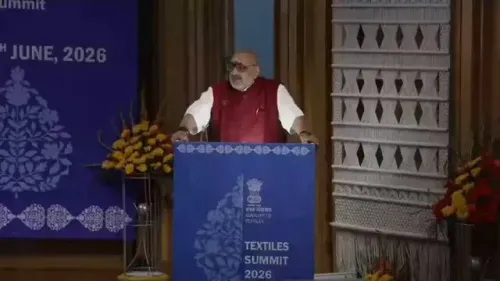
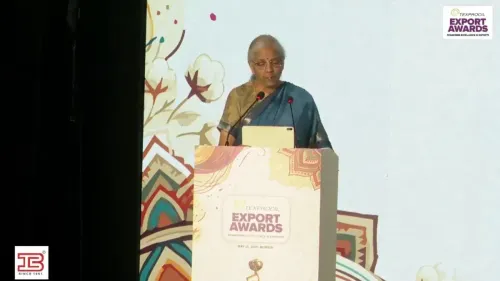
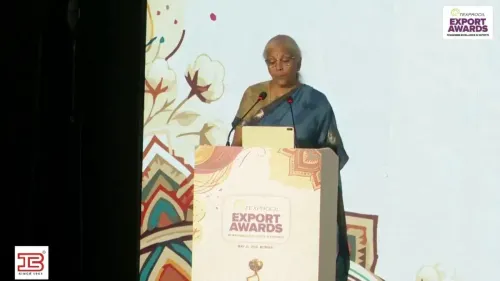
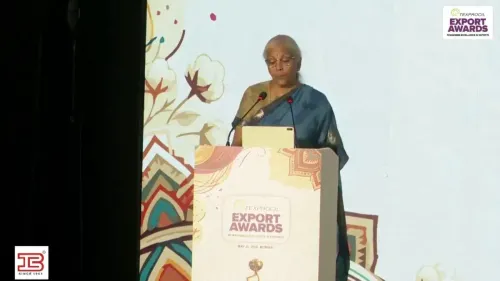
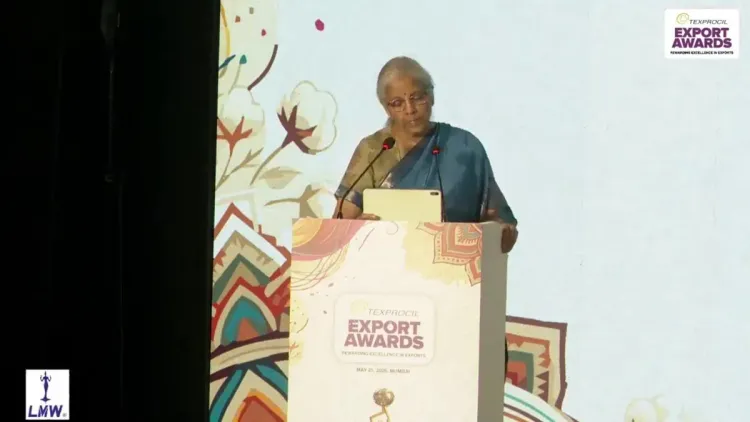
Union Finance Minister Nirmala Sitharaman spoke at an industry event in Mumbai on 25 May 2026 .
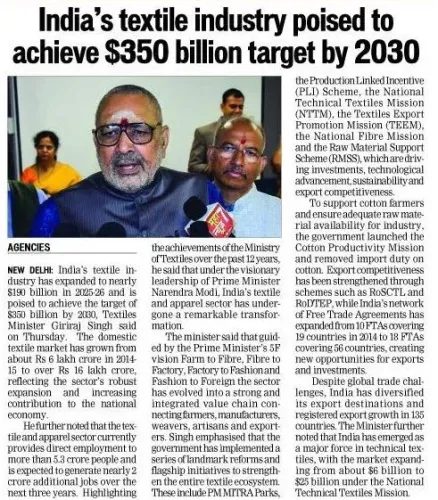
The government is targeting $100 billion in textile exports and $250 billion in textile production by 2030 .
India's fibre production, currently around 15 million metric tonnes , must grow significantly to support these targets.
The targets are framed as integral to the Viksit Bharat 2047 vision of a developed India by the centenary of independence.
Existing policy instruments include the PLI Scheme for Textiles (Rs 10,683 crore) and the National Technical Textiles Mission (Rs 1,480 crore).
The Mumbai remarks are part of a thread, with further details expected in subsequent posts.
Union Finance Minister Nirmala Sitharaman, speaking in Mumbai on Monday, 25 May 2026, outlined ambitious sectoral milestones for India's textile industry, framing them as essential to realising the Viksit Bharat 2047 vision of transforming India into a developed economy by the centenary of independence.
Context
Posting from Mumbai, Sitharaman's office stated that achieving the national vision demands action 'on a scale commensurate with that ambition.' For the textile sector, this translates into reaching $100 billion in textile exports and $250 billion in textile production by 2030, with further scaling envisaged beyond that horizon. India's current fibre production, cited at approximately 15 million metric tonnes, was flagged as needing significant expansion to support these targets.
The post is part of a thread — marked '1/n' — indicating a series of remarks made by the Finance Minister at an industry event in Mumbai, with further details expected in subsequent posts.
Policy Backdrop
The targets sit within a broader policy architecture the central government has been building since 2020. The National Technical Textiles Mission, launched that year with an outlay of Rs 1,480 crore, was designed to scale up technical textile production and exports. In September 2021, the Cabinet approved the Production Linked Incentive (PLI) Scheme for Textiles with an outlay of Rs 10,683 crore, focused on man-made fibre apparel and technical textiles to reduce the sector's traditional dependence on cotton and capture higher-value global supply-chain segments.
India's Foreign Trade Policy 2023 set an overarching merchandise export goal of USD 2 trillion by 2030, with textiles identified as a priority contributor. Successive Union Budgets have reinforced incentives for fibre diversification and value-added manufacturing, consistent with the government's stated aim of raising India's share of global trade.
Stakeholders and Impact
The targets carry direct implications for textile exporters, fibre manufacturers, and apparel MSMEs — three constituencies that collectively employ tens of millions of workers across states such as Gujarat, Tamil Nadu, Maharashtra, and Telangana. Scaling fibre production well beyond current levels would require substantial capital investment in spinning, weaving, and processing infrastructure, alongside policy support for technology adoption.
For man-made fibre producers in particular, the government's emphasis on moving away from cotton dependency signals continued policy tailwinds, including potential duty rationalisation and PLI disbursements, as the sector competes with established exporters such as China, Bangladesh, and Vietnam.
What's Next
The remaining posts in Sitharaman's Mumbai thread are expected to elaborate on specific policy measures or announcements from the event. Analysts and industry bodies will watch the Union Budget 2027-28 for revised export incentives, fresh allocations, and any mid-term review of PLI scheme performance. Progress on fibre production capacity additions will be a key indicator of whether the 2030 milestones remain on track within the broader Viksit Bharat 2047 roadmap.
Point of View
The Finance Ministry is effectively setting a public benchmark against which future budgets and PLI outcomes will be measured. The emphasis on scaling fibre production points to a deliberate pivot toward man-made fibres and technical textiles — higher-margin segments where India has historically lagged behind East and South-East Asian competitors. Whether the existing PLI architecture is adequate to close that gap, or whether fresh fiscal support is needed, is likely to become a sharper political and industry debate as 2030 approaches.
NationPress
9 Oct 2026
Frequently Asked Questions
What is Nirmala Sitharaman's textile export target for India?
Finance Minister Nirmala Sitharaman has outlined a target of $100 billion in textile exports and $250 billion in textile production by 2030, framed within the Viksit Bharat 2047 vision.
What is Viksit Bharat 2047?
Viksit Bharat 2047 is Prime Minister Narendra Modi's long-term vision to transform India into a fully developed economy by 2047, marking 100 years of independence.
What is India's current fibre production capacity?
India's fibre production is currently around 15 million metric tonnes, according to the figures cited by Sitharaman's office, and will need to grow significantly to meet the 2030 targets.
What government schemes support India's textile sector?
Key schemes include the Production Linked Incentive (PLI) Scheme for Textiles with an outlay of Rs 10,683 crore, approved in September 2021, and the National Technical Textiles Mission launched in 2020 with Rs 1,480 crore.
Why is India focusing on man-made fibres in textiles?
The government is pushing man-made fibres and technical textiles to reduce dependence on cotton and compete in higher-value global supply-chain segments, where rivals such as China, Bangladesh, and Vietnam currently hold larger market shares.