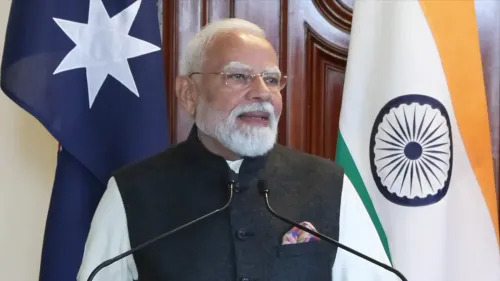
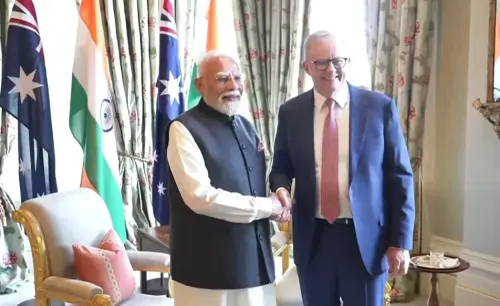
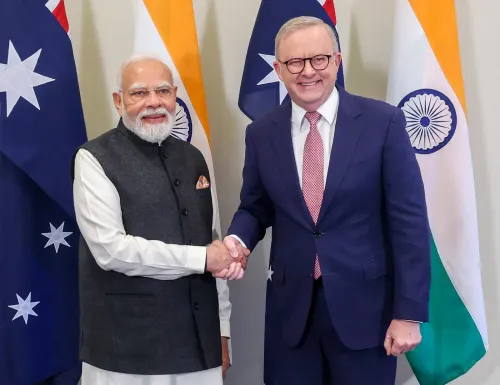
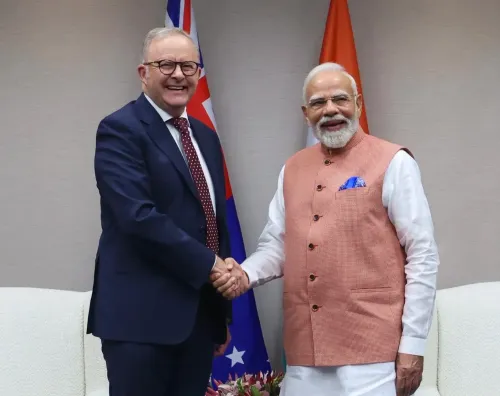
Modi, Albanese sign defence, nuclear and cyber pacts at Melbourne Summit
Synopsis
At Melbourne's Annual Leaders' Summit, Modi and Albanese didn't just exchange pleasantries — they operationalised years of strategic intent. Uranium exports unlocked, a cyber and critical technologies partnership launched, a maritime security roadmap endorsed, and CECA negotiations accelerated: the India-Australia relationship has shifted from warm words to binding architecture, with the Indo-Pacific balance of power as the clear subtext.
Key Takeaways
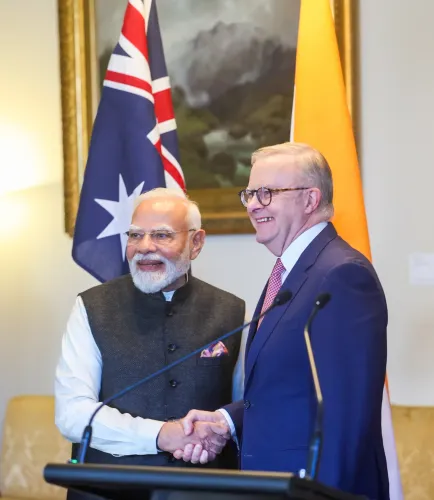
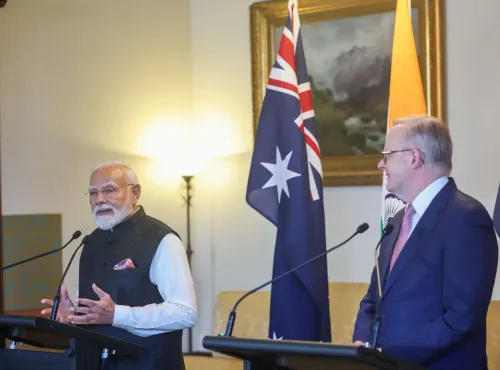
PM Modi and Australian PM Albanese held their Annual Leaders' Summit in Melbourne on 10 July , issuing a comprehensive joint statement.
Both sides signed a Joint Declaration on Defence and Security Cooperation and endorsed a Joint Maritime Security Collaboration Roadmap .
An administrative arrangement was confirmed to enable uranium exports to India under the 2015 Australia-India Nuclear Cooperation Agreement .
A new Australia-India Partnership on Cyber, Critical Technologies and Supply Chains was formally launched.
Both countries agreed to accelerate CECA and bilateral investment treaty negotiations, building on the 2022 ECTA .
Australia will support India's Gaganyaan spaceflight programme via a tracking terminal on the Cocos (Keeling) Islands .
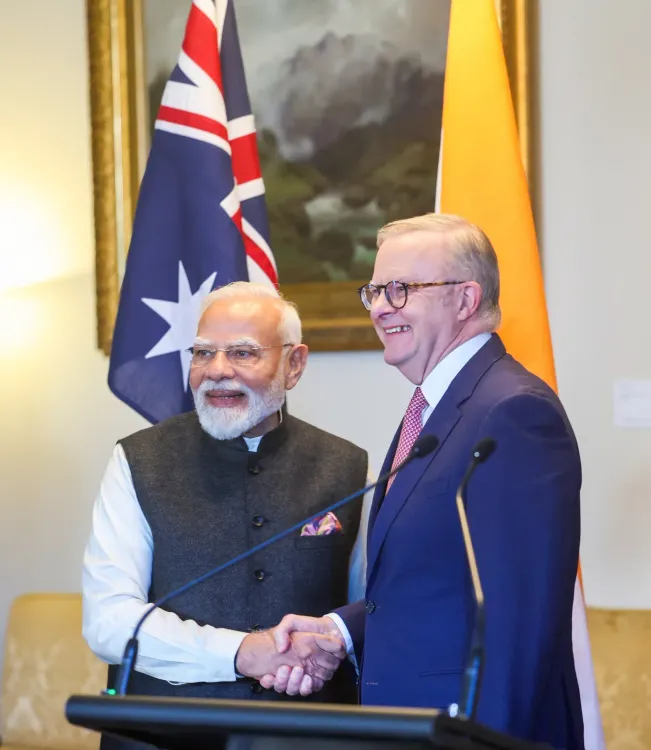
Prime Minister Narendra Modi and Australian Prime Minister Anthony Albanese on Friday, 10 July issued a sweeping joint statement following their Annual Leaders' Summit in Melbourne, unveiling landmark agreements spanning defence, nuclear energy, cyber technologies, critical minerals, and trade — further cementing the India-Australia Comprehensive Strategic Partnership. The summit produced a Joint Declaration on Defence and Security Cooperation and accelerated progress on a Comprehensive Economic Cooperation Agreement (CECA), signalling the most consequential bilateral upgrade in years.
Key Agreements Signed
The two leaders endorsed a Joint Maritime Security Collaboration Roadmap and launched a new Australia-India Partnership on Cyber, Critical Technologies and Supply Chains. On energy, both sides confirmed the signing of an administrative arrangement to operationalise uranium exports to India under the 2015 Australia-India Nuclear Cooperation Agreement — a long-pending step that now clears the path for Australian uranium to support India's civil nuclear programme.
Albanese also announced Australian support for India's Gaganyaan human spaceflight programme through a temporary space tracking terminal on the Cocos (Keeling) Islands, and flagged progress on cultural repatriation initiatives between the two countries.
What the Leaders Said
'Australia values India as a top-tier security partner,' Albanese said at the joint media statement, adding that the Joint Declaration on Defence and Security Cooperation 'reflects our shared commitment to a peaceful, stable and prosperous Indo-Pacific region.' He described the bilateral relationship as having 'never been more consequential' in the six years since the Comprehensive Strategic Partnership was established.
Modi thanked Albanese for his 'personal efforts and commitment', saying India-Australia relations had 'attained new heights and acquired breadth and depth.' On the nuclear arrangement, Modi said: 'This will pave the way for uranium supplies from Australia to India and give our clean energy objectives fresh momentum.' On critical minerals, he announced both countries would jointly develop 'a critical minerals corridor.'
In a lighter moment in Melbourne — often described as Australia's sporting capital — Modi drew a cricket analogy: 'The agenda is focused like a one-day match. Decisions are quick like a T20 match. And partnership is long-term and intense like a test match.'
Trade and Economic Cooperation
Both sides agreed to accelerate negotiations on the CECA and a bilateral investment treaty. Modi described the prospective agreement as 'balanced, ambitious and win-win for both countries', building on the Economic Cooperation and Trade Agreement (ECTA) signed in 2022, which he said had 'consistently broadened the scope of our trade and investment.'
Indo-Pacific and Counter-Terrorism Stance
Regional security featured prominently in both leaders' remarks. Modi reaffirmed that the maritime security roadmap would 'infuse new strength into our shared efforts in the Indo-Pacific.' On terrorism, he stated: 'Both India and Australia believe that terrorism is a serious challenge not just for one single country, but for entire humanity. And that is why our fight against terrorism is shared, and our resolve is unbreakable.'
This comes amid intensifying strategic competition in the Indo-Pacific, where both nations are also members of the Quad grouping alongside the United States and Japan. The Melbourne summit reinforces the bilateral track as a complementary pillar to multilateral security arrangements in the region.
What Comes Next
CECA negotiations are now expected to move at an accelerated pace, with both sides signalling political will for a swift conclusion. The uranium export arrangement, once fully operationalised, will mark a significant addition to India's civil nuclear supply chain. Observers will watch whether the critical minerals corridor announcement translates into binding supply agreements, given global competition for lithium, cobalt, and rare earths in which Australia holds substantial reserves.
Point of View
Similarly, has been negotiated in fits and starts since 2011. Meanwhile, the critical minerals corridor is a headline without a supply contract. India needs Australian lithium and rare earths; Australia needs Indian demand and investment — the alignment is real, but so is the history of announcements outpacing agreements. What distinguishes this summit is the defence and cyber architecture, which moves faster than trade law and reflects where both governments see the urgency: the Indo-Pacific security order, not just commerce.
NationPress
10 Jul 2026
Frequently Asked Questions
What agreements were signed at the India-Australia Leaders' Summit in Melbourne?
The two sides signed a Joint Declaration on Defence and Security Cooperation, endorsed a Joint Maritime Security Collaboration Roadmap, launched an Australia-India Partnership on Cyber, Critical Technologies and Supply Chains, and confirmed an administrative arrangement to enable uranium exports to India under the 2015 Nuclear Cooperation Agreement. Both countries also agreed to accelerate CECA and bilateral investment treaty negotiations.
What does the uranium export arrangement mean for India?
The administrative arrangement operationalises the 2015 Australia-India Nuclear Cooperation Agreement, clearing the way for Australian uranium to be supplied to India for peaceful purposes. PM Modi said it would give India's clean energy objectives 'fresh momentum', supporting the country's expanding civil nuclear programme.
What is the CECA and why does it matter?
The Comprehensive Economic Cooperation Agreement (CECA) is a proposed full-scale free trade deal between India and Australia that goes beyond the interim Economic Cooperation and Trade Agreement (ECTA) signed in 2022. Both leaders agreed to accelerate negotiations, with Modi describing the target agreement as 'balanced, ambitious and win-win for both countries.'
How does this summit fit into India's Indo-Pacific strategy?
Both India and Australia are members of the Quad alongside the United States and Japan. The Melbourne summit reinforces the bilateral track as a complementary pillar to multilateral security arrangements, with the Joint Maritime Security Collaboration Roadmap and the new cyber partnership directly addressing Indo-Pacific stability concerns.
What is the Australia-India critical minerals corridor?
PM Modi announced that both countries would jointly develop a critical minerals corridor, building on existing cooperation in the sector. Australia holds significant reserves of lithium, cobalt, and rare earths — materials critical to India's clean energy and EV manufacturing ambitions. Details of the corridor's structure and binding supply commitments are yet to be announced.