Puri credits ethanol blending for India's low petrol prices
Synopsis
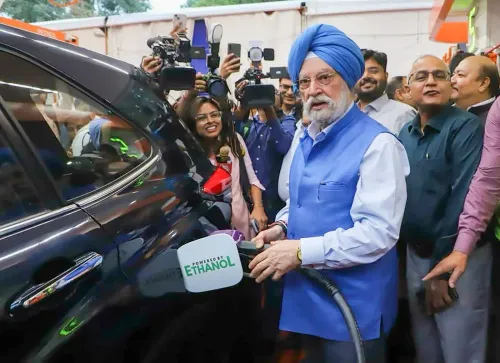
Union Petroleum Minister Hardeep Singh Puri credited India's ethanol blending programme — which sources ethanol from farmers at fixed annual prices — as a major factor keeping domestic petrol prices low even as global crude oil costs rise.
Key Takeaways
Petroleum Minister Hardeep Singh Puri said ethanol blending is a key reason India ranks among countries with the cheapest petrol globally.
Ethanol is procured from Indian farmers at government-fixed annual prices , shielding a portion of the fuel blend from global crude volatility.
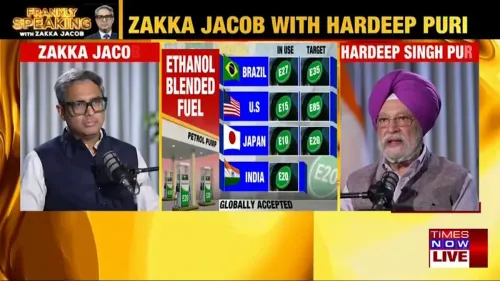
India's Ethanol Blended Petrol Programme began in 2003 with a 5% blending target and has since been scaled up to a 20% target , originally set for 2030 and advanced to 2025.
The National Policy on Biofuels, 2018 provides the current framework for procurement targets and price-setting mechanisms.
Key stakeholders include sugarcane farmers (as ethanol suppliers) and oil marketing companies (as mandated blenders and distributors).
The next policy milestone is the full rollout of E20-compatible vehicles and potential expansion of ethanol feedstock sources.
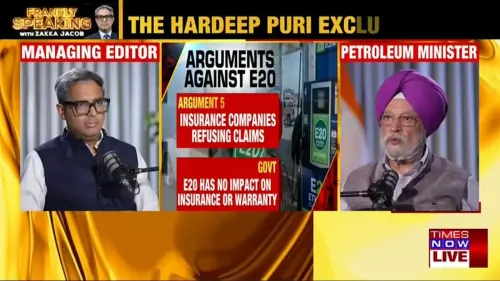
Union Petroleum Minister Hardeep Singh Puri on Friday, 10 July 2026, highlighted India's ethanol blending programme as a key reason the country is able to offer among the most affordable petrol prices globally, stating that domestically sourced ethanol — purchased from farmers at fixed annual prices — buffers India from global crude oil volatility.
Context
Puri wrote in Hindi: 'आज भारत दुनिया के सबसे सस्ते पेट्रोल उपलब्ध कराने वाले देशों में शामिल है, तो इसके पीछे एक बड़ा कारण इथेनॉल मिश्रण भी है' — ('Today, India is among the countries providing the cheapest petrol in the world, and a major reason behind this is ethanol blending.'). He added that while the world struggles with rising crude oil prices, India has ethanol sourced from its own farmers, with prices fixed for the entire year.
The post, accompanied by a video, underscores the government's framing of the Ethanol Blended Petrol (EBP) Programme as both an energy-security measure and an instrument of farmer welfare — a dual narrative the BJP-led government has consistently deployed ahead of policy reviews and electoral cycles.
Policy Backdrop
India's ethanol blending initiative dates to 2003, when the government set an initial target of 5% blending of ethanol with petrol. The National Policy on Biofuels, 2018 raised the indicative target to 20% blending by 2030, a deadline subsequently advanced to 2025. Since 2019, the government has fixed ethanol procurement prices annually, providing price certainty to oil marketing companies and income predictability to sugarcane farmers.
The administered-price mechanism is central to Puri's argument: because ethanol is procured at a government-set rate rather than a market-linked one, its cost does not fluctuate with global crude benchmarks like Brent or WTI. This insulates a portion of the fuel blend from international price shocks, theoretically dampening retail petrol price increases during crude price spikes.
Stakeholders and Impact
Sugarcane farmers are the most direct beneficiaries of the programme, as ethanol procurement channels surplus sugar-sector output into the fuel supply chain, providing an assured off-take at fixed prices. Oil marketing companies (OMCs) — including Indian Oil Corporation, Bharat Petroleum, and Hindustan Petroleum — are the institutional buyers mandated to blend and distribute the ethanol-mixed fuel.
For consumers, the blending programme is presented as a mechanism to moderate retail fuel prices. The government's broader import-substitution logic holds that every percentage point of ethanol blending reduces India's dependence on imported crude, saving foreign exchange and limiting the pass-through of global price surges to the pump.
What's Next
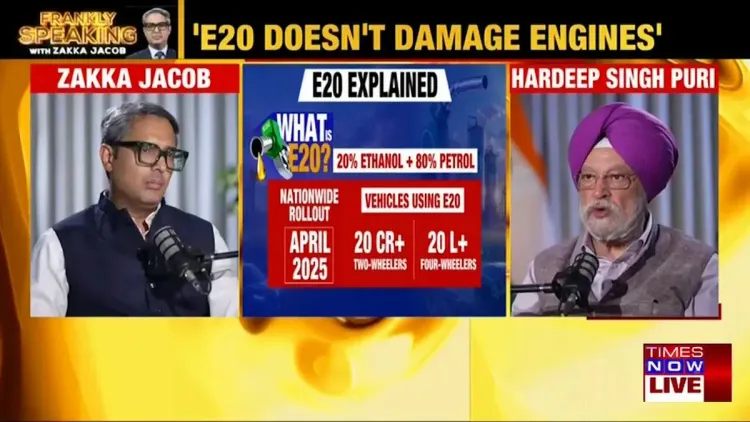
The rollout of E20-compatible vehicles — designed to run on petrol blended with up to 20% ethanol — remains a key infrastructure milestone for the programme to reach its full potential. Automakers have been progressively transitioning model lines to E20 compatibility in line with government timelines.
Policy analysts will watch for any revision to the 20% blending target in upcoming budget statements or biofuel policy reviews, as well as whether the government expands feedstock sources beyond sugarcane to include grains and agricultural residue, which would further widen the farmer-beneficiary base and reduce seasonal supply constraints.
Point of View
Giving the government a durable, farmer-linked narrative on energy affordability. The dual framing of ethanol as both a price stabiliser and a farmer-income tool is a recurring BJP communication strategy that links urban consumer interests to rural agricultural welfare. Coming at a time when global crude markets remain unpredictable, the statement positions India's biofuel policy as a proactive hedge rather than a reactive subsidy mechanism. The emphasis on fixed annual prices also implicitly signals policy continuity and administrative predictability to the sugar sector and OMCs.
NationPress
8 Oct 2026
Frequently Asked Questions
Why is petrol cheaper in India because of ethanol blending?
Ethanol blended into petrol is sourced domestically from Indian farmers at government-fixed annual prices, which do not rise with global crude oil prices. This means a portion of every litre of petrol sold is insulated from international price volatility, helping moderate the retail price at the pump.
What is India's Ethanol Blended Petrol Programme?
The Ethanol Blended Petrol (EBP) Programme is a central government initiative that mandates oil marketing companies to blend ethanol — produced mainly from sugarcane — with petrol. Launched in 2003 with a 5% target, the programme now aims for 20% blending, a target that was advanced from 2030 to 2025.
What did Hardeep Singh Puri say about ethanol and petrol prices?
Puri stated on 10 July 2026 that India is among the countries offering the cheapest petrol in the world, and credited ethanol blending as a major reason. He noted that India's ethanol is purchased from domestic farmers at prices fixed for the entire year, unlike crude oil which fluctuates on global markets.
How does ethanol blending help Indian farmers?
The government procures ethanol primarily from sugarcane farmers and grain producers at administered prices set annually. This provides farmers an assured, price-stable market for surplus agricultural produce, directly supporting rural incomes while reducing India's crude oil import bill.
What is India's 20% ethanol blending target?
Under the National Policy on Biofuels 2018, India set a target of blending 20% ethanol with petrol. The original 2030 deadline was advanced to 2025. Achieving this requires E20-compatible vehicles and sufficient ethanol production capacity from sugarcane and grain feedstocks.