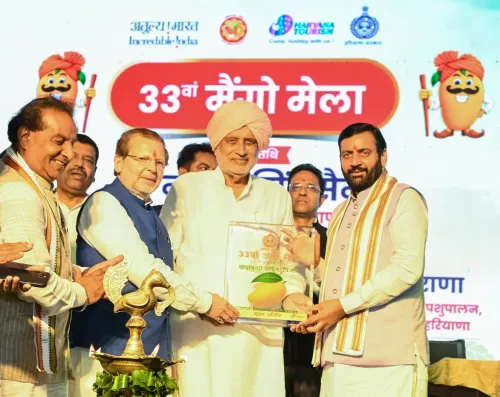
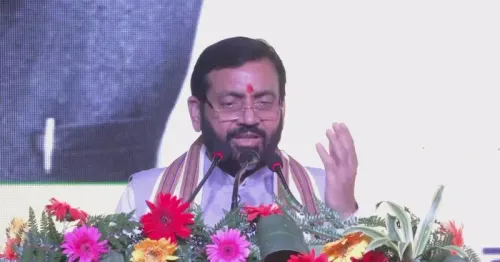
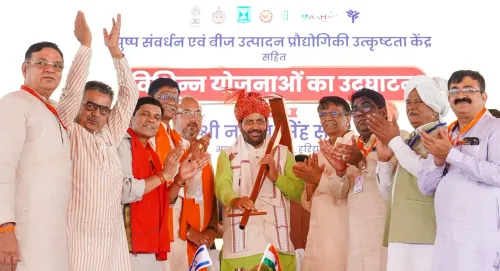
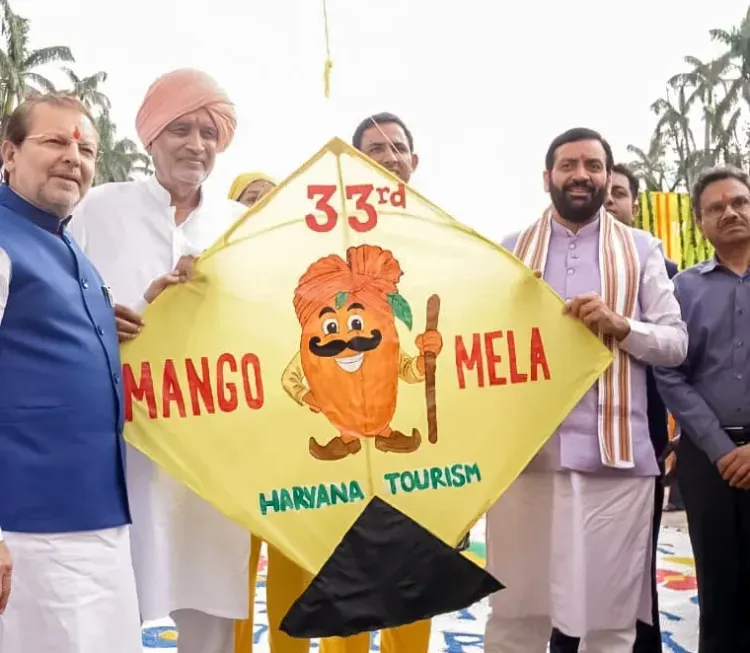
CM Saini Inaugurates 33rd Mango Mela at Pinjore's Yadavindra Garden
Synopsis
Haryana Chief Minister Nayab Singh Saini inaugurated the 33rd Mango Mela at Pinjore's Yadavindra Garden on 10 July 2026, calling it a celebration of farmer innovation and biodiversity, and pledging to take Haryana mangoes to global markets to boost farmer incomes.
Key Takeaways
CM Nayab Singh Saini inaugurated the 33rd Mango Mela at Yadavindra Garden, Pinjore on 10 July 2026 .
The mela featured over 200 varieties of mangoes from farmers across Haryana and other states.
Yadavindra Garden has hosted the annual Mango Mela since the early 1990s to promote horticultural diversification.
CM Saini expressed a resolve to establish Haryana mangoes in both domestic and global markets to raise farmer incomes.
The event brought together progressive farmers, horticulture experts, entrepreneurs, and tourists under one platform.
The mela aligns with broader state and central efforts to reduce dependence on the wheat-paddy cycle through fruit cultivation.
Haryana Chief Minister Nayab Singh Saini on Friday, 10 July 2026, inaugurated the 33rd Mango Mela at the historic Yadavindra Garden in Pinjore, welcoming progressive farmers, horticulture experts, entrepreneurs, and tourists from Haryana and several other states to the annual showcase of mango diversity.
Context
Posting on X, CM Saini described the event as more than an exhibition of mango varieties — calling it 'kisan bhaiyon ki mehnat, navachaar aur Bharat ki samridh jaiv vividhata ka jeevant utsav' (a living celebration of the hard work, innovation, and rich biodiversity of India). He stated that over 200 varieties of mangoes were on display, calling them proof of the skill of farmers and the immense potential of the horticulture sector. He expressed a resolve that 'm'hare Haryana ka aam' — the mango of Haryana — should carve a distinct identity not just in domestic markets but in global markets as well, so that farmers' incomes grow steadily and the horticulture sector gains fresh momentum.
Policy Backdrop
Yadavindra Garden, a Mughal-style terraced garden in Panchkula district, has served as the venue for the Mango Mela since Haryana launched the event in the early 1990s to encourage horticultural diversification beyond the dominant wheat-paddy cycle. The annual mela has grown into a platform that connects growers with buyers, showcases indigenous and improved varieties, and promotes awareness of agricultural biodiversity. State-level fruit festivals of this kind align with central horticulture promotion programmes that aim to raise farmer incomes through value addition and branding.
Northern Indian states have increasingly used such melas to reduce pressure on groundwater caused by cereal monoculture, positioning fruit cultivation as both an economic and an environmental alternative. Haryana's horticulture department has used the mela to facilitate interactions between farmers and domain experts, providing a setting for knowledge exchange on modern orchard management and post-harvest practices.
Stakeholders and Impact
The primary beneficiaries of the mela are mango growers and horticulture farmers from across Haryana and neighbouring states who use the platform to display produce, access market contacts, and learn about new cultivation techniques. Entrepreneurs and agri-business operators attend to scout for sourcing and processing opportunities, while tourists add a cultural and agri-tourism dimension to the event. CM Saini's explicit mention of global markets signals an intent to build an export narrative around Haryana mangoes, which could open conversations around geographical indication tagging and premium branding for specific local varieties.
What's Next
The government's stated ambition to establish Haryana mangoes in global markets will likely require follow-through on market linkage programmes, potential GI tagging of distinct local varieties, and buyer-seller meets that connect growers with export-oriented trade channels. Policy watchers will track whether the state announces specific export promotion measures or partnerships with agri-export bodies in the weeks following the mela. The success of such initiatives will be a key indicator of whether the annual festival translates into sustained income gains for the farming community.
Point of View
CM Saini is deploying a familiar BJP playbook of branding agricultural produce with regional pride to strengthen rural voter connect. The emphasis on global market ambitions for Haryana mangoes signals that the state is looking to graduate the mela from a showcase event to a trade-facilitation platform — a shift that would require concrete policy follow-through on GI tagging and export infrastructure. The event also fits into Haryana's longer-term push to diversify away from water-intensive paddy cultivation, making horticulture promotion both an economic and an environmental policy signal. Whether the rhetoric translates into measurable income gains for mango growers will be the real test of this initiative.
NationPress
9 Oct 2026
Frequently Asked Questions
What is the Mango Mela in Pinjore?
The Mango Mela is an annual horticulture festival held at Yadavindra Garden in Pinjore, Haryana, that showcases mango varieties from across the state and country. It has been organised since the early 1990s to promote crop diversification and connect farmers with markets. The 2026 edition is the 33rd instalment of the event.
Who inaugurated the 33rd Mango Mela?
Haryana Chief Minister Nayab Singh Saini inaugurated the 33rd Mango Mela at Yadavindra Garden, Pinjore, on 10 July 2026.
How many mango varieties were displayed at the 2026 Mango Mela?
CM Saini stated in his post that over 200 varieties of mangoes were on display at the 33rd Mango Mela, reflecting the diversity of mango cultivation across Haryana and other states.
Where is Yadavindra Garden located?
Yadavindra Garden is a historic Mughal-style terraced garden located in Pinjore, in the Panchkula district of Haryana. It has served as the venue for the annual Mango Mela for decades.
What is Haryana's goal for its mango farmers?
CM Saini stated that Haryana aims to establish its mangoes — referred to as 'm'hare Haryana ka aam' — in both domestic and global markets to ensure a steady rise in farmer incomes and give fresh momentum to the state's horticulture sector.